Persoonia lanceolata
Andrews
Lance Leaf Geebung, Lance-leaved Geebung

(c) Tony Rodd, some rights reserved (CC BY-NC-SA)

(c) John Tann, some rights reserved (CC BY)
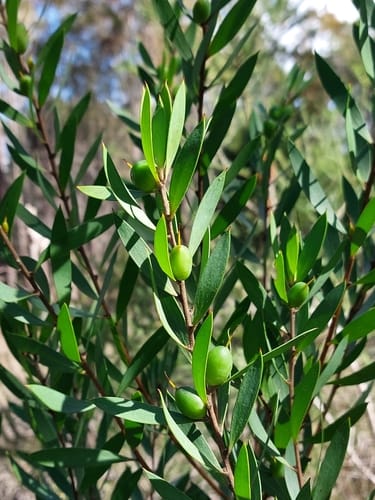
(c) David, some rights reserved (CC BY-NC)
What to Eat
Edible parts: Fruit
The fleshy fruit are eaten.
Where to Find It
They grow in warm temperate locations from near sea level to mountain ranges. They grow on sandstone and in dry forest. They need well drained acid soils. It can tolerate some frost and dry periods. It suits hardiness zones 9-11.
Australia*, Britain, Europe,
How to Identify
A medium sized shrub. It grows 1-2.5 m high and spreads 0.6-3 m wide. Young growth is yellowish-green with white hairs. The leaves are 3-10 cm long by 0.5-2 cm wide. They are a broad sword shape and can be spoon shape. They are alternate and fairly crowded. They are pale green. The flowers are 1 cm across and yellow. They are in leafy clusters. The fruit are fleshy with one stone. They are 1 cm long by 0.8 cm wide. They are green.
Nutrition Score: 12/100
| Part | Moisture | kJ | kcal | Protein | Vit A | Vit C | Iron | Zinc |
|---|---|---|---|---|---|---|---|---|
| Fruit | 77.7 | — | — | 1.5 | — | — | 1.1 | 0.1 |
How to Grow
Plants can be grown from seed or cuttings of very young growth.
Wikipedia
Source ↗Persoonia lanceolata, commonly known as lance-leaf geebung, is a shrub native to New South Wales in eastern Australia. It reaches 3 m (10 ft) in height and has smooth grey bark and bright green foliage. Its small yellow flowers grow on racemes and appear in the austral summer and autumn (January to April), followed by green fleshy fruits (known as drupes) which ripen the following spring (September to October). Within the genus Persoonia, P. lanceolata belongs to the lanceolata group of 58 closely related species. It interbreeds with several other species found in its range. The species is usually found in dry sclerophyll forest on sandstone-based nutrient-deficient soil. It has adapted to a fire-prone environment; plants lost in bushfires can regenerate through a ground-stored seed bank. Seedlings mostly germinate within two years of fires. Several species of native bee of the genus Leioproctus pollinate the flowers. Swamp wallabies are a main consumer of its fruit, and the seeds are spread in wallaby faeces. Its lifespan ranges from 25 to 60 years, though difficulties in propagation have seen low cultivation rates.
Notes
There are about 90 Persoonia species. They grow in Australia. Many have fruit which are edible.
References (5)
- Bodkin, F., 1991, Encyclopedia Botanica. Cornstalk publishing, p 774
- Cherikoff V. & Isaacs, J., The Bush Food Handbook. How to gather, grow, process and cook Australian Wild Foods. Ti Tree Press, Australia p 196
- Elliot, W.R., & Jones, D.L., 1997, Encyclopedia of Australian Plants suitable for cultivation. Vol 7. Lothian. p 219 (Drawing)
- Etherington, K., & Imwold, D., (Eds), 2001, Botanica's Trees & Shrubs. The illustrated A-Z of over 8500 trees and shrubs. Random House, Australia. p 515
- Flora of Australia Volume 16, Elaeagnaceae, Proteaceae 1. Melbourne: CSIRO Australia (1995) p 99
More from Proteaceae


