Persoonia levis
(Cav.) Domin
Broad-leaved Geebung, Smooth geebung

(c) John Tann, some rights reserved (CC BY)

(c) John Tann, some rights reserved (CC BY)
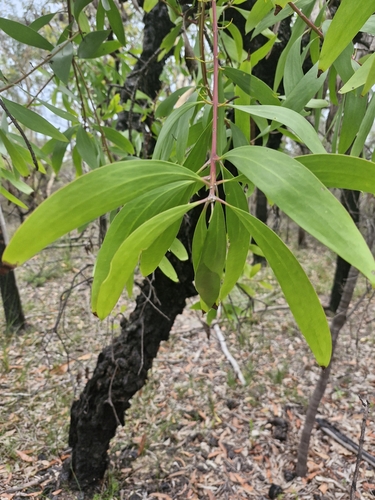
(c) ronavery, some rights reserved (CC BY), uploaded by ronavery
What to Eat
Edible parts: Fruit, Seeds
The fruit can be eaten raw or cooked. It is succulent but astringent, with a sweet, fibrous pulp attached to one large seed and a flavour somewhat like sweet cotton wool. Australian Aborigines have long relished it.
Where to Find It
It is a warm temperate plant. It grows near the coast and in hills nearby. It need freely draining acid soil. It can grow in sun or light shade. It can tolerate frost and dry periods.
Australia*,
How to Identify
An erect or spreading shrub. It can be 5 m high. The bark is flaky showing a red stem beneath. The leaves are thick and bright green. They are oval and 6-18 cm long by 8 cm wide. They are often sickle shaped. They have a rounded tip ending in a small point. The flowers are small and yellow. They are 1 cm across. They are tubular. The occur singly on short stalks 8 mm long. The fruit is a green fleshy fruit with a stone inside. It is about 1 cm long. There is one seed 1 cm long by 1.2 cm wide.
How to Grow
Plants can be grown from seed or cuttings of very young growth.
Propagation: Scarify the seed and sow in a greenhouse as soon as it is ripe in autumn. Keep the seed tray in a sunny position through the following summer; germination should occur the next autumn, with around 46% success expected. Prick seedlings out into individual pots within 1–2 days of emergence, as the roots are very brittle and plants are easily lost. Grow on in the greenhouse for at least the first two winters, then plant out into permanent positions in early summer. Provide protection from winter cold for at least the first winter outdoors.
Medicinal Uses
None known.
Other Uses
None known.
Wikipedia
Source ↗Persoonia levis, commonly known as the broad-leaved geebung, is a shrub native to New South Wales and Victoria in eastern Australia. It reaches 5 m (16 ft) in height and has dark grey papery bark and bright green asymmetrical sickle-shaped leaves up to 14 cm (5.5 in) long and 8 cm (3.2 in) wide. The small yellow flowers appear in summer and autumn (December to April), followed by small green fleshy fruit, which are classified as drupes. Within the genus Persoonia, it is a member of the Lanceolata group of 58 closely related species. P. levis interbreeds with several other species where they grow together. Found in dry sclerophyll forest on sandstone-based nutrient-deficient soils, P. levis is adapted to a fire-prone environment; the plants resprout epicormic buds from beneath their thick bark after bushfires, and can live for over 60 years. Regeneration also takes place after fire by a ground-stored seed bank. The longtongue bee Leioproctus carinatifrons is a pollinator of the flowers, and the fruit are consumed by vertebrates such as kangaroos, possums and currawongs. Despite its horticultural appeal, P. levis is rare in cultivation as it is very hard to propagate, either by seed or cuttings.
Notes
There are about 90 Persoonia species. They grow in Australia. Many have fruit which are edible.
Names & Synonyms
References (12)
- Biblioth. Bot. 89:582(1136). 1929
- Bodkin, F., 1991, Encyclopedia Botanica. Cornstalk publishing, p 774
- Caton, J.M. & Hardwick, R. J., 2016, Field Guide to Useful Native Plants from Temperate Australia. Harbour Publishing House. p 336
- Cherikoff V. & Isaacs, J., The Bush Food Handbook. How to gather, grow, process and cook Australian Wild Foods. Ti Tree Press, Australia p 196
- Cronin, L., 1989, The Concise Australian Flora. Reed. p 133
- Elliot, W.R., & Jones, D.L., 1997, Encyclopedia of Australian Plants suitable for cultivation. Vol 7. Lothian. p 220 (Drawing)
- Flora of Australia Volume 16, Elaeagnaceae, Proteaceae 1. Melbourne: CSIRO Australia (1995) p 100
- Greig, D., 1996, Flowering Natives for Home Gardens. Angus & Robertson. p 282
- Grieg, D., 2002, A photographic guide to Wildflowers of South-eastern Australia. New Holland. p 115
- Hardwick, R.J., 2000, Nature's Larder. A Field Guide to the Native Food Plants of the NSW South Coast. Homosapien Books. p 70
- Plants for a Future database, The Field, Penpol, Lostwithiel, Cornwall, PL22 0NG, UK. http://www.scs.leeds.ac.uk/pfaf/
- Smith, K & I., 1999, Grow your own bushfoods. New Holland. Australia. p 38
More from Proteaceae


