Persoonia mollis
R.Br.
Soft Geebung
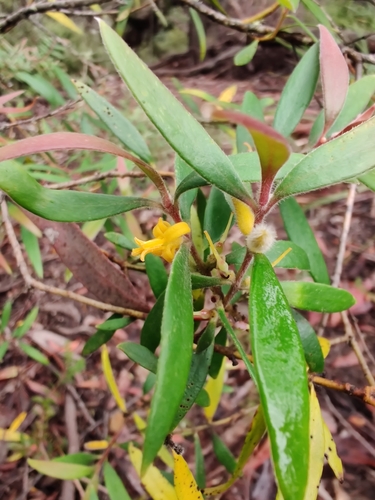
(c) Ruby E Stephens, some rights reserved (CC BY-NC), uploaded by Ruby E Stephens

(c) Margaret Sky, some rights reserved (CC BY-NC), uploaded by Margaret Sky

(c) Jill Dark, some rights reserved (CC BY-NC), uploaded by Jill Dark
What to Eat
Edible parts: Fruit
The fruit can be eaten raw or cooked. It is succulent but astringent, with a sweet, fibrous pulp attached to one large seed and a flavour somewhat like sweet cotton wool. Australian Aborigines have long relished it.
Where to Find It
It grows in warm temperate locations. It grows on sandy soils and can be in wet or dry forests. It needs good drainage and an acid soil. It does best with light shade. It can stand heavy frosts. It suits hardiness zones 9-11.
Australia*,
How to Identify
A tall shrub. It can be 1.5-5 m high and spread 1-4.5 m wide. Young growth has white or copper coloured hairs. The bark is pale grey to brown. The leaves are 4-10 cm long by 0.6-1.5 cm wide. They are narrowly sword shaped. They can be alternate, opposite or in rings. They are soft and green above with soft white hairs underneath. The edges curve back slightly. The flowers are 1 cm across and yellow. They occur singly and are hairy. They can be on leafy stalks 15 cm long. The fruit is fleshy with a hard stone inside. They are 0.8 cm long by 0.7 cm wide. They are green or purplish brown. There are several sub species.
How to Grow
We have very little information on this species and do not know how hardy it will be in Britain. Plants tolerate temperatures down to at least -7°c in Australian gardens, though this cannot be translated directly to British gardens due to our cooler summers and longer colder and wetter winters. The following notes are based on the general needs of the genus. Requires a warm position in full sun in a freely draining preferably sandy slightly acid soil, preferring a pH around 6.3 to 6.5. Soils should be low in nutrients, especially nitrates and phosphates.
Propagation: Scarify the seed and sow in a greenhouse as soon as it is ripe in autumn. Keep the seed tray in a sunny position through the following summer; germination should occur the next autumn, with around 46% success expected. Prick seedlings out into individual pots within 1–2 days of emergence, as the roots are very brittle and plants are easily lost. Grow on in the greenhouse for at least the first two winters, then plant out into permanent positions in early summer. Provide protection from winter cold for at least the first winter outdoors.
Medicinal Uses
None known.
Other Uses
None known.
Wikipedia
Source ↗Persoonia mollis, commonly known as soft geebung, is a plant in the family Proteaceae and is endemic to New South Wales. It is an erect to prostrate shrub with linear to oblong or spatula-shaped leaves, yellow flowers in groups of up to thirty on a rachis up to 150 mm (5.9 in) long and relatively small fruit.
Notes
There are about 90 Persoonia species. They grow in Australia. Many have fruit which are edible.
Names & Synonyms
References (6)
- Caton, J.M. & Hardwick, R. J., 2016, Field Guide to Useful Native Plants from Temperate Australia. Harbour Publishing House. p 268
- Cundall, P., (ed.), 2004, Gardening Australia: flora: the gardener's bible. ABC Books. p 1014
- Elliot, W.R., & Jones, D.L., 1997, Encyclopedia of Australian Plants suitable for cultivation. Vol 7. Lothian. p 222
- Etherington, K., & Imwold, D., (Eds), 2001, Botanica's Trees & Shrubs. The illustrated A-Z of over 8500 trees and shrubs. Random House, Australia. p 515
- Hibbert, M., 2002, The Aussie Plant Finder 2002, Florilegium. p 229
- Plants for a Future database, The Field, Penpol, Lostwithiel, Cornwall, PL22 0NG, UK. http://www.scs.leeds.ac.uk/pfaf/
More from Proteaceae


