Persoonia virgata
R. Br.
Small-leaved Geebung
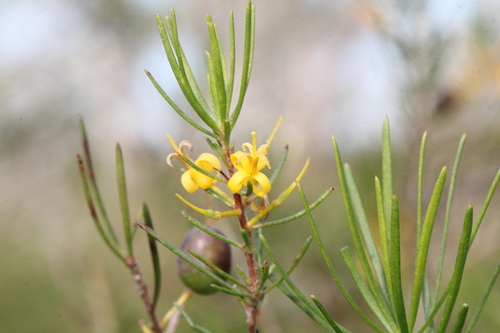
(c) Pete Woodall, some rights reserved (CC BY-NC), uploaded by Pete Woodall
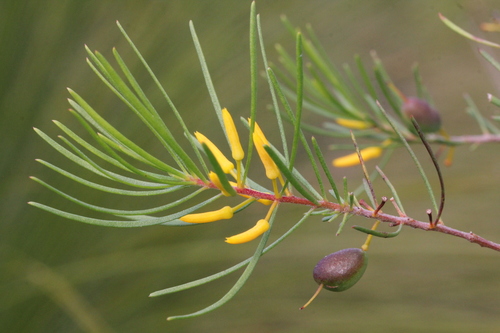
(c) Pete Woodall, some rights reserved (CC BY-NC), uploaded by Pete Woodall
What to Eat
Edible parts: Fruit
The ripe fruit is eaten when black or purple.
Where to Find It
It grows in warm temperate regions. They grow on sandy soils over clays and can be in moist soils or dry forest. They need moist but not waterlogged, acid soils.
Australia*,
How to Identify
A tall shrub. It grows 2-6 m high and 1.5-4 m wide. Young growth is hairy. There are many branches and they are slender and often erect. The small branches are often reddish. The leaves are 2-6 cm long by 0.1-0.5 cm wide. They are alternate. They are bright green. The flowers are 1 cm across and yellow. The fruit are 1.2 cm long by 0.9 cm wide. They are fleshy with a hard stone and turn purple.
How to Grow
Plants can be grown from seed or from cuttings of very young growth.
Wikipedia
Source ↗Persoonia virgata is a species of flowering plant in the family Proteaceae and is endemic to coastal areas of eastern Australia. It is usually an erect shrub with smooth bark, hairy young branchlets, linear to narrow spatula-shaped leaves, and yellow flowers borne in groups of up to seventy-five on a rachis up to 230 mm (9.1 in) long that continues to grow after flowering.
Notes
There are about 90 Persoonia species. They grow in Australia. Many have fruit which are edible.
References (5)
- Elliot, W.R., & Jones, D.L., 1997, Encyclopedia of Australian Plants suitable for cultivation. Vol 7. Lothian. p 233 (Drawing)
- Flora of Australia Volume 16, Elaeagnaceae, Proteaceae 1. Melbourne: CSIRO Australia (1995) p 72
- Haslam, S., 2004, Noosa's Native Plants. Noosa Integrated Catchment Assn. Inc. p 268
- Low, T., 1991, Wild Food Plants of Australia. Australian Nature FieldGuide, Angus & Robertson. p 134
- Melzer, R. & Plumb, J., 2011, Plants of Capricornia. Belgamba, Rockhampton. p 283
More from Proteaceae


