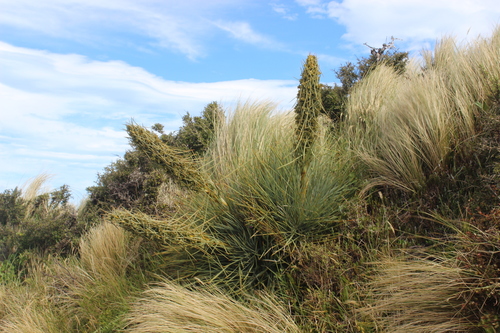
Notobubon laevigatum
(Aiton) Magee
Large wild carrot
ApiaceaeLeaves
iNaturalist · cc-by-nc
(c) Craig Peter, some rights reserved (CC BY-NC), uploaded by Craig Peter
(c) Craig Peter, some rights reserved (CC BY-NC), uploaded by Craig Peter

iNaturalist · cc-by-nc
(c) Gerhard Malan, some rights reserved (CC BY-NC), uploaded by Gerhard Malan
(c) Gerhard Malan, some rights reserved (CC BY-NC), uploaded by Gerhard Malan
iNaturalist · cc-by
(c) Jeremy Gilmore, some rights reserved (CC BY), uploaded by Jeremy Gilmore
(c) Jeremy Gilmore, some rights reserved (CC BY), uploaded by Jeremy Gilmore
What to Eat
Edible parts: Leaves
The leaves are cooked and eaten.
Where to Find It
It is a subtropical plant.
Africa, Eswatini, South Africa, Southern Africa, Swaziland,
Countries: Angola, Burkina Faso, Burundi, Benin, Botswana, Congo (DRC), Central African Republic, Congo (Republic), Cote d'Ivoire, Cameroon, Cape Verde, Djibouti, Algeria, Egypt, Eritrea, Ethiopia, Gabon, Ghana, Gambia, Guinea, Equatorial Guinea, Guinea-Bissau, Kenya, Comoros, Liberia, Lesotho, Libya, Morocco, Madagascar, Mali, Mauritania, Mauritius, Malawi, Mozambique, Namibia, Niger, Nigeria, Rwanda, Seychelles, Sudan, Sierra Leone, Senegal, Somalia, South Sudan, Sao Tome & Principe, Eswatini, Chad, Togo, Tunisia, Tanzania, Uganda, South Africa, Zambia, Zimbabwe
How to Identify
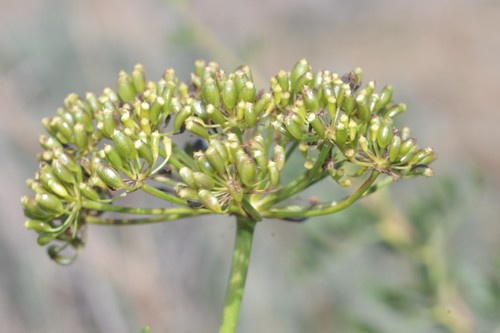
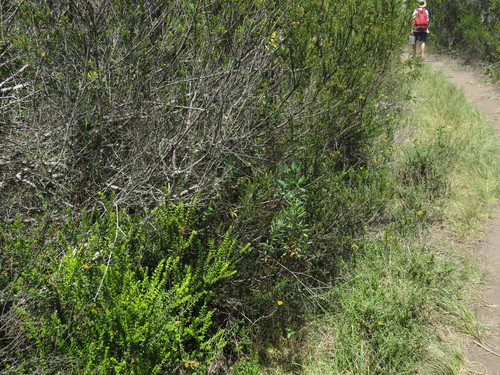
A herb or shrub. It is a stiffly erect plant and grows 1.2 m high. The stem have leaves along its length. The leaves can be 12 cm long. They end with 3 close leaflets. There can be 1 or 2 pairs of leaflets along the axis. The leaflets are sword shaped. They are 5 cm long by 2 cm wide. The flowers are in a branched clusters. They are yellow. The fruit is flat and 6 mm long by 4 mm wide.
Names & Synonyms
Intlashane
Laserpitium capense Thunb.Peucedanum capense (Thunb.) Sond.Peucedanum virgatum Cham. & Schltdl.and several others
References (8)
- Fox, F. W. & Young, M. E. N., 1982, Food from the Veld. Delta Books. p 88 (As Peucedanum capense)
- W. H. Harvey & O. W. Sonder, Fl. cap. 2:554. 1862, nom. cons. (As Peucedanum capense)
- Jardin, C., 1970, List of Foods Used In Africa, FAO Nutrition Information Document Series No 2.p 94 (As Peucedanum capense)
- Long, C., 2005, Swaziland's Flora - siSwati names and Uses http://www.sntc.org.sz/flora/ (As Peucedanum capense)
- Martin, F.W. & Ruberte, R.M., 1979, Edible Leaves of the Tropics. Antillian College Press, Mayaguez, Puerto Rico. p 222 (As Peucedanum capense)
- Ruiters-Welcome, A. K., 2019, Food plants of southern Africa. Ph.D. thesis. Univ. of Johannesburg p 20
- Swaziland's Flora Database http://www.sntc.org.sz/flora (As Peucedanum capense)
- Welcome, A. K. & Van Wyk, B.-E., 2019, An inventory and analysis of the food plants of southern Africa. South African Journal of Botany 122 (2019) 136–179