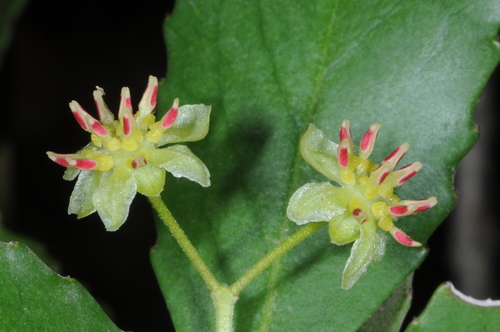
Peumus boldus
Molina
Boldo, Boldina

(c) Nicolás Villaseca Merino, some rights reserved (CC BY-SA), uploaded by Nicolás Villaseca Merino

(c) Italo Pérez Codern, some rights reserved (CC BY-NC), uploaded by Italo Pérez Codern

(c) andresamenabar, some rights reserved (CC BY-NC)
What to Eat
Edible parts: Leaves - tea, Fruit, Oil
The fruit can be eaten raw or cooked. It is sweet and aromatic with an agreeable flavour and grows up to 2cm in diameter. The leaves and bark are also used as a condiment.
Known Hazards
Where to Find It
It is a subtropical plant. It is damaged by frost. It does best in a warm sheltered position. It needs a well-drained, sandy, acid soil. It needs to be in the sun. It suits hardiness zones 9-11. Arboretum Tasmania.
Africa, Andorra, Australia, Bolivia, Central America, Chile*, Côte d'Ivoire, Ecuador, Europe, Guinea, Guinée, Ivory Coast, Mexico, North America*, Paraguay, Peru, South America, Tasmania, Turkey, Türkiye, West Africa,
How to Identify
An evergreen shrub or tree. It has an aroma. It grows 4-6 m tall. It can grow to 20 m tall. The leaves are oval and dark green. They are 5 cm long. The leaves have yellow silky hairs underneath. Male and female flowers are on separate plants. The flowers are small and white. They are in short panicles at the ends of branches. The fruit are the size of hawthorn berries. They are edible.
How to Grow
Dislikes soils that are too moist. Prefers a well-drained acid sandy soil in full sun. Hardy in climatic zone 9 (tolerating occasional light frosts), this plant normally requires greenhouse protection in Britain but is capable of withstanding light frosts and might succeed outdoors in the mildest areas of the country, especially if grown against a sunny wall. One report says that the plant succeeds outdoors at Kew Gardens in London, where it often flowers all year round. All parts of the plant are sweetly aromatic. The leaves have a lemon-camphor aroma. Dioecious, male and female plants must be grown if fruit and seed is required.
Propagation: Sow seed in spring in a warm greenhouse. Prick seedlings into individual pots once large enough to handle and grow on under glass for at least the first winter. Plant out in early summer with protection from winter cold for at least the first two years outdoors. Alternatively, take half-ripe cuttings in July or August and root in a frame, growing them on under cover for at least their first winter.
Medicinal Uses
Boldu is a traditional remedy of the Araucanian Indians of Chile, where it has long been used as a tonic. It stimulates liver activity and bile flow and is chiefly valued for treating gallstones and liver or gallbladder pain. It is typically taken for only a few weeks at a time, as an infusion or tincture, and is often combined with herbs such as Berberis vulgaris or Chionanthus virginicus when treating gallstones. The leaves are analgesic, antiseptic (specifically urinary), bitter, cholagogue, diuretic, stimulant and tonic, and are considered in South America to be an effective treatment for gonorrhoea. The plant is taken internally for liver disease (though the bark is more effective for this), gallstones, urinary tract infections, intestinal parasites and rheumatism. It has historically been used as a quinine substitute for treating malaria. Leaves are harvested during the growing season and dried for later use. A volatile oil from the plant destroys internal parasites, and alkaloids in the bark stimulate the liver. The plant should not be used by pregnant women. The German Commission E Monographs approve Peumus boldus for dyspeptic complaints.
Other Uses
The bark yields tannin and is also used as a dye. A fragrant essential oil is obtained from the leaves. Dried, powdered leaves can be scattered among clothes to sweeten them and repel insects. The small fruits are dried and used as beads in necklaces; when warmed by the body or sun they release a scent of cinnamon. The wood is used to make charcoal.
Wikipedia
Source ↗An evergreen tree growing to 6 m at a slow rate, hardy to UK zone 9. It retains foliage year-round and flowers from August to September. The species is dioecious, requiring both male and female plants for seed production. It grows in light or medium soils with good drainage and prefers mildly acid to neutral pH. It tolerates semi-shade or full sun in dry or moist conditions.
Notes
There is only one Peumus species. It grows natually in Chile. An oil extract from the bark is used in medicine.
Names & Synonyms
Ajedreas, Aluma, Belloto, Boldo, Boldu, Folo
References (25)
- Barreau, A., et al, 2016, How Can We Teach Our Children if We Cannot Access the Forest? Generational Change in Mapuche Knowledge of Wild Edible Plants in Andean Temperate Ecosystems of Chile. Journal of Ethnobiology 36(2): 412–432
- Burkill, H. M., 1985, The useful plants of west tropical Africa, Vol. 4. Kew.
- Cordero, S. E., Abello, L. A., & Galvez, F. L., 2017, Plantas silvestres comestibles y medicinales de Chile y otras partes del mundo. CORMA p 99
- Daly, A. B., 20014, Narrating changing foodways: wild edible plant knowledge and traditional food systems in Mapuche lands of the Andean Temperate Forests, Chile. Masters Thesis Vancouver. p 45
- Etherington, K., & Imwold, D., (Eds), 2001, Botanica's Trees & Shrubs. The illustrated A-Z of over 8500 trees and shrubs. Random House, Australia. p 515
- Facciola, S., 1998, Cornucopia 2: a Source Book of Edible Plants. Kampong Publications, p 153
- Grandtner, M. M. & Chevrette, J., 2013, Dictionary of Trees, Volume 2: South America: Nomenclature, Taxonomy and Ecology. Academic Press p 493
- Hedrick, U.P., 1919, (Ed.), Sturtevant's edible plants of the world. p 476
- Hellmuth, N. M., 2011, Maya Ethnobotany. Complete Inventory of plants. Associacion FLAAR Mesoamerica. Tenth edition.
- Heywood, V.H., Brummitt, R.K., Culham, A., and Seberg, O. 2007, Flowering Plant Families of the World. Royal Botanical Gardens, Kew. p 217
- Hibbert, M., 2002, The Aussie Plant Finder 2002, Florilegium. p 230
- Kermath, B. M., et al, 2014, Food Plants in the Americas: A survey of the domesticated, cultivated and wild plants used for Human food in North, Central and South America and the Caribbean. On line draft. p 635
- Kunkel,
- Leon-Lobos, P., et al, 2022, Patterns of Traditional and Modern Uses of Wild Edible Native Plants of Chile: Challenges and Future Perspectives. Plants (Basel) v 11 (6) Table S1
- Martin, J. S. & Villagra M. M., 2013, Productos forestales no madereros de la Region del Maule. p 12
- Plants for a Future database, The Field, Penpol, Lostwithiel, Cornwall, PL22 0NG, UK. http://www.scs.leeds.ac.uk/pfaf/
- Raghavan, S., 2007, Handbook of Spices, Seasonings, and Flavourings. Second Edition. CRC Press p 76
- Rapoport, E. H. & Ladio, A. H., 1999, Plantas comestibles. Bosque Volume 20 No. 2. ISSN 0314-8799
- Ryan, S., 2008, Dicksonia. Rare Plants Manual. Hyland House. p 46
- Sag. stor. nat. Chili 185, 350. 1782
- Self, M., 199, Phoenix Seeds catalogue. p 14
- Tanaka,
- Wiersema, J. H. & Leon, B., 2013, World Economic Plants. A Standard Reference CRC Press. 2nd Ed. p 512
- World Checklist of Useful Plant Species 2020. Royal Botanic Gardens, Kew
- www.chileflora.com