Amyema maidenii
(Blakely) Barlow
Mistletoe

(c) ronavery, some rights reserved (CC BY), uploaded by ronavery
(c) ronavery, some rights reserved (CC BY), uploaded by ronavery

(c) Douglas Goldman, some rights reserved (CC BY-SA), uploaded by Douglas Goldman
What to Eat
Edible parts: Fruit
The fruit are eaten.
Where to Find It
They grow on acacia trees. The species are mostly Acacia aneura, Acacia harpophylla, and Acacia tetragonophylla. It grows in inland Australia. It can grow in arid places.
Australia*,
How to Identify
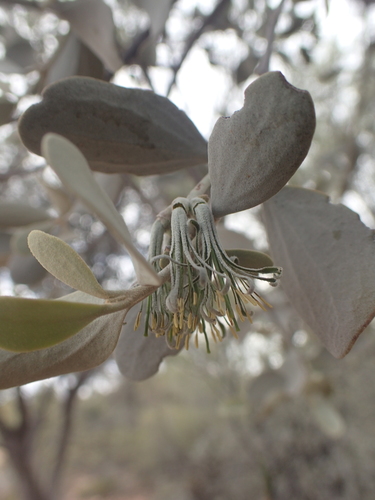
A branched plant. It grows on the branches of some Acacia species. It lives partly off these plants. The stems are covered with white to brown hairs. The leaves are oval and greyish. The flowers are green. The fruit are shaped like a cylinder and are yellow when ripe.
How to Grow
Plants are grown by seed.
Wikipedia
Source ↗Amyema maidenii is a species of flowering plant within the genus Amyema, an epiphytic hemiparasitic plant of the family Loranthaceae native to Australia and found Australia-wide in the inland (but not in Victoria nor Tasmania).
Notes
There are about 90-100 Amyema species.
Names & Synonyms
Nyirunypa, Park-parka
References (12)
- Bindon, P., 1996, Useful Bush Plants. Western Australian Museum. p 38
- Bodkin, F., 1991, Encyclopedia Botanica. Cornstalk publishing, p 77
- Elliot, W.R., & Jones, D.L., 1982, Encyclopedia of Australian Plants suitable for cultivation. Vol 2. Lothian. p 189
- Hunter, J.T., 2017, Is there a relationship between contemporary high Aboriginal plant resource locations and mapped vegetation communities? Cunninghamia 17:27-34. The Royal Botanic Garden Sydney. ISSN 2200 - 405X
- Lang, P. J., et al, 1986, Anangu Pitjantjatjara Lands Biological Survey. p 43
- Latz, P., 1996, Bushfires and Bushtucker. IAD. p 126
- Latz, P & Wightman, G., 1995, Desert Bush Tucker Identikit. Common Native Food Plants of Central Australia. Parks & Wild Commission Northern territory. p 60
- Lazarides, M. & Hince, B., 1993, Handbook of Economic Plants of Australia, CSIRO. p 19
- Paczkowska, G. & Chapman, A.R., 2000, The Western Australian Flora. A Descriptive Catalogue. Western Australian Herbarium. p 284
- Smith, N. M., 1991, Ethnobotanical Field Notes from the Northern Territory, Australia, J. Adelaide Bot. Gard. 14(1): 1-65
- Williams, K.A.W., 1999, Native Plants of Queensland Volume 4. Keith A.W. Williams North Ipswich, Australia. p 54
- World Checklist of Useful Plant Species 2020. Royal Botanic Gardens, Kew


