Phragmites karka
(Retz.) Trin. ex Steudel
Common reed, Tropical Reed
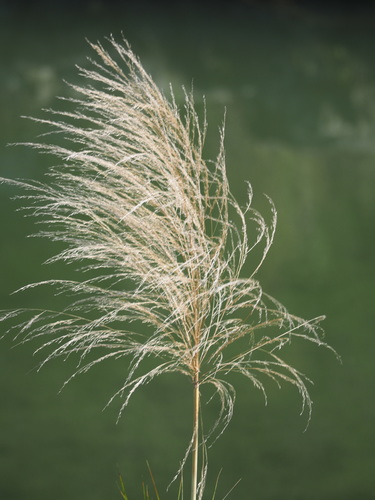
no rights reserved, uploaded by 葉子
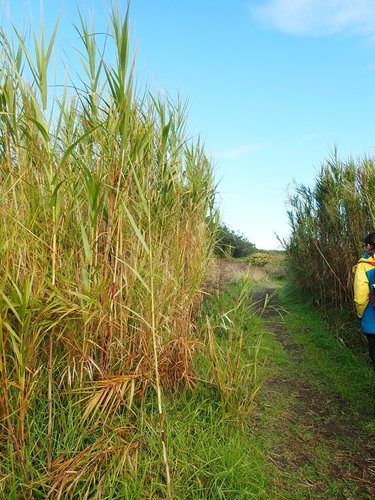
(c) Arnim Littek, some rights reserved (CC BY), uploaded by Arnim Littek
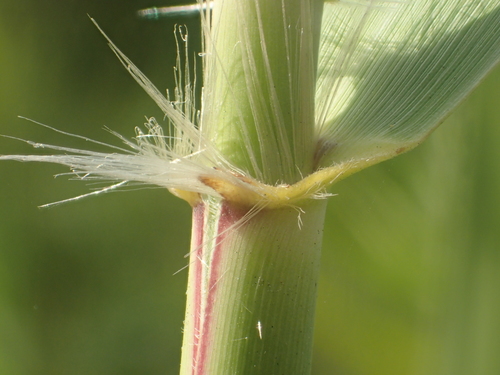
no rights reserved, uploaded by 葉子
What to Eat
Edible parts: Shoots
Locally, this species is utilised as a source of building and construction material, and as food. It is often planted near rivers to purify water, and as an anchor against soil erosion. The young shoots of this plant can be cooked and eaten, like bamboo or asparagus. The young leaves can also be used as fodder. The grass is also use for thatching and making screens, baskets, brooms, hats, mats, paper and reeds for musical instruments and fuel. In the Philippines, the panicles of this species are bunched-up in a fan-shape to create a broom, with the culms being tightly bound to a central bamboo piece.
Where to Find It
A tropical plant. It grows near creek banks and rivers. It grows in tropical and subtropical places. It is often near rivers and the edges of mangroves.
Africa, Asia, Australia, Burkina Faso, Cambodia, China, Chuuk, Guam, Guinea, Guinée, Guinea-Bissau, Himalayas, India, Indochina, Indonesia, Japan, Korea, Laos, Malaysia, Mariana Islands, Micronesia, Myanmar, Nepal, Pacific, Pakistan, Palau, Papua New Guinea, PNG, Philippines, Pohnpei, SE Asia, Sri Lanka, Taiwan, Thailand, West Africa, Yap,
How to Identify
A large grass. It grows 1.5-3 m high. It is similar to Phragmites australis but has more narrow leaves. These are rough underneath. They end in a stiff, sharp point. The flowers are white and brown.
How to Grow
Plants can be grown from seed. They should be soaked for 3-4 months then sown in waterlogged soil.
Propagation: Seed - surface sow in a light position. Keep the soil moist by emmersing the pot in 3cm of water. Germination usually takes place quite quickly. Prick out the seedlings into individual pots when they are large enough to handle and plant them out when large enough. Division at any time, but especially when the plant is coming into new growth. Very simple, any part of the root that has a growth bud will grow into a new plant. Larger divisions can be planted out direct into their permanent positions.
Other Uses
The panicles can be arranged in a fan-like manner form a broom, whilst the culms are tightly bound to a central strengthening piece of bamboo to form a handle. These brooms are of great utility, especially for sweeping highly polished floors, and were extensively used in the Philippines. The stems have been used for weaving coarse hats, mats, hurdles etc. They are split and woven into coarse matting for covering the sides of houses, for partitions, and for ceilings, often covered with whitewash or mud, and serving as laths for plastering. The stems can be used for fuel. Beds of this plant can be used for water purification purposes. The plant has a dense root system and is an excellent species for planting by water to protect the land from erosion. The plant seems to be a reliable indicator of fresh water.When growing near tidal areas there is usually a sharp division between this species and the plants which grow in brackish water.
Wikipedia
Source ↗Phragmites karka, the tall reed or common reed, is a species of flowering plant in the grass family. It is native to West Africa.
Names & Synonyms
Bagnarri, Bichhra, Hulugilu, Karka, Karriso, Khaila, Khailuwa, Maitantos, Nagasvaramu, Nairi, Nal, Nala, Nalam, Nali, Nannana, Nara, Narkat, Narkul, Noto, Oncoco, Perunanal
References (14)
- Ambasta, S.P. (Ed.), 2000, The Useful Plants of India. CSIR India. p 450
- Borrell, O.W., 1989, An Annotated Checklist of the Flora of Kairiru Island, New Guinea. Marcellin College, Victoria Australia. p 24
- Elliot, W.R., & Jones, D.L., 1997, Encyclopedia of Australian Plants suitable for cultivation. Vol 7. Lothian. p 282
- Flora of Pakistan. www.eFloras.org
- Kenneally, K.E., Edinger, D. C., and Willing T., 1996, Broome and Beyond, Plants and People of the Dampier Peninsula, Kimberley, Western Australia. Department of Conservation and Land Management. p 222
- Lazarides, M. & Hince, B., 1993, Handbook of Economic Plants of Australia, CSIRO. p 188
- Leach, G.J., & Osborne, P.L., 1985, Freshwater Plants of Papua New Guinea. UPNG Press, p 140
- Low, T., 1992, Bush Tucker. Australia’s Wild Food Harvest. Angus & Robertson. p 131
- Nomencl. bot. ed. 2, 2:324. 1841
- Paczkowska, G. & Chapman, A.R., 2000, The Western Australian Flora. A Descriptive Catalogue. Western Australian Herbarium. p 114
- Peekel, P.G., 1984, (Translation E.E.Henty), Flora of the Bismarck Archipelago for Naturalists, Division of Botany, Lae, PNG. p 55, 54
- Romanowski, N., 2007, Edible Water Gardens. Hyland House. p 66
- Wheeler, J.R.(ed.), 1992, Flora of the Kimberley Region. CALM, Western Australian Herbarium, p 1206
- World Checklist of Useful Plant Species 2020. Royal Botanic Gardens, Kew


