Ataenidia conferta
(Bentham) Milne-Redhead
(c) John P, some rights reserved (CC BY-NC)
(c) John P, some rights reserved (CC BY-NC)
(c) Andreas Schneider, some rights reserved (CC BY)
What to Eat
Edible parts: Leaves
The leaves are edible.
Where to Find It
A tropical plant. Cairns Botanical Garden.
Africa, Angola, Australia, Cameroon, Central Africa, Central African Republic, CAR, Congo DR, Côte d'Ivoire, Hawaii, Ivory Coast, Pacific, Sudan, West Africa, USA,
How to Identify
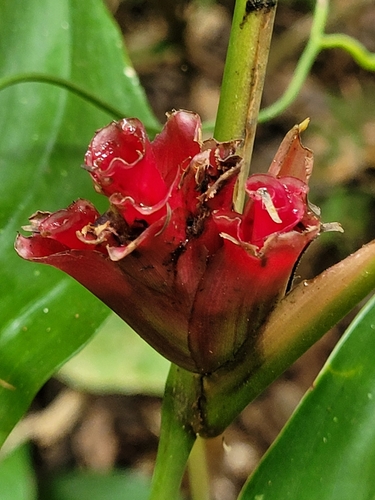
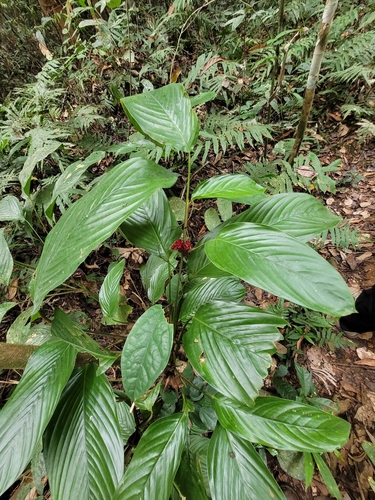
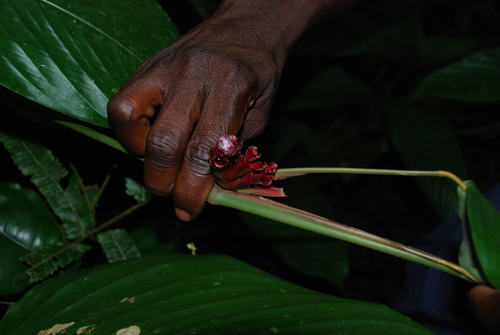
An erect herb. It keeps growing from year to year. It grows 45-100 cm high. The leaves are turned in one direction. These are at the base and along the stem. The leaf stalk is blackish-purple. There is a swelling at the base of the leaf 3 cm long. The leaf blade is oval and without hairs. It is 35-44 cm long and 15-22 cm wide. The tip is rounded but with a point. The upper surface is dark green and it is red-brown underneath. The flowering arrangement is shaped like a top. It is reddish-brown.
Medicinal Uses
The roots are used to treat pulmonary problems.
Other Uses
The stems are used for making mats and baskets.
Notes
There are about 20 Phrynium species. They grow in tropical Asia.
Names & Synonyms
Iyolu, Molu
References (4)
- Martin, F.W. & Ruberte, R.M., 1979, Edible Leaves of the Tropics. Antillian College Press, Mayaguez, Puerto Rico. p 204
- Okigbo, B.N., Vegetables in Tropical Africa, in Opena, R.T. & Kyomo, M.L., 1990, Vegetable Research and development in SADCC countries. Asian Vegetable Research and development Centre. Taiwan. p 44
- Staples, G.W. and Herbst, D.R., 2005, A tropical Garden Flora. Bishop Museum Press, Honolulu, Hawaii. p 706
- Terashima, H., et al, 1992, Ethnobotany of the Lega in the Tropical Rainforest of Eastern Zaire (Congo): Part Two, Zone de Walikale, African Study Monographs, Suppl. 19:1-60


