Phyllostachys aurea
(Carrière) Rivière & C. Rivière
Fishpole Bamboo, Golden bamboo
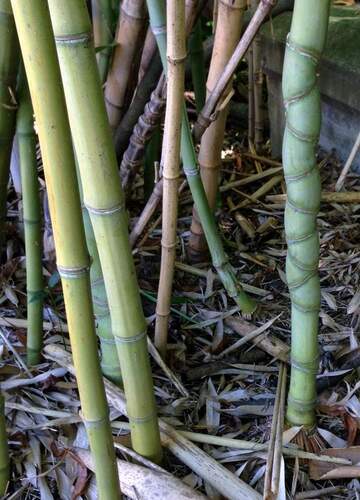
(c) Abrahami, some rights reserved (CC BY-SA)
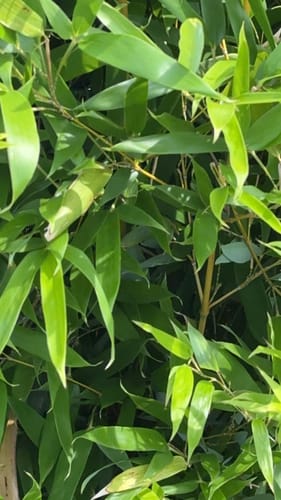
(c) geekdad1138, some rights reserved (CC BY-NC)
What to Eat
Edible parts: Seeds, Stem, Cereal, Shoots, Vegetable
The young shoots can be eaten raw or cooked, and are considered the sweetest of the genus, with very little bitterness. Canes grown in Britain are about 15mm in diameter, while those in China reach 2–5cm. Shoots are harvested in spring when about 8cm above ground, cut around 5cm below soil level. The seed, though only produced at intervals of several years, is also edible raw or cooked — it can be prepared in all the ways rice is used, or ground into flour and used as a cereal.
Where to Find It
It grows in warm temperate areas. It is cold hardy. It suits hardiness zones 7-11. Melbourne Botanical Gardens. Geelong Botanical Gardens.
Africa, Asia, Australia, Cameroon, Central Africa, China*, Hawaii, Indochina, Indonesia, Japan, Malaysia, North America, Pacific, SE Asia, Taiwan, Tasmania, USA, Vietnam, West Africa,
How to Identify
A bamboo. It forms clumps. It has strong underground stems. It grows 3-10 m tall. The lower internodes are very short. The stems are tough and erect. They are smooth and olive-green. They are more yellow in the sun. They are 25-40 mm wide. The leaf joints are enlarged and produce attractive yellow leaves. These are 5-10 cm long.
How to Grow
Phyllostachys aurea is found wild in the warm temperate zone of southeast China, but is also widely cultivated in many areas of the world from cool temperate zones to the tropics, where it succeeds at lower elevations but grows best at moderate elevations. In the Philippines it grows very well in Baguio at an elevation of 1,500 metres, where the average temperature is 18 - 26°c. It is quite cold hardy, though it suffers leaf and culm damage at temperatures below about -15°c. Grows well in dappled shade, succeeding in full sun once established. Requires a rich, moist but well-drained soil in a sheltered position. Dislikes prolonged exposure to hard frosts. Established plants are drought resistant. Phyllostachys aurea has been widely grown as an ornamental in many countries around the world - it is now showing itself to be a highly invasive plant that is especially problematic in Australia and North America, but is also causing problems in countries and regions such as the Mediterranean, New Zealand, the Philippines and Indonesia. The plant rapidly forms a dense monoculture, suffocating other native plants and altering the entire ecosystem. As well as having detrimental effects on the environment, this bamboo may also damage property and pose as a potential health threat from its harbouring of a fungus responsible for the Histoplasmosis disease. Invasive bamboos are among the fastest growing plants on Earth and in warmer climates one infestation of Phyllostachys aurea can spread as far as 15 kilometres. The spread is rapid in all directions, increasing each successive year. The plant rarely produces seed, so most naturalization will be through this vegetative spread of the rhizomes[, 1093. When grown as an ornamental, surplus rhizomes are often dug out and disposed of - if these are just dumped then they ill often continue to grow and will spread into the local environment. New shoots are produced from late spring - they grow rapidly, reaching full height within 1 month, after which the branches and leaves develop. A culm reaches maturity in 3 - 5 years and can then be harvested for its many uses. Plants only flower at intervals of many years, perhaps 15 - 30 years. When they do come into flower most of the plants energies are directed into producing seed and consequently the plant is severely weakened. They sometimes die after flowering, but if left alone they will usually recover though they will look very poorly for a few years. If fed with artificial NPK fertilizers at this time the plants are more likely to die. Although called the ' Golden Bamboo', the leaves of this plant only turn golden if plants are grown in full sun, especially if the plants are half-starved. This species is notably resistant to honey fungus.
Propagation: Surface sow fresh seed in a greenhouse at around 20°C, keeping the compost consistently moist. Germination is usually fairly quick with good-quality seed, though it may take 3–6 months. Grow seedlings in light shade under glass until large enough to plant out. Seed is rarely available. Divide clumps in spring as new growth begins — divisions from open ground transplant poorly and should be potted and kept under cover until at least late spring. Carry out division during wet weather; small divisions establish more reliably than large clumps. Alternatively, large divisions can be lifted and moved directly to their permanent positions if misted or drenched frequently until established. Basal cane cuttings can also be taken in spring.
Medicinal Uses
None known.
Other Uses
The plant is used for erosion control, as a windbreak, and as a timber source for construction and crafts. It fits well into agroforestry systems as a shade provider and ground cover. The canes are very hard yet highly flexible, making them suitable for plant supports, umbrella handles, walking sticks, fan handles, and pipe stems. A fibre extracted from the stems is used for papermaking: stems are harvested at any time of year, crushed with a hammer, cooked for 2 or more hours with lye, then beaten in a ball mill for 4 hours, producing a yellow-gold to cream paper.
Wikipedia
Source ↗Phyllostachys aurea is a species of bamboo, and is of the 'running bamboo' type, belonging to the diverse Bambuseae tribe. It is native to Fujian and Zhejiang in China. It is commonly known by the names fishpole bamboo, golden bamboo, monk's belly bamboo, and fairyland bamboo (Australia).
Notes
There are about 80 Phyllostachys species. It can become invasive.
Names & Synonyms
Bambu joran kail, Gosan chiku, Hotei-chiku
References (21)
- Arora, R. K., 2014, Diversity in Underutilized Plant Species - An Asia-Pacific Perspective. Bioversity International. p 43
- Brickell, C. (Ed.), 1999, The Royal Horticultural Society A-Z Encyclopedia of Garden Plants. Convent Garden Books. p 791
- Bull. Soc. Natl. Acclim. France ser. 3, 5:716, fig. 36. 1878
- Burkill, H. M., 1985, The useful plants of west tropical Africa, Vol. 2. Kew. (As Phyllostachys aervea)
- Crawford, M., 2012, How to grow Perennial Vegetables. Green Books. p 75
- Creasy, R., 2000, The Edible Asian Garden. Periplus p 22
- Crouzet, I., Starosta, P., 1998, Bamboos. Evergreen. p 36
- Cundall, P., (ed.), 2004, Gardening Australia: flora: the gardener's bible. ABC Books. p 1035
- Facciola, S., 1998, Cornucopia 2: a Source Book of Edible Plants. Kampong Publications, p 46
- Grubben, G. J. H. and Denton, O. A. (eds), 2004, Plant Resources of Tropical Africa 2. Vegetables. PROTA, Wageningen, Netherlands. p 564
- http://www.plantnames.unimelb.edu.au/sorting/Bamboos_Edible.html
- Levy-Yamamori, R., & Taaffe, G., 2004, Garden Plants of Japan. Timber Press. p 367
- Lord, E.E., & Willis, J.H., 1999, Shrubs and Trees for Australian gardens. Lothian. p 98
- Marinelli, J. (Ed), 2004, Plant. DK. p 465
- Plants for a Future database, The Field, Penpol, Lostwithiel, Cornwall, PL22 0NG, UK. http://www.scs.leeds.ac.uk/pfaf/
- Ryan, S., 2008, Dicksonia. Rare Plants Manual. Hyland House. p 85
- Slocum, P.D. & Robinson, P., 1999, Water Gardening. Water Lilies and Lotuses. Timber Press. p 130
- Staples, G.W. and Herbst, D.R., 2005, A tropical Garden Flora. Bishop Museum Press, Honolulu, Hawaii. p 747 (Drawing)
- Sukarya, D. G., (Ed.) 2013, 3,500 Plant Species of the Botanic Gardens of Indonesia. LIPI p 848
- Valder, P., 1999, The Garden Plants of China. Florilegium. p 98
- World Checklist of Useful Plant Species 2020. Royal Botanic Gardens, Kew


