Amyema preissii
(Miq.) Tieghem
Wire-leaf Mistletoe
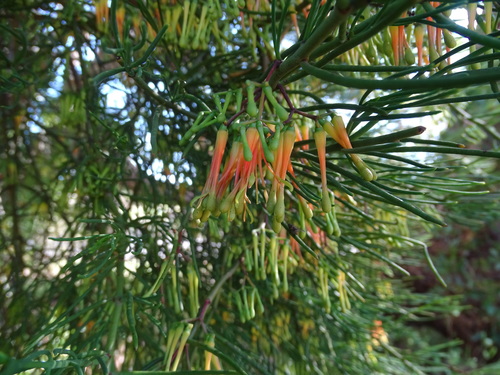
(c) Ralph Foster, some rights reserved (CC BY-NC), uploaded by Ralph Foster

(c) Ralph Foster, some rights reserved (CC BY-NC), uploaded by Ralph Foster

(c) cinclosoma, some rights reserved (CC BY-NC), uploaded by cinclosoma
What to Eat
Edible parts: Fruit
The fruit is eaten.
Where to Find It
A tropical plant. It grows on Acacia and Casuarina species. It grows from tropical to temperate places. It can grow in arid places.
Australia*,
How to Identify
It grows on the branches of other plants. It partly lives from them. It is a shrub. The leaves are 2-10 cm long by 0.5-2.5 cm wide. They are angular and opposite or scattered. They are green. The flowering stalk is in the axils of leaves. The stalk is 30 cm long. it bears 2 or sometimes 3 groups of 3 flowers in a cluster. They are bright red.
Wikipedia
Source ↗Amyema preissii, commonly known as wireleaf mistletoe, is a species of mistletoe, an epiphytic, hemiparasitic plant of the family Loranthaceae. It is native to Australia where it has been recorded from all mainland states. The flowers are red and up to 26 mm long. The fruits are white or pink, globose and 8–10 mm in diameter. Its habitat is sclerophyll forest and woodland where it is often found on wattles. On Victoria's Bellarine Peninsula its hosts include coast wirilda, golden wattle and drooping sheoak. Its sticky seeds are eaten and dispersed by mistletoebirds.
Notes
There are about 90-100 Amyema species.
Names & Synonyms
References (9)
- Cancilla, D., 2018, Ethnobotanical and Ethnozoological Values Desktop Assessment - Eliwana Project. p 10
- Dashorst, G.R.M., and Jessop, J.P., 1998, Plants of the Adelaide Plains & Hills. Botanic Gardens of Adelaide and State Herbarium. p 50
- Elliot, W.R., & Jones, D.L., 1982, Encyclopedia of Australian Plants suitable for cultivation. Vol 2. Lothian. p 189
- Latz, P.K., 1996, Bushfires and Bushtucker: Aboriginal plant use in Central Australia. IAD Press Alice Springs p 126
- Lazarides, M. & Hince, B., 1993, Handbook of Economic Plants of Australia, CSIRO. p 19
- Paczkowska, G. & Chapman, A.R., 2000, The Western Australian Flora. A Descriptive Catalogue. Western Australian Herbarium. p 284
- Wheeler, J.R.(ed.), 1992, Flora of the Kimberley Region. CALM, Western Australian Herbarium, p 573
- Williams, K.A.W., 1999, Native Plants of Queensland Volume 4. Keith A.W. Williams North Ipswich, Australia. p 54
- World Checklist of Useful Plant Species 2020. Royal Botanic Gardens, Kew


