Pilea melastomoides
(Poir.) Wedd.
Poh-pohon, Sweet nettle

(c) Kuan-Chieh (Chuck) Hung, some rights reserved (CC BY-NC-SA), uploaded by Kuan-Chieh (Chuck) Hung
(c) Lijin Huang (紫楝), some rights reserved (CC BY-NC)
(c) 眼子菜, some rights reserved (CC BY-NC)
What to Eat
Edible parts: Leaves as condiment, Spice, Vegetable
The young leaves are used to flavour food, eaten raw or steamed, and serve as a condiment, spice, and vegetable.
Where to Find It
A tropical plant. In Indonesia it grows between 500-2,700 m above sea level. It grows in humid places. In Yunnan.
Asia, China, India, Indonesia, Japan, Myanmar, Philippines, SE Asia, Sri Lanka, Taiwan, Vietnam,
How to Identify
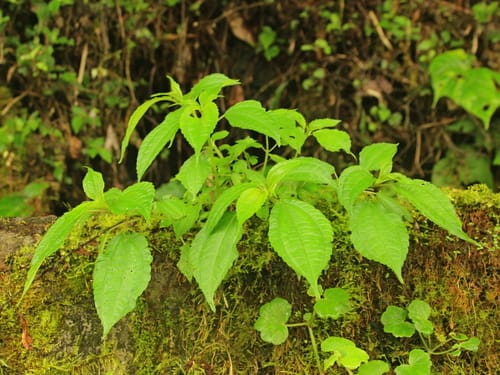
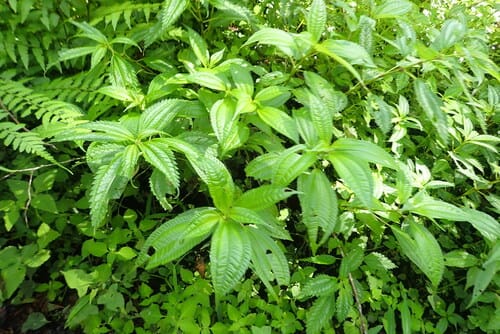
A herb. It is robust and can be erect or curving upwards. It grows 50-200 cm high. The stems are fleshy and often tinged red. The leaves are on unequal length stalks. The leaves are broadly oval or sword shaped and the base is wedge shaped. There are coarse teeth along the edge. The leaves are 5-25 cm long by 3-10 cm wide. They are shiny and dark green above.
Nutrition Score: 62/100
| Part | Moisture | kJ | kcal | Protein | Vit A | Vit C | Iron | Zinc |
|---|---|---|---|---|---|---|---|---|
| Leaves | 77.4 | — | 340 | 18.7 | — | — | 1.6 | 1.2 |
How to Grow
It can be grown from cuttings or side branches that have developed roots.
Other Information
It is a commercially cultivated vegetable. It is sold in local markets.
Notes
There are about 250 Pilea species. They occur in tropical and warm temperate regions.
Names & Synonyms
References (14)
- Ambasta, S.P. (Ed.), 2000, The Useful Plants of India. CSIR India. p 455
- Andarwulan, N., et al, 2010, Flavonoid content and antioxidant activity of vegetables from Indonesia. Food Chemistry 121: 1231-1235
- Ann. Sci. Nat. Bot. ser. 4, 1:186. 1854
- Arora, R. K., 2014, Diversity in Underutilized Plant Species - An Asia-Pacific Perspective. Bioversity International. p 44
- Burkill, I.H., 1966, A Dictionary of the Economic Products of the Malay Peninsula. Ministry of Agriculture and Cooperatives, Kuala Lumpur, Malaysia. Vol 2 (I-Z) p 1756
- Flora of China @ efloras.org Volume 5
- Heyne, K., 1927, p 582
- Kays, S. J., and Dias, J. C. S., 1995, Common Names of Commercially Cultivated Vegetables of the World in 15 languages. Economic Botany, Vol. 49, No. 2, pp. 115-152 (As Pilea trinervia)
- Lembogi Biologi Nasional, 1980, Sayur-sayuran. Balai Pustaka, Jakarta. p 92
- Martin, F.W. & Ruberte, R.M., 1979, Edible Leaves of the Tropics. Antillian College Press, Mayaguez, Puerto Rico. p 99, 223
- Ochse, J. J. et al, 1931, Vegetables of the Dutch East Indies. Asher reprint. p 722
- Priyadi, H., et al, Five hundred plant species in Gunung Halimun Salak National Park West Java. A checklist including Sundanese names, distribution and use. CIFOR, FFPRI, SLU p 144
- Wiersema, J. H. & Leon, B., 2013, World Economic Plants. A Standard Reference CRC Press. 2nd Ed. p 527
- World Checklist of Useful Plant Species 2020. Royal Botanic Gardens, Kew


