Pinellia ternata
(Thunb.) Makino
Ban xia

(c) 空猫 T. N, some rights reserved (CC BY-NC), uploaded by 空猫 T. N

no rights reserved, uploaded by 葉子
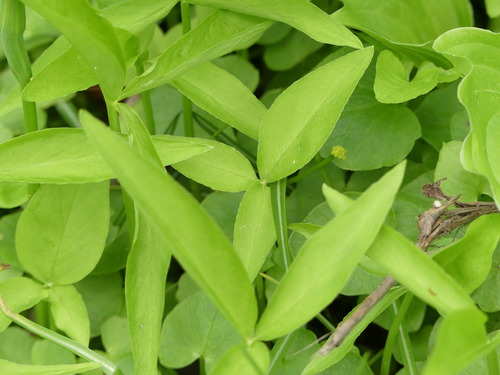
(c) Grace Jeschke, some rights reserved (CC BY-NC), uploaded by Grace Jeschke
What to Eat
Edible parts: Root, Tuber, Caution
The tuber, which is about 12mm in diameter, is edible. Reports give no further detail on preparation, but caution is advised since the fresh root is toxic. The toxins can be destroyed by thoroughly drying or very well cooking the root before consumption.
Where to Find It
A tropical plant. It grows in grassy land, secondary forest, wasteland and cultivated land; below 2500 m in China.
Asia, Australia, China, Europe, Japan, Korea, North America,
How to Identify
A herb. It keeps growing from year to year. It has round tubers 1-2 cm across. There are 2-5 leaves. The leaf stalks are 15-20 cm long. They form sheaths at the base. The leaves have 3 or sometimes 5 leaflets. They are narrowly oval or sword shaped and 3-10 cm long by 1-3 cm wide and with side leaflets 4-8 cm long by 2 cm wide. The spathe is greenish.
How to Grow
Propagation: Seed — no specific information is available for this species, but sowing in a cold frame as soon as seed is ripe is recommended, or in early spring if that is not possible. Prick seedlings out into individual pots once large enough to handle, and grow on in a greenhouse for at least the first winter. Plant out into permanent positions in late spring or early summer, after the last expected frosts. Division of offsets can be done as new growth begins in spring. Bulbils from the leaf axils can be potted up in late summer and planted out in late spring.
Medicinal Uses
The root of ban xia is antiemetic, antiphlogistic, expectorant, febrifuge, sialagogue, and styptic, and also strengthens the spleen. Modern research has confirmed it is highly effective at controlling nausea and vomiting. It is also an ingredient in a Chinese prescription for removing gallstones without surgery — a procedure that typically causes severe nausea. Internally, the root is used to treat coughs with thin, watery phlegm and gastritis. The fresh root is extremely acrid and toxic; these properties are neutralized by drying or by soaking in tea or vinegar. The root is harvested in summer and dried for later use — it must never be used fresh. Plant extracts have demonstrated analgesic, antiemetic, anticancer, and sedative activity.
Other Uses
No other uses are known for this plant.
Wikipedia
Source ↗Pinellia ternata (Chinese: 半夏, Japanese: カラスビシャク), crow-dipper, is a plant that is native to China, Japan, and Korea. However, it also grows as an invasive weed in parts of Europe (Austria, Germany) and in North America (California, Ontario, the northeastern United States). The leaves are trifoliate, and the flowers are of the spathe and spadix form that is typical of plants in the family Araceae.
Notes
The tuber is used in medicine. There are 6 Pinellia species.
Names & Synonyms
References (4)
- Bot. Mag. (Tokyo) 15:135. 1901 (W. Breitenbach, Bot. Zeitung (Berlin) 37:687. 1879, nom. inval.) -
- Hibbert, M., 2002, The Aussie Plant Finder 2002, Florilegium. p 234
- Li Heng, Araceae, Flora of China
- Plants for a Future database, The Field, Penpol, Lostwithiel, Cornwall, PL22 0NG, UK. http://www.scs.leeds.ac.uk/pfaf/


