Piper auritum
H. B. Kunth
Ear-leafed pepper, Mexican pepper leaf

(c) bernzpa, some rights reserved (CC BY-NC)

(c) Juan Cruzado Cortés, some rights reserved (CC BY-SA), uploaded by Juan Cruzado Cortés

(c) Andy, some rights reserved (CC BY-NC), uploaded by Andy
What to Eat
Edible parts: Leaves, Stem, Leaves - tea, Flower spikes - flavouring
It is often used in Mexican cuisine in tamales, fish or meat wrapped in its fragrant leaves for cooking, and as an essential ingredient in mole verde, a green sauce originally from the Puebla/Oaxaca region of Mexico. It is also used to flavor eggs and soups like pozole. In Central Mexico, it is used to flavor chocolate drinks. In southeastern Mexico, a green liquor called verdín is made from hoja santa. While typically used fresh, it is also used dried, although the drying process removes much of the flavor and makes the leaf too brittle to be used as a wrapper.
Where to Find It
A tropical plant. It suits seasonally moist, moderate rainfall. It can grow in an average, well-drained soil. It can grow in full sun or light shade. In Costa Rica it grows from sea level to about 1,700 m altitude. It suits hardiness zones 10-12.
Amazon, Belize, Caribbean, Central America*, Colombia, Costa Rica, Cuba, Ecuador, El Salvador, French Guiana, Guatemala, Guianas, Haiti, Honduras, Jamaica, Mexico, Micronesia, Nicaragua, North America, Pacific, Panama, South America*, Suriname, West Indies,
How to Identify
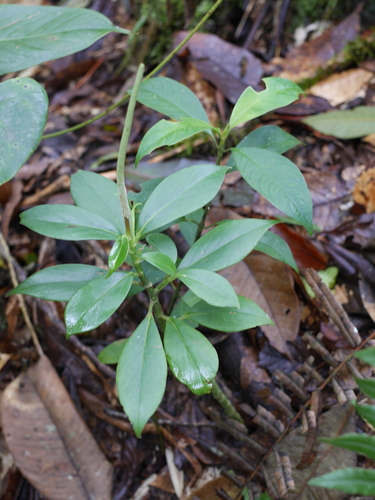
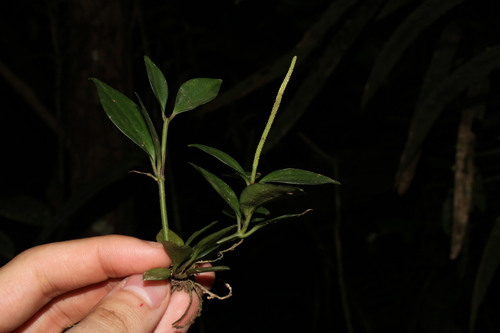
A herb or small tree. It keeps growing from year to year. It grows 2-5 m tall. The stems are swollen at the nodes. It has large heart shaped leaves. They are 30 cm long. The sides at the base are unequal. The leaves taper to the tip and are softly hairy. The leaf stalk has wings. The leaves have an anise scent. The flowers are white. They are on erect, slender spikes. These droop at the ends. They are 15-28 cm long. This flower stalk is produced opposite a leaf. The fruit is small and fleshy.
Nutrition Score: 29/100
| Part | Moisture | kJ | kcal | Protein | Vit A | Vit C | Iron | Zinc |
|---|---|---|---|---|---|---|---|---|
| Leaves - dry | 4.4 | — | — | 29.8 | — | — | — | — |
How to Grow
It can spread by suckers. Seeds are also scattered by bats.
Other Information
It is a cultivated food plant. Leaves are sold in local markets.
Notes
There are between 1000-2000 Piper species. They are mostly in the tropics.
Names & Synonyms
Acuja, Acuyo, Aguiyu, Anisillo, Bullhoof pepper, Caisimon, Cordoncillo, Hierba santa, Hoja de estrella, Hoja de Santa Maria, Hoja Santa, Kauput, Makulan, Mexican pepper leaf, Root beer plant, Sacred pepper, Santamaria, Sika tara, Tlanepa, Ugudi bagasu, Vera Cruz pepper, Yerba santa
References (31)
- Altschul, S.V.R., 1973, Drugs and Foods from Little-known Plants. Notes in Harvard University Herbaria. Harvard Univ. Press. Massachusetts. no. 480
- Arellanes, Y., et al, 2013, Influence of traditional markets on plant management in the Tehuacan Valley. Journal of Ethnobiology and Ethnomedicine 9:38
- Blake, S. F., Native Names and Uses of some Plants of Eastern Guatemala and Honduras. Contributions from the National Herbarium. p 97
- Chizmar Fernandez, C., et al, 2009, Plantas comestibles de Centroamerica. Instituto de Biodiversidad, Costa Rica. p 256
- Coe, F. G., and Anderson, G. J., 1996, Ethnobotany of the Garifuna of Eastern Nicaragua. Economic Botany 50(1) pp 71-107
- Coe, F. G. & Anderson, G. J., 1997, Ethnobotany of the Miskitu of Eastern Nicaragua. Journal of Ethnobiology 17(2): 171-214
- Coe, F. G. and Anderson, G. J., 1999, Ethnobotany of the Sumu (Ulwa) of Southeastern Nicaragua and Comparisons with Miskitu Plant Lore. Economic Botany Vol. 53. No. 4. pp. 363-386
- Creasey, R., 2000, Edible Mexican Garden. Periplus. p 36
- Diaz-Betancourt, M., et al, 1999, Weeds as a future source for human consumption. Rev. Biol. Trop. 47(3):329-338
- Duke,
- Facciola, S., 1998, Cornucopia 2: a Source Book of Edible Plants. Kampong Publications, p 171
- Grandtner, M. M., 2008, World Dictionary of Trees. Wood and Forest Science Department. Laval University, Quebec, Qc Canada. (Internet database http://www.wdt.qc.ca)
- Grandtner, M. M. & Chevrette, J., 2013, Dictionary of Trees, Volume 2: South America: Nomenclature, Taxonomy and Ecology. Academic Press p 501
- Ibarra-Manriquez, G., et al, 1997, Useful Plants of the Los Tuxtlas Rain Forest (Veracruz, Mexico): Considerations of their Market Potential. Economic Botany, Vol. 51, No. 4, pp. 362-376
- Kermath, B. M., et al, 2014, Food Plants in the Americas: A survey of the domesticated, cultivated and wild plants used for Human food in North, Central and South America and the Caribbean. On line draft. p 664
- Larios, et al., 2013, Plant management and biodiversity conservation in Náhuatl homegardens of the Tehuacán Valley, Mexico. Journal of Ethnobiology and Ethnomedicine 2013 9:74.
- Lentz, D. L., 1993, Medicinal and Other Economic Plants of the Paya of Honduras. Economic Botany, Vol. 47, No. 4, pp. 358-370
- Llamas, K.A., 2003, Tropical Flowering Plants. Timber Press. p 313
- Manzanero-Medina, G. I., et al, 2020, Ethnobotany of food plants (quelites) sold in two traditional markets of Oaxaca, Mexico. South African Journal of Botany. 130 (2020) 215-223
- Martin, F.W. & Ruberte, R.M., 1979, Edible Leaves of the Tropics. Antillian College Press, Mayaguez, Puerto Rico. p 212
- Mapes, C. & Basurto, F., 2016, Biodiversity and Edible Plants of Mexico. Chapter 5 in R. Lira, et al. (eds.), Ethnobotany of Mexico, Ethnobiology, Springer. p 112
- Morton,
- Pascual-Mendoza, S. et al, 2021, Traditional knowledge of edible plants in an indigenous community in the Sierra Norte of Oaxaca, Mexico. Plant Biosystems - An International Journal Dealing with all Aspects of Plant Biology
- Pena, F. B., et al, 1998, Los quelites de la Sierra Norte de Puebla, Mexico: Inventory Y Formas de Preparacion. Bol. Soc. Bot. Mexico 62:49-62
- Piedra-Malagón, E. M., et al, 2022, Edible native plants of the Gulf of Mexico Province. Biodiversity Data Journal 10: e80565 p 27
- Plants of Haiti Smithsonian Institute http://botany.si.edu/antilles/West Indies
- Roa, J. A. G. & Boada, D. S. G., 2018, Fundación para el Fortalecimiento de la Fruticultura y Plantas Alimenticias no Convencionales en Colombia.
- F. W. H. A. von Humboldt et al., Nov. gen. sp. 1:45[folio]; 1:54[quarto]. 1816
- Wiersema, J. H. & Leon, B., 2013, World Economic Plants. A Standard Reference CRC Press. 2nd Ed. p 535
- World Checklist of Useful Plant Species 2020. Royal Botanic Gardens, Kew
- Zuchowski W., 2007, Tropical Plants of Costa Rica. A Zona Tropical Publication, Comstock Publishing. p 64