Piper longum
L.
Long pepper, Indian long pepper

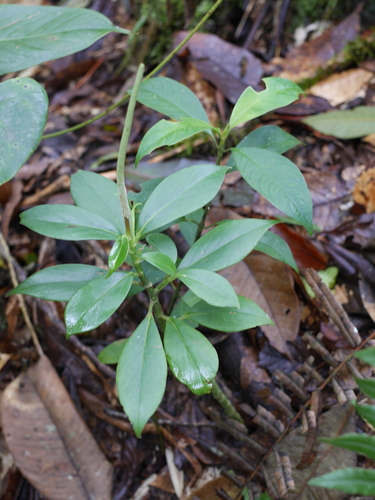
(c) kosala-abeykoon, some rights reserved (CC BY-NC)

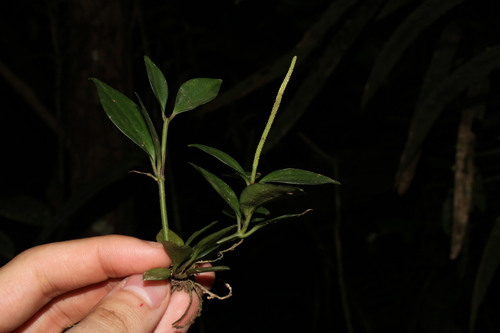
(c) jularat, some rights reserved (CC BY-NC)

(c) jularat, some rights reserved (CC BY-NC)
What to Eat
Edible parts: Fruit, Herb, Spice, Leaves
The dried berries are used as a spice, added to curries and pickles, while young fruit are eaten raw. The leaves are eaten raw, fried with meat, or used in soups.
Where to Find It
A tropical and subtropical plant. In Nepal it grows to about 800 m altitude. In China it grows at about 600 m altitude in Yunnan. It is cultivated in other provinces in the south. In XTBG Yunnan.
Andamans, Asia, Australia, Bangladesh, Bhutan, China, Himalayas, India, Indochina, Indonesia, Laos, Malaysia, Myanmar, Nepal, Northeastern India, Philippines, SE Asia, Sikkim, Sri Lanka, Thailand, Vietnam,
How to Identify
A twining herb. It can be several metres long. It is creeping or climbing and forms roots below. The leaves often have small hairs. The branches are smooth. The leaves have stalks. The leaf blade is 3-12 cm long by 2-12 cm wide. They are broadly oval to heart shaped. They taper to a short tip. The lower leaves have long stalks. The upper leaves do not have stalks and clasp the stem. There are usually 5 veins at the base. The flowers are green. They are opposite the leaves. The male spike is 5.5 cm long and 3 mm wide. The female spike is 1.5-1.5 cm long and 2.5-4 mm wide. The fruit is a berry. The berries stick to the axis or central stalk.
How to Grow
Plants are grown from seed or root offshoots. Seeds are slow to germinate taking 30 days. Plants can be grown from cutting runner shoots. These should be 15-22 cm long with 2-3 nodes. These can be put in a nursery and transplanted after 3-4 months. It is best in shade. A spacing of 1.5 m is suitable.
Propagation: Seed - Semi-ripe cuttings.
Medicinal Uses
The fruit is used in traditional medicine and has been noted to have anticancer properties.
Production
Plants produce after 3-4 years.
Other Information
It is a cultivated food plant. It is sold in markets.
Notes
There are between 1000-2000 Piper species. They are mostly in the tropics. It is used in medicine. It has anticancer properties.
Names & Synonyms
Bi ba, Bithipokang, Fanfeuwali, Hippali, Jaborandi pepper, Janli pan, Kandan, Lahare pan, Likadu, Magadhi, Nallamulagu, Nga-yok-kaung, Paik-chin, Peepla, Peli ja, Phrik haang, Pimpli, Pimpoli, Pipal, Pipala, Pipali, Pipla, Piplamor, Piplamul, Pipli, Pipoli, Pippali, Pippili, Pippuloo, Pipul, Punthong, Singmalta, Siramulam, Tieu dai, Tieu lot, Tippili, Tieu dai
References (50)
- Acharya K. P. and Acharya, R., 2010, Eating from the Wild: Indigenous knowledge on wild edible plants in Parroha VDC of Rupandehi District, Central Nepal. International Journal of Social Forestry. 3(1):28-48
- Ambasta, S.P. (Ed.), 2000, The Useful Plants of India. CSIR India. p 460
- Ara, R. I. T., 2015, Leafy Vegetables in Bangladesh. Photon eBooks. p 68
- Arora, R. K., 2014, Diversity in Underutilized Plant Species - An Asia-Pacific Perspective. Bioversity International. p 107
- Balkrishna, A., et al, 2022, Indigenous Uses of Plants among Forest-dependent Communities of Seijosa, Arunachal Pradesh. International Journal of Economic Plants 2022, 9(1):064-080
- Bremness, L., 1994, Herbs. Collins Eyewitness Handbooks. Harper Collins. p 283
- Burkill, I.H., 1966, A Dictionary of the Economic Products of the Malay Peninsula. Ministry of Agriculture and Cooperatives, Kuala Lumpur, Malaysia. Vol 2 (I-Z) p 1766, 1774
- Chowdery, T., et al, 2014, Wild edible plants of Uttar Dinajpur District, West Bengal. Life Science Leaflets. 47:pp 20-36 http://lifesciencesleaflets.ning.com
- Chowdhury, M. & Mukherjee, R., 2012, Wild Edible Plants Consumed by Local Communities of Maldah of West Bengal, India. Indian J.Sci.Res.3(2) : 163-170
- Dangol, D. R., 2002, Economic uses of forest plant resources in western Chitwan, Nepal. Banko Janakari, 12(2): 56-64
- Facciola, S., 1998, Cornucopia 2: a Source Book of Edible Plants. Kampong Publications, p 171
- Gangte, H. E., et al, 2013, Wild Edible Plants used by the Zou Tribe in Manipur, India. International Journal of Scientific and Research Publications, Volume 3, Issue 5
- Gautam, R. S., et al, 2020, Wild Edible Fruits of Nepal. Int. J. Appl. Sci. Biotechnol. Vol 8(3): 289-304
- Ghorbani, A., et al, 2012, A comparison of the wild food plant use knowledge of ethnic minorities in Naban River Watershed Nature Reserve, Yunnan, SW China. Journal of Ethnobiology and Ethnomedicine; 8:17
- Ghosh, C. & Das A. P., 2011, Some useful and poisonous tea garden weeds from the Darjiling District of West Bengal, India. Pleione 5(1): 91 - 114
- Ghosh, A, 2014, Survey of Ethno-medicinal Climbing plants in Andaman and Nicobar Islands, India. Int. J. of Pharm. Life Sci. 5(7): July, 2014:3671-3677
- Guite, C., 2016, Study of wild edible plants associated with the Paite Tribe of Manipur, India. International Journal of Current Research. Vol. 8, Issue 11, pp. 40927-40932
- Hedrick, U.P., 1919, (Ed.), Sturtevant's edible plants of the world. p 500
- Hemphill, I, 2002, Spice Notes. Macmillan. p 299
- Heywood, V.H., Brummitt, R.K., Culham, A., and Seberg, O., 2007, Flowering Plant Families of the World. Royal Botanical Gardens, Kew. p 256
- Hibbert, M., 2002, The Aussie Plant Finder 2002, Florilegium. p 235
- Hu, Shiu-ying, 2005, Food Plants of China. The Chinese University Press. p 333
- Jacquat, C., 1990, Plants from the Markets of Thailand. D.K. Book House p 62
- Kintzios, S. E., 2006, Terrestrial Plant-Derived Anticancer Agents and Plant Species Used in Anticancer research. Critical Reviews in Plant Sciences. 25: pp 79-113
- Kiple, K.F. & Ornelas, K.C., (eds), 2000, The Cambridge World History of Food. CUP p 1789
- Kybal, J., 1980, Herbs and Spices, A Hamlyn Colour Guide, Hamlyn Sydney p 160
- Macmillan, H.F. (Revised Barlow, H.S., et al), 1991, Tropical Planting and Gardening. Sixth edition. Malayan Nature Society. Kuala Lumpur. p 384
- Manandhar, N.P., 2002, Plants and People of Nepal. Timber Press. Portland, Oregon. p 365
- Mukhia, P.K., et al, 2013, Wild plants as Non Wood Forest Products used by the rural community of Dagana, a southern foothill district of Bhutan, SAARC Journal, 27 pages
- Pham-Hoang Ho, 1999, An Illustrated Flora of Vietnam. Nha Xuat Ban Tre. p 297
- Patiri, B. & Borah, A., 2007, Wild Edible Plants of Assam. Geethaki Publishers. p 118
- Pegu, R., et al, 2013, Ethnobotanical study of Wild Edible Plants in Poba Reserved Forest, Assam, India. Research Journal of Agriculture and Forestry Sciences 1(3):1-10
- Purseglove, J.W., 1968, Tropical Crops Dicotyledons, Longmans. p 436
- Ramachandran, V.S., 1987, Further Notes on the Ethnobotany of Cannanore District, Kerala. J. Econ. Tax. Bot. Vol. 11 No. 1 pp 47-
- Rajendra, K.C., 2014. Prominent Non-Wood Forest Products of Te- rai and Siwalik Regions in Nepal. Food and Agriculture Organization, Kathmandu, Nepal. p 93
- Recher, P, 2001, Fruit Spirit Botanical Gardens Plant Index. www.nrg.com.au/~recher/ seedlist.html p 3
- Sarma, H., et al, 2010, Updated Estimates of Wild Edible and Threatened Plants of Assam: A Meta-analysis. International Journal of Botany 6(4): 414-423
- Savita, et al, 2006, Studies on wild edible plants of ethnic people in east Sikkim. Asian J. of Bio Sci. (2006) Vol. 1 No. 2 : 117-125
- Sawian, J. T., et al, 2007, Wild edible plants of Meghalaya, North-east India. Natural Product Radiance Vol. 6(5): p 420
- Sp. pl. 1:29. 1753
- Tanaka, Y. & Van Ke, N., 2007, Edible Wild Plants of Vietnam. Orchid Press. p 112
- Tseng Yung-chien, Xia Nianhe, Gilbert, M.G., Piperaceae. Flora of China.
- Tsering, J., et al, 2017, Ethnobotanical appraisal on wild edible plants used by the Monpa community of Arunchal Pradesh. Indian Journal of Traditional Knowledge. Vol 16(4), October 2017, pp 626-637
- Uprety, Y., et al, 2010, Non-timber Forest Products in Bardiya District of Nepal: Indigenous Use, Trade and Conservation. J Hum Ecol, 30(3): 143-158
- Uprety, Y., et al, 2012, Diversity of use and local knowledge of wild edible plant resources in Nepal. Journal of Ethnobotany and Ethnomedicine 8:16
- van Wyk, B., 2005, Food Plants of the World. An illustrated guide. Timber press. p 298
- Wiersema, J. H. & Leon, B., 2013, World Economic Plants. A Standard Reference CRC Press. 2nd Ed. p 535
- World Checklist of Useful Plant Species 2020. Royal Botanic Gardens, Kew
- Zeven, A.C., 1979, Black Pepper, in Simmonds, N.W., (ed), Crop Plant Evolution. Longmans. London. p 234
- Zeven, A. C. & de West, J. M. J., 1982, Dictionary of cultivated plants and their regions of diversity. Wageningen. p 78