Piper retrofractum
Vahl
Javanese long pepper

(c) oldman19510, some rights reserved (CC BY-NC), uploaded by oldman19510
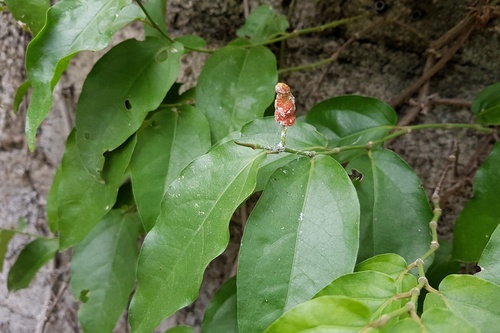
(c) Cheongweei Gan, some rights reserved (CC BY-NC), uploaded by Cheongweei Gan
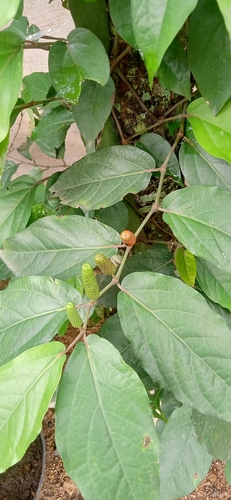
(c) Sofi Abraham, some rights reserved (CC BY-NC), uploaded by Sofi Abraham
What to Eat
Edible parts: Fruit, Spice, Flower
Seeds - used as a spice. Used for green peppercorn spice. Used as a seasoning in curries, preserves and pickles. More pungent than Piper nigrum, but also sweeter.
Where to Find It
A tropical plant. It grows on dry soils. It grows in deciduous forests on poor soils up to 600 m above sea level.
Asia, Cambodia, India, Indochina, Indonesia, Laos, Malaysia, Philippines, SE Asia, Thailand, Vietnam,
How to Identify
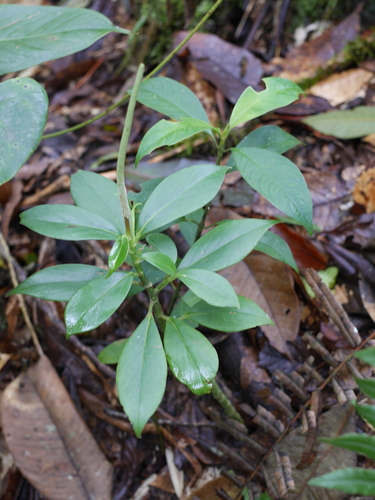
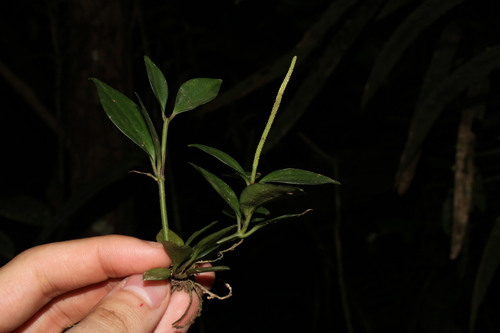
A climbing shrub. It grows 5-10 m tall. The stem is 3-4 mm across. The leaves are sword shaped and taper to the tip and are unequal at the base. They are 10-12 cm long by 3-4 cm wide. Male and female flowers are on separate plants. Female spikes are 4 cm long while male spikes are 5 cm long. The fruit are oval berries. The spikes are red. Possibly now Piper chaba
How to Grow
Plants can be grown from cuttings. Plants are pruned to make them flower.
Medicinal Uses
Used as a medicine in Indonesia.
Other Uses
The wood and root are the source of a dye - it is pale brown if used alone on cotton, but mixed with bakam (Caesalpinia sappan), it gives a brownish-red.
Wikipedia
Source ↗Piper retrofractum, the Balinese long pepper or Javanese long pepper, is a flowering vine in the family Piperaceae, cultivated for its fruit, which is usually dried and used as a spice and seasoning. This species is native to Java island in Indonesia.
Other Information
It is a cultivated plant.
Notes
Used as a medicine in Indonesia. There are between 1000-2000 Piper species. They are mostly in the tropics.
Names & Synonyms
Bi ba, Cabe jawa, Cabe rambat, Chab, Chabe alas, Chabe sula, Chabean, Chai, Chavala, Chavi, Choi, Dei plei, Di pli, Gachha, Lada panjang, Seu kaa meu, Tieu doi
References (22)
- Ambasta, S.P. (Ed.), 2000, The Useful Plants of India. CSIR India. p 461
- Arora, R. K., 2014, Diversity in Underutilized Plant Species - An Asia-Pacific Perspective. Bioversity International. p 107
- Burkill, I.H., 1966, A Dictionary of the Economic Products of the Malay Peninsula. Ministry of Agriculture and Cooperatives, Kuala Lumpur, Malaysia. Vol 2 (I-Z) p 1781
- Enum. pl. 1:314. 1804
- Hedrick, U.P., 1919, (Ed.), Sturtevant's edible plants of the world. p 499 (As Piper chaba)
- Hemphill, I, 2002, Spice Notes. Macmillan. p 299
- Johnson, N., 2002, Environmental Change in northern Thailand: Impact on Wild Edible Plant Availability. Ecology of Food and Nutrition, 41: 5, 373-399
- Kiple, K.F. & Ornelas, K.C., (eds), 2000, The Cambridge World History of Food. CUP p 1792
- Macmillan, H.F. (Revised Barlow, H.S., et al), 1991, Tropical Planting and Gardening. Sixth edition. Malayan Nature Society. Kuala Lumpur. p 384
- Maisuthisakul, P., 2012, Phenolic Constituents and Antioxidant Properties of some Thai Plants. Chp. 9 in Book Phytochemicals - A Global Perspective of Their Role in Nutrition and Health
- Nakahara, K. et al, 2002, Antimutagenicity of Some Edible Thai Plants, and a Bioactive Carbazole Alkaloid, Mahanine, Isolated from Micromelum minutum. Journal of Agricultural and Food Chemistry. 50: 4796-4892
- Pham-Hoang Ho, 1999, An Illustrated Flora of Vietnam. Nha Xuat Ban Tre. p 300
- Phon, P., 2000, Plants used in Cambodia. © Pauline Dy Phon, Phnom Penh, Cambodia. p 502
- Purseglove, J.W., 1968, Tropical Crops Dicotyledons, Longmans. p 436
- Sukarya, D. G., (Ed.) 2013, 3,500 Plant Species of the Botanic Gardens of Indonesia. LIPI p 956
- Sukenti, K., et al, 2016, Ethnobotanical study on local cuisine of the Sasak tribe in Lombok Island, Indonesia. Journal of Ethnic Foods. 3 (2016) 189-200 p 198
- Tanaka, Y. & Van Ke, N., 2007, Edible Wild Plants of Vietnam. Orchid Press. p 113
- van Wyk, B., 2005, Food Plants of the World. An illustrated guide. Timber press. p 298
- Wiersema, J. H. & Leon, B., 2013, World Economic Plants. A Standard Reference CRC Press. 2nd Ed. p 535
- Wijayakusuma, H.M.H., et al, 1996, Tanaman Berkhasiat Obat Di Indonesia. Pustaka Kartini. p 42
- World Checklist of Useful Plant Species 2020. Royal Botanic Gardens, Kew
- Zeven, A. C. & de West, J. M. J., 1982, Dictionary of cultivated plants and their regions of diversity. Wageningen. p 62