Piper stenocarpum
C.DC.
Tombelso
PiperaceaeLeaves

gbif · cc0
President and Fellows of Harvard College
President and Fellows of Harvard College
What to Eat
Edible parts: Leaves
Cooked leaves are eaten as a vegetable, often prepared together with fungi.
Where to Find It
A tropical plant. It grows in the highlands between 1500 and 3500 m altitude and is most common in oak type forest near 2200 m altitude.
Pacific, Papua New Guinea, PNG,
Countries: Australia, Fiji, Micronesia, Kiribati, Marshall Islands, Nauru, New Zealand, Papua New Guinea, Palau, Solomon Islands, Tonga, Tuvalu, Vanuatu, Samoa
How to Identify
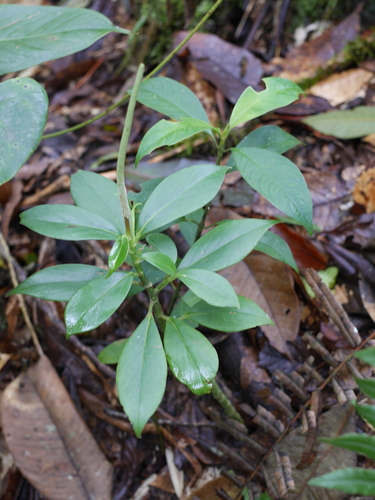
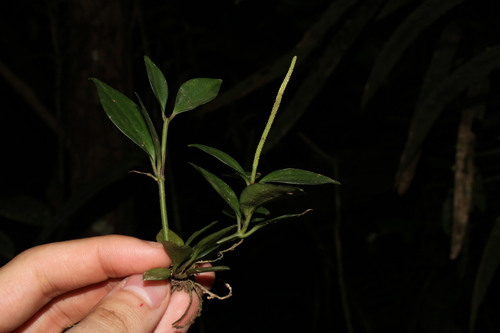
A vine like daka and pepper which climbs up logs and tree trunks in the bush. The fruiting part is a long (20 cm) thin (1 cm) part like daka. It is longer than the leaves and turns red at maturity.
How to Grow
It grows wild.
Medicinal Uses
Used as a leafy green vegetable in high altitude areas of Papua New Guinea.
Other Information
A minor edible leafy green in some high altitude areas of Papua New Guinea.
Notes
There are between 1000-2000 Piper species. They are mostly in the tropics.
Names & Synonyms
Kilawa duaden
References (3)
- Hide, R., et al, 1979, A checklist of some plants in the territory of the Sinasina Nimai (Simbai Province, Papua New Guinea), with notes on their uses. Department Anthropology, University of Aukland
- Powell, J.M., Ethnobotany. In Paijmans, K., 1976, New Guinea Vegetation. Australian National University Press. p 111
- World Checklist of Useful Plant Species 2020. Royal Botanic Gardens, Kew