Platysace maxwellii
(Cav.) C. Norman
Round yam, Karno
(c) geoffbyrne, some rights reserved (CC BY-NC)
(c) Jamie Lee, some rights reserved (CC BY-NC), uploaded by Jamie Lee
(c) Hugo Innes, some rights reserved (CC BY), uploaded by Hugo Innes
What to Eat
Edible parts: Tubers, Root
The tubers and roots are eaten.
Where to Find It
It grows in sandy soils in SW of Western Australia. It needs good drainage and a warm location. It suits warm temperate and semi-arid locations. It can tolerate some frost and dry periods.
Australia*,
How to Identify
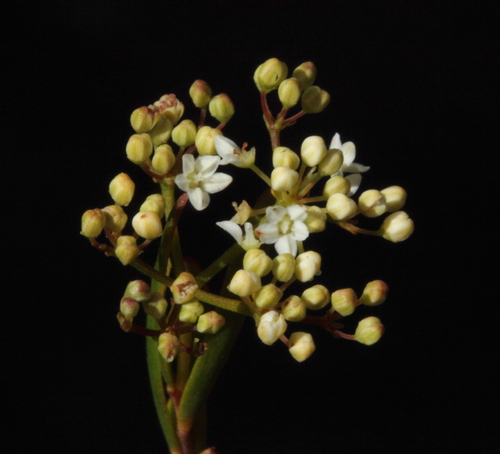
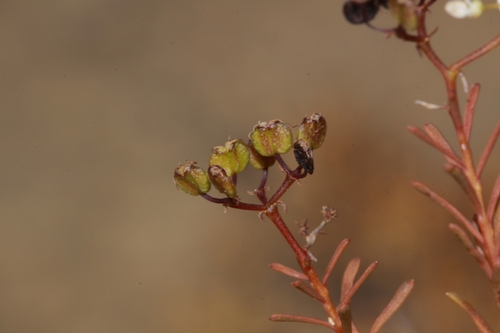
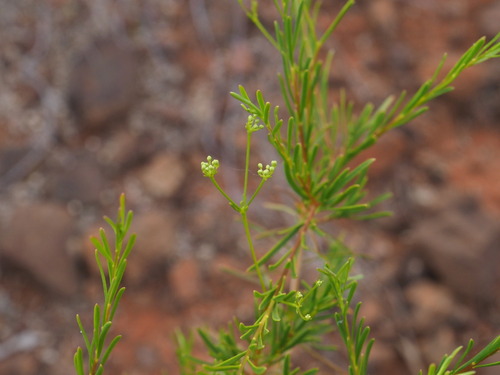
A small shrub. It grows 0.5-1.2 m high and spreads 0.4-1.2 m wide. It has creeping rhizomes or underground stems. The stems are erect and slender. The leaves are 1.5-3 cm long by 0.1-0.2 cm wide. They are narrow and crowded and point upwards. They are green and rigid with a pointed tip. The flowers are 0.3 cm across. They are yellow. The occur in groups near the ends of branches. There are bracts about 2 cm long. The fruit is about 0.2 cm across.
How to Grow
Plants can be grown from seed or cuttings of firm young growth.
Wikipedia
Source ↗Platysace maxwellii, commonly known as native potato or karno, is a shrub that is endemic to Western Australia. The Noongar names for the plant are karno and yook, with the latter name also referring to the closely related species Platysace deflexa which grows further south. The shrub has a slender, erst to straggling habit and typically grows to a height of 0.3 to 1.2 metres (1 to 4 ft). It blooms between October and April producing white flowers. Found on plains and hills with a scattered distribution from the Mid West through the Wheatbelt and into the south west of the Goldfields-Esperance region of Western Australia where it grows in sandy, loamy, clay or lateritic soils. Initially described by the botanist Ferdinand von Mueller in 1892 as Trachymene maxwellii in the article Descriptions of new Australian plants, with occasional other annotations in the journal The Victorian Naturalist It was later reclassified into the Platysace genera in 1939 by C. Norman in the Journal of Botany, British and Foreign Aborigines used the plant as a food source since it produces large numbers of round tubers about 0.5 metres (1.6 ft) underground which are accessed using a digging stick. The younger tubers closest to the surface are preferred and can be eaten raw or roasted over a fire.
References (3)
- Bindon, P., 1996, Useful Bush Plants. Western Australian Museum. p 203
- Elliot, W.R., & Jones, D.L., 1997, Encyclopedia of Australian Plants suitable for cultivation. Vol 7. Lothian. p 369
- Paczkowska, G. & Chapman, A.R., 2000, The Western Australian Flora. A Descriptive Catalogue. Western Australian Herbarium. p 148