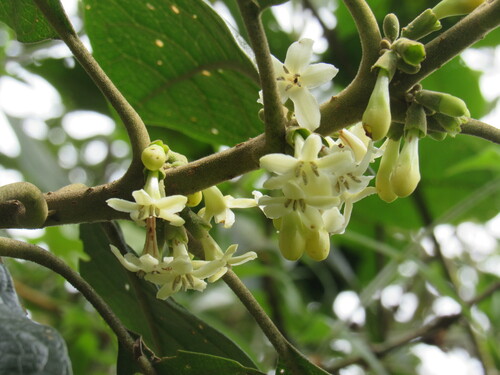
Plectranthus forsteri
Benth.
Lata, Latha

(c) juju98, some rights reserved (CC BY-NC)

(c) juju98, some rights reserved (CC BY-NC)

(c) hervevan, some rights reserved (CC BY-NC)
What to Eat
Edible parts: Leaves - drink
The leaves are used as a substitute for sage in cooking and for drinks.
Where to Find It
A warm temperate plant. It suits hardiness zones 8-10. In Fiji it grows from sea level to 1,050 m altitude. It grows in rocky places in forests.
Australia, Fiji, New Caledonia, Pacific, Samoa, Vanuatu,
How to Identify
A shrub. It grows 0.9-2.4 m high and spreads 3 m wide. It is sprawling and keeps growing from year to year. It has an aroma. The stems are hairy and 100 cm long. The leaves are oval and hairy. They have teeth along the edge.
Medicinal Uses
The leaves have been used in traditional medicine.
Notes
There are about 250 Plectranthus species. They are mainly in the tropics. The leaves have been used in medicine.
Names & Synonyms
Buiagha, Buiaka, Buiakha, Dranumi, Hoanga, Laca, Sede
References (6)
- Cabalion, P. and Morat, P., 1983, Introduction le vegetation, la flore et aux noms vernaculaires de l'ile de Pentcoste (Vanuatu), In: Journal d'agriculture traditionnelle et de botanique appliquee JATBA Vol. 30, 3-4
- Cundall, P., (ed.), 2004, Gardening Australia: flora: the gardener's bible. ABC Books. p 1060
- Lazarides, M. & Hince, B., 1993, Handbook of Economic Plants of Australia, CSIRO. p 193
- Parham, H. B. R, 1940, Supplement to the Journal of the Polynesian Society No. 16. Fiji Plants: Their Name and Uses.
- Parham, B. E. V., 1972, Plants of Samoa. New Zealand Department of Scientific and Industrial Research. Information Series. No. 85 p 105
- Smith, A.C., 1991, Flora Vitiensis Nova, Lawaii, Kuai, Hawaii, Volume 5 p 224