Poa pratensis
L.
Kentucky blue grass, Smooth-stalked meadow grass

(c) Bill Harms, some rights reserved (CC BY-NC), uploaded by Bill Harms
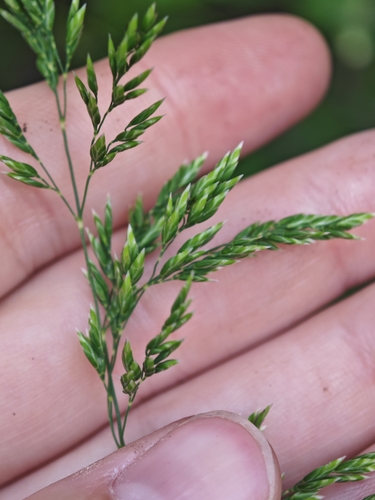
(c) Ирина Есина, some rights reserved (CC BY-NC), uploaded by Ирина Есина

(c) Matt Lavin, some rights reserved (CC BY-SA)
What to Eat
Edible parts: Seeds, Cereal
One source suggests this plant may be edible but provides no specific details. It most likely refers to the seed, which is small and very fiddly to use, though it could alternatively refer to the base of the leaf stems — a part eaten in at least one other species within this genus.
Where to Find It
It is a temperate plant. In Pakistan it grows between 1,500-4,700 m altitude. In Argentina it grows from sea level to 3,800 m above sea level. It suits hardiness zones 3-6.
Afghanistan, Africa, Arctic, Argentina, Asia, Australia, Balkans, Belarus, Bhutan, Brazil, Britain, Central Asia, Chile, China, Europe, Falklands, Haiti, Himalayas, Hungary, India, Indonesia, Jamaica, Japan, Kazakhstan, Korea, Kyrgyzstan, Luxembourg, Macedonia, Mongolia, Myanmar, Nepal, New Guinea, New Zealand, Norfolk Island, North Africa, North America, Pacific, Pakistan, Puerto Rico, Russia, SE Asia, South Africa, South America, Southern Africa, Sri Lanka, St Helena, Taiwan, Tajikistan, Tasmania, Tibet, Turkmenistan, Uruguay, Uzbekistan, West Indies,
How to Identify
A grass which keeps growing from year to year. It has creeping underground stems or rhizomes. The stem is erect. It grows 10-90 cm high. The leaves are flat and pliable. The flower panicle is oval shape. It is 2-20 cm long. The spikelets are oval and 4-6 mm long. There are 2-5 flowers.
How to Grow
Succeeds in any well-drained moderately fertile soil in a sunny position. A polymorphic species. It can be grown in lawns.
Propagation: Surface sow seed in spring in a cold frame, keeping the compost consistently moist. Prick seedlings into individual pots once large enough to handle, and grow them on in the greenhouse through their first winter. Plant out into permanent positions in late spring or early summer, after the last expected frosts. Division in spring is also straightforward — larger divisions can go directly into permanent positions. Smaller divisions are better potted up and grown on in light shade in a cold frame until well established, then planted out in late spring or early summer.
Medicinal Uses
None known.
Other Uses
None known.
Wikipedia
Source ↗Poa pratensis, commonly known as Kentucky bluegrass (or blue grass), smooth meadow-grass, or common meadow-grass, is a perennial species of grass native to practically all of Europe, North Asia and the mountains of Algeria, Morocco, and Tunisia. There is disagreement about its native status in North America, with some sources considering it native and others stating the Spanish Empire brought the seeds of Kentucky bluegrass to the New World in mixtures with other grasses. It is a common and incredibly popular lawn grass in North America with the species being spread over all of the cool, humid parts of the United States. In its native range, Poa pratensis forms a valuable pasture plant, characteristic of well-drained, fertile soil. It is also used for making lawns in parks and gardens and has established itself as a common invasive weed across cool moist temperate climates like the Pacific Northwest and the Northeastern United States. When found on native grasslands in Canada, for example, it is considered an unwelcome exotic plant, and is indicative of a disturbed and degraded landscape.
Other Information
They are eaten especially by children.
Notes
There are about 300-500 Poa species. They grow in temperate regions.
Names & Synonyms
Travka
References (15)
- Ambasta, S.P. (Ed.), 2000, The Useful Plants of India. CSIR India. p 471
- Cundall, P., (ed.), 2004, Gardening Australia: flora: the gardener's bible. ABC Books. p 1063
- Curtis, W.M., & Morris, D.I., 1994, The Student's Flora of Tasmania. Part 4B St David's Park Publishing, Tasmania, p 214
- Dashorst, G.R.M., and Jessop, J.P., 1998, Plants of the Adelaide Plains & Hills. Botanic Gardens of Adelaide and State Herbarium. p 176
- Denes, A., et al, 2012, Wild plants used for food by Hungarian ethnic groups living in the Carpathian Basin. Acta Societatis Botanicorum Poloniae 81 (4): 381-396
- Flora of Australia Volume 49, Oceanic Islands 1, Australian Government Publishing Service, Canberra. (1994) p 454
- Flora of Pakistan. www.eFloras.org
- Luczaj, L. et al, 2013, Wild edible plants of Belarus: from Rostakinski's questionnaire of 1883 to the present. Journal of Ethnobiology and Ethnomedicine 9:21
- Lamp, C.A., Forbes, S.J. and Cade, J.W., 1990, Grasses of Temperate Australia. Inkata Press. p 246
- Paczkowska, G. & Chapman, A.R., 2000, The Western Australian Flora. A Descriptive Catalogue. Western Australian Herbarium. p 115
- Plants for a Future database, The Field, Penpol, Lostwithiel, Cornwall, PL22 0NG, UK. http://www.scs.leeds.ac.uk/pfaf/
- Plants of Haiti Smithsonian Institute http://botany.si.edu/antilles/West Indies
- Sp. pl. 1:67. 1753
- Tasmanian Herbarium Vascular Plants list p 88
- Upson, R., & Lewis R., 2014, Updated Vascular Plant Checklist and Atlas for the Falkland Islands. Falklands Conservation and Kew.


