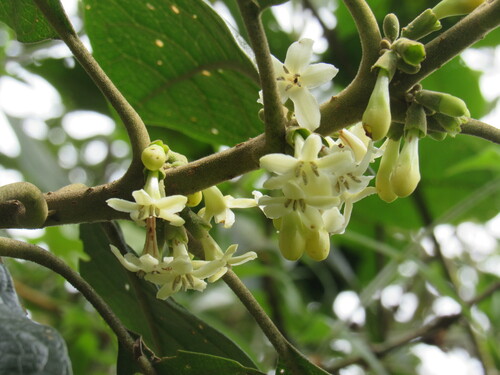
Pogostemon cablin
(Blanco) Benth.
Patchouli

Wikimedia Commons - No machine-readable author provided. Valérie75 assumed (based on copyright claims).

Wikimedia Commons - Krzysztof Ziarnek, Kenraiz
What to Eat
Edible parts: Leaves - flavouring, Leaves - oil
Patchouli leaves have been used to make a herbal tea. In some cultures, the leaves are eaten as a vegetable or used as a seasoning. There are also several herbal medicines, both in Indonesia and in China (TCM), that include dry, ground patchouli leaves as one of the key ingredients.
Where to Find It
A tropical plant. It needs to grow in the tropics or subtropics. In Fiji it grows from sea level to 400 m altitude. In Nepal it grows between 100-1,000 m above sea level. It cannot tolerate frost. It can grow in soils with a pH between 5.5-8.0. It suits hardiness zone 10.
American Samoa, Asia, China, Cuba, Fiji, India, Indonesia, Madagascar, Malaysia, Nepal, Pacific, Papua New Guinea, PNG, Paraguay, Philippines, Samoa, SE Asia, Singapore, Sri Lanka, Taiwan, Thailand, Tonga, West Indies,
How to Identify
A herb or small shrub. It keeps growing from year to year. It has a smell. The stems are erect and 30-100 cm tall. The leaf stalk is 1-6 cm long. The leaf blade is almost round and 2-10.5 cm long by 1-8.5 cm wide. There are irregular teeth along the edge. There are many flowers. They are purple.
How to Grow
Plants can be grown from seeds but often plants don't form seeds. It is best grown from stem cuttings. Stem cuttings 10-15 cm long with 3-4 nodes are best. These are best put in a nursery and rooting hormone used. It can be transplanted after 3-4 months. A spacing of 60 - 90 cm is suitable.
Propagation: Seed - plants rarely set seed. Greenwood cuttings with a heel. Division.
Medicinal Uses
Patchouli leaves contain an essential oil comprised mainly of the sesquiterpenes patchoulol (35%) and bulnesene. In the East, Patchouli oil is believed to prevent the spread of infection, and it is widely used for this purpose. Both the leaves, and the essential oil obtained from them, are used medicinally and are considered to be antiseptic, aphrodisiac, astringent, diuretic, febrifuge, digestive, sedative, stomachic and tonic. The herb is used internally in the treatment of colds, headaches, nausea, vomiting, abdominal pain and diarrhoea. An infusion is used to make a convalescent bath. Externally, it is used to treat halitosis, a range of skin problems, snake bite etc. The leaves and tops are added to baths, and are said to have an antirheumatic action. The essential oil is used in aromatherapy to treat nervous exhaustion, depression, low libido and frigidity. It is thought to have a regenerative effect upon skin tone and is used to help clear conditions such as eczema and acne. The leaves are harvested 2 - 3 times a year and are usually dried for oil distillation.
Other Uses
The leaves are used in potpourri. The dried leaves, which are very fragrant, are sometimes used for scenting wardrobes. It is said that they prevent the clothes from being attacked by moths. The essential oil from the leaves is an important ingredient in many perfumes. The pure oil has a strong musky odour, and is usually mixed with other essential oils in making perfumes. It is often used as a fixing agent in perfumes. It is also used in a range of other products including toiletries, cosmetics, breath fresheners, incense, insecticides, insect repellents and disinfectants. The scent is very effective in combatting the frequently very obtrusive odour of perspiration, completely suppressing it. The essential oil is present in small quantities in the fresh leaves, and only develops through a kind of fermentation of the cut leaves packed into bundles - yields from the dried leaves can be around 3.5 - 4%.
Other Information
It is cultivated.
Notes
Probably medicine. There are about 60-70 Pogostemon species. They grow in the tropics. The oil is used to scent soaps and perfumes.
Names & Synonyms
Daun delem, Guang huo xiang, Nilam wangi, Pachauli, Pachulf, Patchauli, Patiale, Patchouli, Pucha-put, Samoan sage
References (23)
- Ambasta, S.P. (Ed.), 2000, The Useful Plants of India. CSIR India. p 474
- Bremness, L., 1994, Herbs. Collins Eyewitness Handbooks. Harper Collins. p 204
- Burkill, I.H., 1966, A Dictionary of the Economic Products of the Malay Peninsula. Ministry of Agriculture and Cooperatives, Kuala Lumpur, Malaysia. Vol 2 (I-Z) p 1813
- Cobley, L.S. (rev. Steele, W.M.) 2nd Ed., 1976, An Introduction to the Botany of Tropical Crops. Longmans. p 329
- A. L. P. P. de Candolle, Prodr. 12:156. 1848
- Facciola, S., 1998, Cornucopia 2: a Source Book of Edible Plants. Kampong Publications, p 133
- Kermath, B. M., et al, 2014, Food Plants in the Americas: A survey of the domesticated, cultivated and wild plants used for Human food in North, Central and South America and the Caribbean. On line draft. p 674
- Lawton, B.P., 2002, Mints. A Family of Herbs and Ornamentals. Timber Press, Portland, Oregon. p 174
- Li Hai-wen, Hedge, I.C., Lamiaceae. Flora of China. 345
- Miguel, E., et al, 1989, A checklist of the cultivated plants of Cuba. Kulturpflanze 37. 1989, 211-357
- Morton,
- Parham, B. E. V., 1972, Plants of Samoa. New Zealand Department of Scientific and Industrial Research. Information Series. No. 85 p 98
- Rajendra, K.C., 2014. Prominent Non-Wood Forest Products of Te- rai and Siwalik Regions in Nepal. Food and Agriculture Organization, Kathmandu, Nepal. p 89
- Samy, J., Sugumaran, M., Lee, K. L. W., 2009, Herbs of Malaysia, Marshall Cavendish. p 196
- Smith, A.C., 1991, Flora Vitiensis Nova, Lawaii, Kuai, Hawaii, Volume 5 p 232
- Sukarya, D. G., (Ed.) 2013, 3,500 Plant Species of the Botanic Gardens of Indonesia. LIPI p 691
- Tanaka,
- Van Duong,
- Wiersema, J. H. & Leon, B., 2013, World Economic Plants. A Standard Reference CRC Press. 2nd Ed. p 546
- Williams, C.N., Chew, W.Y., and Rajaratnam, J.A., 1989, Tree and Field Crops of the Wetter Regions of the Tropics. Longman, p 230
- World Checklist of Useful Plant Species 2020. Royal Botanic Gardens, Kew
- World Checklist of Useful Plant Species 2020. Royal Botanic Gardens, Kew (As Pogostemon hortensis)
- Zeven, A. C. & de West, J. M. J., 1982, Dictionary of cultivated plants and their regions of diversity. Wageningen. p 56