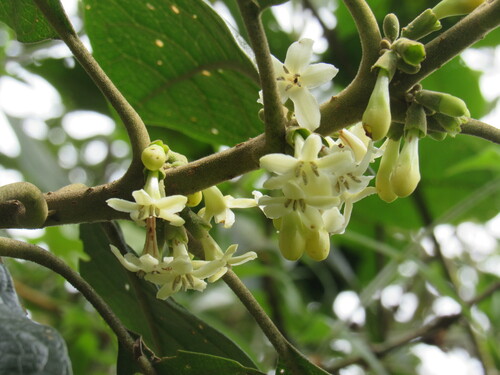
Pogostemon parviflorus
Benth.
Phangla, Pangli
LamiaceaeLeaves

gbif · cc-by-sa
GBIF
GBIF

gbif · cc-by
Royal Botanic Gardens, Kew
Royal Botanic Gardens, Kew

gbif · cc-by
Royal Botanic Gardens, Kew
Royal Botanic Gardens, Kew
What to Eat
Edible parts: Leaves
The leaves are eaten in times of scarcity, typically fried or boiled.
Where to Find It
A tropical plant. It grows on the Deccan in India. It grows in high rainfall locations.
Asia, Bangladesh, India, Myanmar, Northeastern India, SE Asia,
Countries: United Arab Emirates, Afghanistan, Armenia, Azerbaijan, Bangladesh, Bahrain, Brunei, Bhutan, China, Georgia, Indonesia, Israel, India, Iraq, Iran, Jordan, Japan, Kyrgyzstan, Cambodia, North Korea, South Korea, Kuwait, Kazakhstan, Laos, Lebanon, Sri Lanka, Myanmar, Mongolia, Maldives, Malaysia, Nepal, Oman, Philippines, Pakistan, Qatar, Saudi Arabia, Singapore, Syria, Thailand, Tajikistan, Timor-Leste, Turkmenistan, Turkey, Taiwan, Uzbekistan, Vietnam, Yemen
How to Identify
A woody herb in the mint family (Lamiaceae) that grows in tropical locations on the Deccan in India, particularly in high rainfall areas.
Other Information
Famine food
Notes
There are about 60 Pogostemon species.
Names & Synonyms
Hanbipo
Some references have this as a synonym of Pogostemon benghalensis
References (5)
- Ambasta, S.P. (Ed.), 2000, The Useful Plants of India. CSIR India. p 474
- Ethnobotany of Karbis. Chapter 4 in p 99
- Singh, H.B., Arora R.K.,1978, Wild edible Plants of India. Indian Council of Agricultural Research, New Delhi. p 39
- N. Wallich, Pl. asiat. rar. 1:31. 1830
- WATT,