Anemone flaccida
F. Schmidt.
Anemone greens

(c) sergeymakeev, some rights reserved (CC BY-NC)
(c) sergeymakeev, some rights reserved (CC BY-NC)

(c) arosawa, some rights reserved (CC BY-NC)
What to Eat
Edible parts: Leaves, Leaf stalk, Flowers
The leaves and stems are edible cooked. Some caution is advised — see notes on toxicity.
Known Hazards
Where to Find It
It is a temperate plant. It grows in grassland. In China it grows in forests and near streams and in shady grassy places between 400-3,000 m above sea level. It suits hardiness zones 6-9. In Sichuan and Yunnan.
Asia, Australia, China*, Japan, Russia,
How to Identify
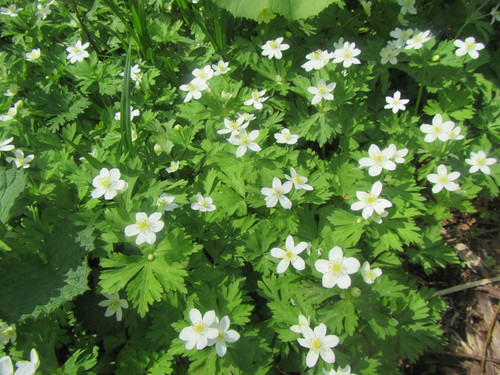
A clump forming herb. It has fleshy stems. It grows 10-20 cm high and spreads 20-40 cm wide. The leaves are light green and feather like. The flowers are cream and 25 mm wide. They can have pink tinges.
Nutrition Score: 62/100
| Part | Moisture | kJ | kcal | Protein | Vit A | Vit C | Iron | Zinc |
|---|---|---|---|---|---|---|---|---|
| Leaves - fresh | 90.5 | 152 | 36 | 2.6 | — | — | 1.4 | 0.3 |
| Leaves - dried | 5.7 | 1.551 | 371 | 26.3 | — | — | 19.5 | 2.5 |
How to Grow
Succeeds in ordinary garden soil but prefers a woodland soil. Prefers a moist peaty soil in some shade. Plants succeed in maritime gardens. Hardy to at least -20°c. Plants seem to be immune to the predations of rabbits. A greedy plant, inhibiting the growth of nearby plants, especially legumes. A good woodland plant.
Propagation: Seed is best sown in a cold frame as soon as it is ripe in summer. Surface sow or only just cover the seed and keep the soil moist. Sow stored seed as soon as possible in late winter or early spring. Seed usually germinates in 1–6 months at 15°C. Once large enough to handle, prick seedlings out into individual pots and grow on in light shade in the greenhouse for at least their first year before planting out in spring. Division can be done in late summer after the plant dies down.
Medicinal Uses
None known
Other Uses
None known
Wikipedia
Source ↗A low-growing perennial reaching 10 cm tall. Hermaphroditic flowers appear in May and are pollinated by bees and flies. The plant is self-fertile and tolerates full to semi-shade conditions. It grows in light, medium, or heavy soils across a range of pH levels, preferring consistently moist conditions. Hardy to UK zone 6.
Notes
There are about 200 Anemone species.
Names & Synonyms
Nirinsou, Pukusakina
References (10)
- Bircher, A. G. & Bircher, W. H., 2000, Encyclopedia of Fruit Trees and Edible Flowering Plants in Egypt and the Subtropics. AUC Press. p 28
- Chen, B. & Qiu, Z., Consumer's Attitudes towards Edible Wild Plants, Ishikawa Prefecture, Japan. p 22 www.hindawi.com/journals/ijfr/aip/872413.pdf
- Cundall, P., (ed.), 2004, Gardening Australia: flora: the gardener's bible. ABC Books. p 152
- Hibbert, M., 2002, The Aussie Plant Finder 2002, Florilegium. p 28
- Kiple, K.F. & Ornelas, K.C., (eds), 2000, The Cambridge World History of Food. CUP p 1718
- Kuhnlein, H. V., et al, 2009, Indigenous Peoples' food systems. FAO Rome p 148
- Mem. Acad. Imp. Sci. Saint-Petersbourg, Ser. 7, 2:103. 1868 (Reisen Amur. 103)
- Plants for a Future database, The Field, Penpol, Lostwithiel, Cornwall, PL22 0NG, UK. http://www.scs.leeds.ac.uk/pfaf/
- Ryan, S., 2008, Dicksonia. Rare Plants Manual. Hyland House. p 94
- Wilson, S., 1997, Some Plants are Poisonous. Reed. p 15


