Anemone stolonifera
Maxim.
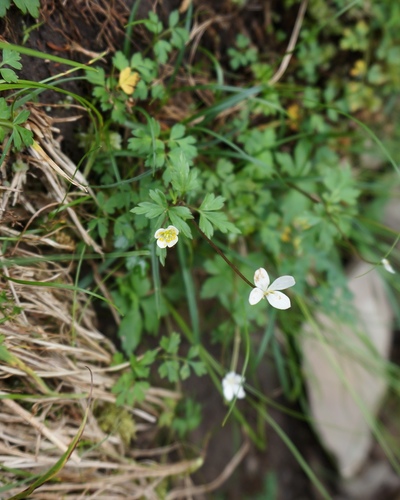
(c) 淑端, some rights reserved (CC BY-NC), uploaded by 淑端

(c) Chen Shu, some rights reserved (CC BY-NC)

(c) Chen Shu, some rights reserved (CC BY-NC)
What to Eat
Edible parts: Leaves
The leaves and stems of Anemone stolonifera are edible when cooked. Some caution is advised regarding toxicity.
Known Hazards
Where to Find It
It is a temperate plant. It grows in broad-leaved forest in mountainous regions in northern China between 1,200-2.600 m above sea level.
Asia, China, Japan, Korea, Taiwan,
How to Identify
A herb. It has rhizomes or underground stems. They are long and 1-2 mm across. There are 2-5 leaves. The leaf stalks are 8-20 cm long. The leaves are 5 sided or kidney shaped. They are 2-5 cm long by 4-8 cm wide.
How to Grow
We have very little information on this species and do not know if it will be hardy in Britain, though judging by its native range it should succeed outdoors in most parts of this country. The following notes are based on the general needs of the genus. Succeeds in ordinary garden soil but prefers a moist well-drained humus-rich soil. Plants seem to be immune to the predations of rabbits. A greedy plant, inhibiting the growth of nearby plants, especially legumes.
Propagation: Sow seed in a cold frame as soon as it ripens in summer, surface-sowing or barely covering it and keeping the soil moist. Stored seed should be sown as early as possible in late winter or early spring. Germination typically takes 1–6 months at 20°C. Once seedlings are large enough to handle, prick them out into individual pots and grow on in light shade in the greenhouse for at least their first year before planting out in spring. Division can be done in late summer after the plant dies down.
Medicinal Uses
None known.
Other Uses
None known.
Wikipedia
A low perennial reaching 20 cm in height. Hermaphroditic flowers appear in June and are insect-pollinated. Grows in sandy, loamy, or clay soils with preference for good drainage. Tolerates semi-shade to full sun and requires moist soil. Suitable across various pH ranges.
Notes
There are about 120 Anemone species.
Names & Synonyms
References (2)
- Plants for a Future database, The Field, Penpol, Lostwithiel, Cornwall, PL22 0NG, UK. http://www.scs.leeds.ac.uk/pfaf/
- Wilson, S., 1997, Some Plants are Poisonous. Reed. p 15


