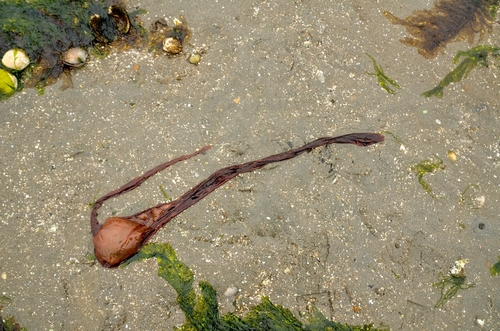
Porphyra suborbiculata
Kjellm.
Tzu-ts'ai

wikimedia · cc-by
Sous Chef (via Wikimedia Commons)
Sous Chef (via Wikimedia Commons)

wikimedia · cc-by-sa
Scudsvlad (via Wikimedia Commons)
Scudsvlad (via Wikimedia Commons)

wikimedia · cc0
김아름 (via Wikimedia Commons)
김아름 (via Wikimedia Commons)
What to Eat
Edible parts: Algae, Frond, Seaweed
When eaten as a banchan (side dish), dried sheets of gim are toasted with sesame oil or perilla oil, sprinkled with fine salt and cut into squares. It may also be deep-fried to make coated fritters called bugak. For use in gimbap, the sheets are not salted, but are instead only toasted.
Where to Find It
It is a temperate plant.
Asia, China, Indochina, Korea, SE Asia, Vietnam,
Countries: United Arab Emirates, Afghanistan, Armenia, Azerbaijan, Bangladesh, Bahrain, Brunei, Bhutan, China, Georgia, Indonesia, Israel, India, Iraq, Iran, Jordan, Japan, Kyrgyzstan, Cambodia, North Korea, South Korea, Kuwait, Kazakhstan, Laos, Lebanon, Sri Lanka, Myanmar, Mongolia, Maldives, Malaysia, Nepal, Oman, Philippines, Pakistan, Qatar, Saudi Arabia, Singapore, Syria, Thailand, Tajikistan, Timor-Leste, Turkmenistan, Turkey, Taiwan, Uzbekistan, Vietnam, Yemen
How to Identify
A temperate seaweed in the Bangiaceae family with edible fronds commonly used in Asian cuisine.
References (6)
- http://www.seavegetables.com
- Kiple, K.F. & Ornelas, K.C., (eds), 2000, The Cambridge World History of Food. CUP p 238
- Lee, B., 2008, Seaweed Potential as a marine vegetable. RIRDC Publication No. 08/009
- Simoons, F.J., 1991, Food in China. Boca Raton, Fla
- Xia, B., and Abbott, I.A., 1987, Edible seaweeds of China and their place in the Chinese diet. Economic Botany 41:341-53
- Zemke-White, W. L. & Ohno, M., 1999, World seaweed utilisation: An end-of-century summary. Journal of Applied Phycology 11: 369-376