Pothos longipes
Schott
Pothos, Candlestick vine
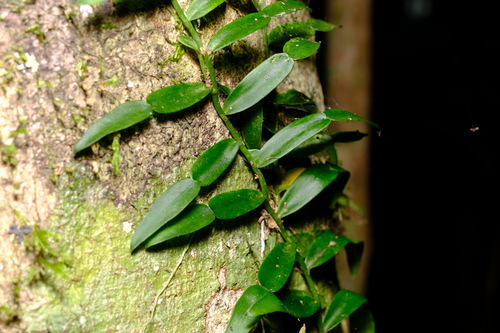
(c) Peter Crowcroft, some rights reserved (CC BY), uploaded by Peter Crowcroft
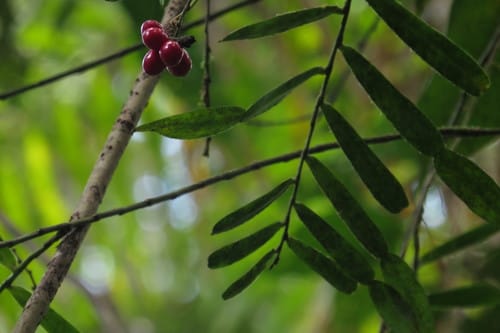
(c) coenobita, some rights reserved (CC BY)

(c) Amaury Durbano, some rights reserved (CC BY-NC), uploaded by Amaury Durbano
What to Eat
Edible parts: Fruit
The flesh around the seeds is eaten raw or roasted.
Where to Find It
A tropical plant. They grow naturally in the rainforest of NE Queensland and into New South Wales, in Australia. It grows from tropical to warm temperate regions. Adelaide Botanical Gardens. In tropical Queensland it grows from sea level to 1040 m altitude.
Australia*,
How to Identify
A climber or vine with roots developing from the stem. It covers rocks and tree trunks. The leaves are made up of a tip section and a thick leaf stalk. The leaves are feather like. The leaf is 2-7 cm long and the leaf stalk is 1-12 cm long. The flowers are pale and on a fleshy spike. The fruit are 13-20 mm long and occur in bunches at the ends of the plant. They are bright red. There are 1-3 seeds and these are 9-12 mm long. The flesh is edible.
How to Grow
Plants can be grown from seed or cuttings.
Wikipedia
Source ↗Pothos longipes is a climbing plant of the family Araceae native to the warmer rainforests of eastern Australia. It was first described in 1856 by the Austrian botanist Heinrich Wilhelm Schott. It ranges from Boorganna Nature Reserve in the Mid North Coast of New South Wales to tropical Queensland. It grows on the trunks of trees with a climbing or hemi-epiphytic habit. An attractive plant with interesting flowers and bright red fruit.
Notes
There are about 50-70 Pothos species.
Names & Synonyms
References (16)
- Aroideae 23, t. 47. 1856-1857
- Bodkin, F., 1991, Encyclopedia Botanica. Cornstalk publishing, p 827
- Cooper W & Cooper W T, 1994, Fruits of the Rain Forest. RD Press p 234
- Cooper, W. and Cooper, W., 2004, Fruits of the Australian Tropical Rainforest. Nokomis Editions, Victoria, Australia. p 61
- Cribb, A.B. & J.W., 1976, Wild Food in Australia, Fontana. p 68
- Edible and Useful Native Plants (off internet)
- Elliot, W.R., & Jones, D.L., 1997, Encyclopedia of Australian Plants suitable for cultivation. Vol 7. Lothian. p 448
- Jackes, B.R., 2001, Plants of the Tropics. Rainforest to Heath. An Identification Guide. James Cook University. p 41
- Jones D, L, 1986, Ornamental Rainforest Plants in Australia, Reed Books, p 297
- Jones, D.L. & Gray, B., 1977, Australian Climbing Plants. Reed. p 58, 60, 136
- Morley, B.D., & Toelken, H.R., (Eds), 1983, Flowering Plants in Australia. Rigby. p 399
- Nicholson, N & H., 1996, Australian Rainforest Plants 2, Terania Rainforest Publishing. NSW. p 51
- Pearson, S. & A., 1992, Rainforest Plants of Eastern Australia. Kangaroo Press p 170
- Ratcliffe D & P., 1987, Australian Native Plants for Indoors. Little Hills press. p 121, 120
- Ryan, M. (Ed.), 2003, Wild Plants of Greater Brisbane. Queensland Museum. p 232
- Townsend, K., 1994, Across the Top. Gardening with Australian Plants in the tropics. Society for Growing Australian Plants, Townsville Branch Inc. p 321


