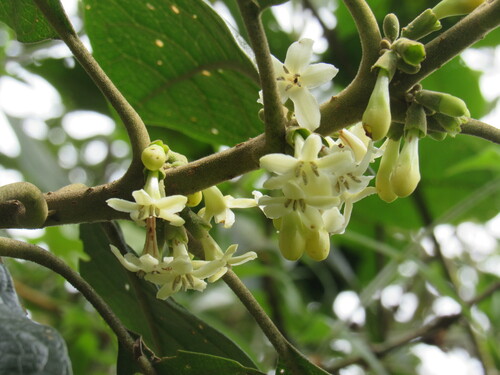
Premna integrifolia
L.

Wikimedia Commons - Tauʻolunga

Wikimedia Commons - Vengolis

Wikimedia Commons - Vengolis
What to Eat
Edible parts: Leaves
The leaves are cooked with fish as a flavoring.
Where to Find It
A tropical plant. Plants often grow near the beach.
Asia, India, Indochina, Indonesia, Malaysia, Mauritius, Myanmar, Pacific, Papua New Guinea, PNG, Polynesia, SE Asia, Thailand, Vietnam,
How to Identify
A small tree. It grows to 4-8 m tall. It does not have hairs. The twigs and leaves are light green and shiny. The leaves are produced opposite each other and are oval and taper to a point. They are entire and 9-19 cm long by 6-12 cm wide. The leaf stalk is 2-7 cm long. The flowers are white and in clusters with flowers at the end of each stalk. These arrangements are 10-20 cm across. The fruit are berries 6-9 mm across. They are blue to black.
Medicinal Uses
The leaves are used in traditional cuisine with fish.
Notes
Also put in the family Verbenaceae.
Names & Synonyms
Bebuas, Bebuat, Chah leud, Ki pahang, Ki seungit, Kywe-thwe, La cach, Singkil alas, Singkil, Taing-tangyi
References (10)
- Altschul, S.V.R., 1973, Drugs and Foods from Little-known Plants. Notes in Harvard University Herbaria. Harvard Univ. Press. Massachusetts. no. 3655
- Ambasta, S.P. (Ed.), 2000, The Useful Plants of India. CSIR India. p 489
- Burkill, I.H., 1966, A Dictionary of the Economic Products of the Malay Peninsula. Ministry of Agriculture and Cooperatives, Kuala Lumpur, Malaysia. Vol 2 (I-Z) p 1838
- Hedrick, U.P., 1919, (Ed.), Sturtevant's edible plants of the world. p 515
- Mant. pl. 2:252. 1771
- Martin, F.W. & Ruberte, R.M., 1979, Edible Leaves of the Tropics. Antillian College Press, Mayaguez, Puerto Rico. p 224
- McMakin, P.D., 2000, Flowering Plants of Thailand. A Field Guide. White Lotus. p 81
- Ogle, B. M., et al, 2003, Food, Feed or Medicine: The Multiple Functions of Edible Wild Plants in Vietnam. Economic Botany 57(1): 103-117
- Peekel, P.G., 1984, (Translation E.E.Henty), Flora of the Bismarck Archipelago for Naturalists, Division of Botany, Lae, PNG. p 479, 478
- WATT,