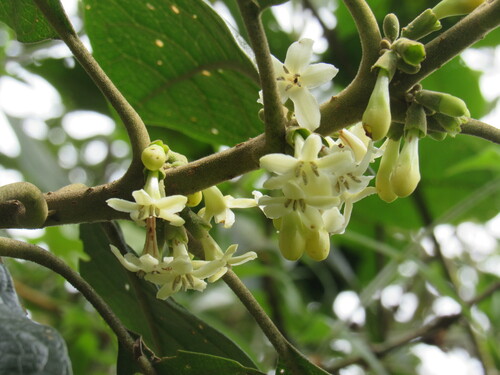
Premna odorata
Blanco
Fragrant premna

(c) ndionson, some rights reserved (CC BY-NC), uploaded by ndionson

(c) 梁士明, some rights reserved (CC BY-NC)
What to Eat
Edible parts: Leaves
The leaves are eaten.
Where to Find It
A tropical plant. It grows in forests near seashores.
Asia, Australia, Cambodia, India, Indonesia, Malaysia, Myanmar, Pacific, Papua New Guinea, PNG, Philippines, SE Asia, Taiwan, Thailand, Vietnam,
How to Identify
A small tree. It grows 12 m high. The leaves are simple and 5-20 cm long by 4-13 cm wide. There are velvety hairs especially underneath. The leaf stalks are 1-8 cm long. The flowers are in a group at the end of the branches. There are 4-5 petals. They are green, white, cream or pink. They are 3-6 mm long. The fruit is fleshy and is purple or black. They are 3-6 mm long and 3-5 mm wide. There are 1-4 seeds. They are green or brown. They are 5 mm long.
Nutrition Score: 37/100
| Part | Moisture | kJ | kcal | Protein | Vit A | Vit C | Iron | Zinc |
|---|---|---|---|---|---|---|---|---|
| Leaves | 80.4 | 268 | 64 | 3.5 | — | — | 3 | — |
How to Grow
Succeeds in full sun and in partial shade. Plants start flowering and fruiting when around 3 - 4 metres tall.
Medicinal Uses
The leaves are used as diuretic; a decoction with sugar and a little 'calamansi' (Citrofortunella microcarpa (Bunge) Wijnands) juice is taken to treat cough and loosen phlegm. An infusion is considered carminative and useful to treat beri-beri. A decoction of the fresh leaves is also prescribed for vaginal irritation. A decoction of leaves or flowers is considered to be a febrifuge and is also used against abdominal pains and dysentery. Masticating the roots is prescribed against cardiac troubles. According to Sunico-Suaco and Valenzuela the leaves do not contain any alkaloid, tannin, saponin, orcyanogenetic substance. The leaves, however, yielded 0.02 per cent of essential oil,which was yellowish-green and had the characteristics aroma of alagau leaves; and an oleoresin, which m. P. 112.5°C., whose constants were: acid number 103; saponification number 246.5 ester number 143.5, and acetyl value 416.2. the oleoresin contained 2.87 per cent methoxyl.
Wikipedia
Source ↗Premna odorata, the fragrant premna, is a species of flowering plant in the Lamiaceae family. It is native to the Indian subcontinent, Yunnan, Southeast Asia, New Guinea, and northern Australia, and naturalized in southern Florida. A small tree rarely reaching 10 m, it is used as a source for traditional medicine in the Philippines, and is planted occasionally as an ornamental there and elsewhere. The island of Siargao in the Philippines is named after P. odorata (known as siargaw or saliargaw in the local languages).
Notes
Also put in the family Verbenaceae.
Names & Synonyms
References (5)
- Cooper, W. and Cooper, W., 2004, Fruits of the Australian Tropical Rainforest. Nokomis Editions, Victoria, Australia. p 239
- De Kok, R., 2013, The genus Premna L. (Lamiaceae) in the Flora Malesiana area. KEW BULLETIN VOL. 68: 1 Y 30 (2013) p 12
- Fl. Filip. 488. 1837
- Food Composition Tables for use in East Asia FAO http://www.fao.org/infoods/directory No. 669
- Martin, F.W. & Ruberte, R.M., 1979, Edible Leaves of the Tropics. Antillian College Press, Mayaguez, Puerto Rico. p 224