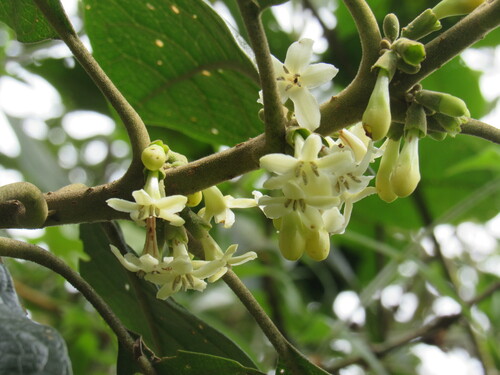
Premna serratifolia
(Blanco) L.
Creek Premna, Coastal premna
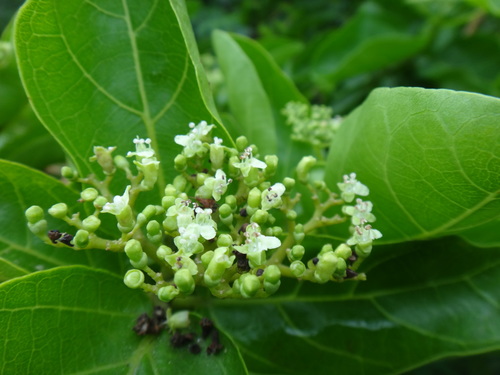
(c) 呂一起(Lu i-chi), some rights reserved (CC BY), uploaded by 呂一起(Lu i-chi)
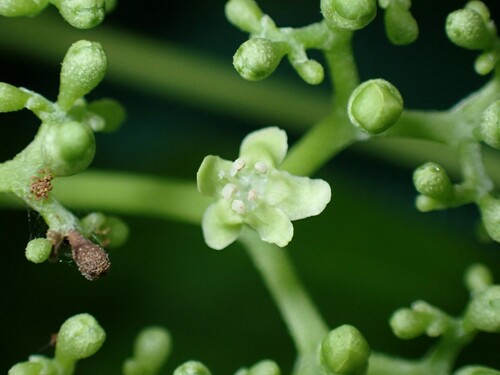
(c) Dominik Maximilián Ramík, some rights reserved (CC BY), uploaded by Dominik Maximilián Ramík

(c) Lauren Gutierrez, some rights reserved (CC BY-ND)
What to Eat
Edible parts: Fruit, Seeds, Leaves
In Vietnam, the aromatic leaves of P. serratifolia are used to cook in some braise or stir fry dishes with chicken, eels or frogs.
Where to Find It
A tropical plant. It occurs in coastal vine thickets and on dunes. It grows in sandy soil along sea coasts and mangrove forests. It grows from sea level to 500 m altitude in Samoa. In Fiji it is usually below 200 m altitude. It grows in sandy soils and limestone. Mt Cootha Botanical Gardens.
Africa, American Samoa, Andamans, Asia, Australia, Bougainville, British Indian Ocean Terr., BIOT, Brunei, Cambodia, Caroline Islands, China, Chuuk, East Africa, East Timor, Fiji, FSM, French Polynesia, Guam, India, Indochina, Indonesia, Japan, Kiribati, Madagascar, Malaysia, Maldives, Marquesas, Marshall Islands, Mauritius, Mayotte, Micronesia, Mozambique, Myanmar, Nauru, New Caledonia, Niue, Pacific, Palau, Papua New Guinea, PNG, Philippines, Pohnpei, Rotuma, Samoa, SE Asia, Seychelles, Singapore, Solomon Islands, Sri Lanka, Taiwan, Thailand, Timor-Leste, Tonga, Tuvalu, Vanuatu, Vietnam, Yap,
How to Identify
A spreading shrub. It grows 2-4 m tall. It can be 12 m tall. The leaves are opposite and large. They are oval and shiny green. They are leathery and have prominent veins. The midrib is raised underneath the leaf. The flowers are in clusters near the ends of branches. They are greenish white. Fruit are small and green. They turn black at maturity.
How to Grow
Plants can be grown from seeds.
Propagation: Seed - Low branches often self-layer.
Medicinal Uses
The plant is extensively used in Indian traditional medicine. Studies on the root wood of P. serratifolia led to the isolation of acteoside, a glucoside derivative. The root bark of the plant which showed biological activities have also shown to contain a potent cytotoxic and antioxidant diterpene, 11,12,16-trihydroxy-2-oxo-5-methyl-10-demethyl-abieta-1,6, 8,11,13-pentene.
Other Uses
The bark is used as a binding material. The leaves and roots are used to perfume coconut oil. A dye is obtained from the root. The root-bark of this plant affords a yellowish-brown powder giving an orange-brown tincture with alcohol. The wood is a light, creamy brown. It is pleasantly scented, beautifully veined, close-grained, very hard and durable, though it can also be knotty and often crooked. It is much used in traditional construction and also for tool and knife handles, implements and paddles. The hard wood of the roots is used for making paddles and tool handles. The wood is used for fuel and also for making fire by friction. The plant is very easy to propagate by layering and cuttings so is used locally as a simple way to make hedges.
Wikipedia
Source ↗Premna serratifolia is a species of small tree or shrub in the family Lamiaceae. It blooms and fruits between May and November. During flowering season, it attracts a large number of butterflies and bees.
Other Information
The ripe fruit are often eaten by children.
Notes
Used in medicine. Also put in the family Verbenaceae. The leaves possibly improve a mother's milk supply.
Names & Synonyms
Adau, Agetha, Agnimanda, Agnimanthah, Aguyabat, Alagua-dagat, Aldas, Aloalo, Aran, Arani, Bachanige, Bagr, Baloh, Bhut-bhiravi, Bhuto bairi, Buas laut, Buas-buas, Chamari, Dhakandhaa, Dieng-lah-marwai, Eegigida, False elder, Gaebbu nelli, Ganiari, Ganioli, Genderi, Ghebboon nellie, Ginaveli, Gineri, Headache tree, Idibinerr, Kaar, Kayu buas, Khara-narvel, Ki pahan, Laban putih, Lambuas, Mara, Mooney do, Mothi-arni, Muney kiray, Munna, Munnay, Padda narva, Pohon malbo, Pohon premna batas, Pohon premna pantai, Pomantii, Singkel, Singkil alas, Takkite, Te ango, Ustabunda, Varvara, Yamgurum
References (36)
- Ambasta, S.P. (Ed.), 2000, The Useful Plants of India. CSIR India. p 490 (As Premna obtusifolia)
- Bhargava, N., 1983, Ethnobotanical Studies of the Tribes of Andaman and Nicobar Islands, India. 1. Onge. Economic Botany 37(1): 110-119
- Brown, W.H., 1920, Wild Food Plants of the Philippines. Bureau of Forestry Bulletin No. 21 Manila. p 151 (As Premna nauseosa)
- Burkill, I.H., 1966, A Dictionary of the Economic Products of the Malay Peninsula. Ministry of Agriculture and Cooperatives, Kuala Lumpur, Malaysia. Vol 2 (I-Z) p 1837 (As Premna nauseosa)
- Clarke, W.C. & Thaman, R.R., 1993, Agroforestry in the Pacific Islands: Systems for sustainability. United Nations University Press. New York. p 256
- Cooper, W. and Cooper, W., 2004, Fruits of the Australian Tropical Rainforest. Nokomis Editions, Victoria, Australia. p 240
- Cowie, I, 2006, A Survey of Flora and vegetation of the proposed Jaco-Tutuala-Lore National Park. Timor-Lests (East Timor) www.territorystories.nt/gov.au p 55
- De Kok, R., 2013, The genus Premna L. (Lamiaceae) in the Flora Malesiana area. KEW BULLETIN VOL. 68: 1 Y 30 (2013) p 21
- Franklin, J., Keppel, G., & Whistler, W., 2008, The vegetation and flora of Lakeba, Nayau and Aiwa Islands, Central Lau Group, Fiji. Micronesica 40(1/2): 169–225, 2008
- Jackes, B.R., 2001, Plants of the Tropics. Rainforest to Heath. An Identification Guide. James Cook University. p 58
- Leach, G. J., 1988, Bush Food Plants of the Blackwater and Karawari Rivers Area, East Sepik Province, Papua New Guinea. Science in New Guinea 14(2). p 104
- Liefting, A., et al, Samoan plant names. http://en.wikipedia.org
- Mant. pl. 2:253. 1771
- Nurfadilah, S., et al, 2017, Species richness, conservation status, and potential uses of plants in Segara Anakan Area of Sempu Island, East Java, Indonesia. BIODIVERSITAS. Volume 18, Number 4
- Paczkowska, G . & Chapman, A.R., 2000, The Western Australian Flora. A Descriptive Calatogue. Western Australian Herbarium. p 567
- Prodr. 512. 1810 (As Premna obtusifolia)
- Reis, S. V. and Lipp, F. L., 1982, New Plant Sources for Drugs and Foods from the New York Botanical Garden herbarium. Harvard. p 253 (As Premna obtusifolia var. gaudichaudii)
- Samy, J., Sugumaran, M., Lee, K. L. W., 2009, Herbs of Malaysia, Marshall Cavendish. p 204
- Selvam, V., 2007, Trees and shrubs of the Maldives. RAP Publication No. 2007/12 p 138
- SHORTT,
- Singh, H.B., Arora R.K.,1978, Wild edible Plants of India. Indian Council of Agricultural Research, New Delhi. p 34 (As Premna obtusifolia)
- Slik, F., www.asianplant.net
- Smith, A.C., 1991, Flora Vitiensis Nova, Lawaii, Kuai, Hawaii, Volume 5 p 187
- Sujanapal, P., & Sankaran, K. V., 2016, Common Plants of Maldives. FAO & Kerala FRI, p 219
- Sukarya, D. G., (Ed.) 2013, 3,500 Plant Species of the Botanic Gardens of Indonesia. LIPI p 470
- Tanaka, Y. & Van Ke, N., 2007, Edible Wild Plants of Vietnam. Orchid Press. p 144
- Thaman, R. and W. Clarke, Paper on Agroforestry on Aneityum and Tanna, Vanuatu from Internet
- Thaman, R. R., 1987, Plants of Kiribati: A listing and analysis of vernacular names. Atoll Research Bulletin No. 296
- Thaman, R. R, 2016, The flora of Tuvalu. Atoll Research Bulletin No. 611. Smithsonian Institute p 118
- Thoa P. T. K., et al, 2013, Biodiversity indices and utilization of edible wild plants: a case study of the Cham Island in Quang Nam Province, Vietnam. Journal of Research in Environmental Science and Toxicology 2(9) :167-174
- Topp, J. M. W., 1988, An Annotated Check List of the Flora of Diego Garcia, British Ocean Territory. Atoll Research Bulletin No. 313
- Townsend, K., 1994, Across the Top. Gardening with Australian Plants in the tropics. Society for Growing Australian Plants, Townsville Branch Inc. p 322
- Townsend, K., 1999, Field Guide to Plants of the Dry Tropics. Society for Growing Australian Plants, Townsville Branch Inc. p 132
- Wheeler, J.R.(ed.), 1992, Flora of the Kimberley Region. CALM, Western Australian Herbarium, p 792
- Whistler, W.A., 2004, Rainforest Trees of Samoa. Isle Botanica Honolulu, Hawaii. p 180
- Williams, K.A.W., 1999, Native Plants of Queensland Volume 4. Keith A.W. Williams North Ipswich, Australia. p 326