Primula veris
L.
Cowslip, Primula

(c) gailhampshire, some rights reserved (CC BY)

(c) Sergey Mayorov, some rights reserved (CC BY-NC), uploaded by Sergey Mayorov

(c) hannula, some rights reserved (CC BY-NC)
What to Eat
Edible parts: Flowers, Leaves, Spice, Leaves - tea, Nectar
Young leaves can be eaten raw or cooked in soups; they are not particularly tasty but are available in late winter. Fresh or dried leaves can be used as a tea substitute. Flowers can be eaten raw, cooked, or used in conserves and as a garnish — they make an ornamental addition to a salad bowl. When this species was more abundant, flowers were harvested in quantity each spring and used to make a wine noted for its sedative and nervine properties. A related species, Primula elatior, is listed by the Council of Europe as a natural food flavouring.
Known Hazards
Where to Find It
It is a temperate plant. It suits hardiness zones 5-9.
Albania, Andorra, Armenia, Australia, Balkans, Bosnia, Britain, Canada, Caucasus, Central Asia, China, Czech Republic, Estonia, Europe, Germany, Hungary, Ireland, Italy, Latvia, Lithuania, Luxembourg, Macedonia, Mediterranean, North America, Norway, Romania, Scandinavia, Slovenia, Spain, Sweden, Switzerland, Tajikistan, Tasmania, Turkey, Türkiye, Ukraine, USA,
How to Identify
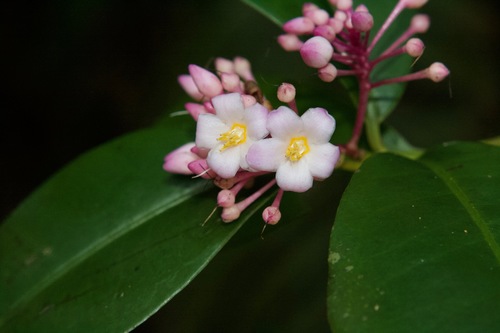
A herb. It grows 30 cm high and spreads 40 cm wide. It keeps growing from year to year. The leaves can be smooth or have coarse teeth. They are 5-20 cm long. The leaves grow from the base of the stem. The flower stems are downy. They have up to 16 yellow flowers. The flowers are sweet smelling. The sepals are pale green.
How to Grow
Prefers a medium to heavy moisture retentive humus rich loam in a cool position with light to medium shade. Grows well in heavy clay soils and on chalk. Prefers full sun and a well-drained alkaline soil if it is to survive well. Plants are hardy to about -20°c. A very ornamental plant, it grows well in the spring meadow. The flowers diffuse a sweet fragrance quite unlike all other flower scents. It has been likened by some to the breath of a cow (cuslippe is the Saxon word for this and thus the origin of the common name), by others to the sweet milky breath of a tiny child.
Propagation: Seed is best sown as soon as ripe in a cold frame. Stored seed can be sown in early spring in a cold frame — germination is inhibited by temperatures above 20°C. When large enough to handle, prick seedlings into individual pots and plant out in summer. Divide in autumn, ideally every other year.
Medicinal Uses
Cowslips are an underused but valuable medicinal herb with a long history of use, particularly for conditions involving spasms, cramps, paralysis and rheumatic pains. The plant contains saponins with an expectorant effect, and salicylates — the main ingredient of aspirin — which have anodyne, anti-inflammatory and febrifuge effects. This remedy should not be prescribed for pregnant women, patients sensitive to aspirin, or those taking anti-coagulant drugs such as warfarin. The flowers and leaves are anodyne, diaphoretic, diuretic and expectorant; they are harvested in spring and can be used fresh or dried. The yellow corolla of the flower is antispasmodic and sedative, recommended for treating over-activity and sleeplessness especially in children, and potentially valuable for asthma and other allergic conditions. An oil once produced by maceration of the flowers has an antiecchymotic effect, treating bruising. The root contains 5–10% triterpenoid saponins that are strongly expectorant, stimulating a more liquid mucus and easing clearance of phlegm; dried and powdered, it has also been used as a sternutatory. The root is additionally mildly diuretic, antirheumatic and slows blood clotting, and is used for chronic coughs (especially those associated with chronic bronchitis and catarrhal congestion), flu and other febrile conditions. It can be harvested in spring or autumn and dried for later use. The leaves share similar medicinal properties to the roots but are weaker in action. A homeopathic remedy made from the plant is used for kidney complaints and catarrh. The German Commission E Monographs approve Primula veris for cough and bronchitis.
Other Uses
None known.
Wikipedia
Source ↗Primula veris, the cowslip, common cowslip, or cowslip primrose (syn. Primula officinalis Hill), is a herbaceous perennial flowering plant in the primrose family Primulaceae. The species is native throughout most of temperate Europe and western Asia, and although absent from more northerly areas including much of northwest Scotland, it reappears in northernmost Sutherland and Orkney and in Scandinavia. This species frequently hybridizes with other Primulas such as the common primrose Primula vulgaris to form false oxlip (Primula × polyantha) which is often confused with true oxlip (Primula elatior), a much rarer plant.
Other Information
It is cultivated.
Notes
There are about 400 Primula species.
Names & Synonyms
Agulice, Chocolateras, Coucu, Jaglac, Kaekaatsed, Kukukvirag, Lule agulice, Maranda, Marianokleblom, Nurmenukk, Paigles, Pampara, Pomladanski jeglič, St. Peter's flower, Vichak, Zgirifet
References (32)
- Abbet, C., et al, 2014, Ethnobotanical survey on wild alpine food plants in Lower and Central Valais (Switzerland). Journal of Ethnopharmacology 151 (2014) 624–634
- Bodkin, F., 1991, Encyclopedia Botanica. Cornstalk publishing, p 832
- Bremness, L., 1994, Herbs. Collins Eyewitness Handbooks. Harper Collins. p 207
- Cerne, M., 1992, Wild Plants from Slovenia used as Vegetables. Acta Horticulturae 318
- Cundall, P., (ed.), 2004, Gardening Australia: flora: the gardener's bible. ABC Books. p 1083
- Denes, A., et al, 2012, Wild plants used for food by Hungarian ethnic groups living in the Carpathian Basin. Acta Societatis Botanicorum Poloniae 81 (4): 381-396
- Dogan, Y., et al, 2015, Of the importance of a leaf: the ethnobotany of sarma in Turkey and the Balkans. Journal of Ethnobiology and Ethnomedicine, 11:56
- Esperanca, M. J., 1988. Surviving in the wild. A glance at the wild plants and their uses. Vol. 1. p 291
- Facciola, S., 1998, Cornucopia 2: a Source Book of Edible Plants. Kampong Publications, p 188
- Girard, N. J., 2020, Sustainable Foraging of Wild Edible Plants in Norway. A Biocultural Approach. M. Sc. thesis Norwegian University. p 134
- Hibbert, M., 2002, The Aussie Plant Finder 2002, Florilegium. p 239
- http://www.botanic-gardens-ljubljana.com/en/plants
- Irving, M., 2009, The Forager Handbook, A Guide to the Edible Plants of Britain. Ebury Press p 256
- Jack, M., Wild Foods and Medicines of Forest Garden Transylvania. http://www.forestgardentransylvania.org/ p14
- Kalle, R. & Soukand, R., 2012, Historical ethnobotanical review of wild edible plants of Estonia (1770s-1960s) Acta Societatis Botanicorum Poloniae 81(4):271-281
- Kermath, B. M., et al, 2014, Food Plants in the Americas: A survey of the domesticated, cultivated and wild plants used for Human food in North, Central and South America and the Caribbean. On line draft. p 701
- Kiple, K.F. & Ornelas, K.C., (eds), 2000, The Cambridge World History of Food. CUP p 432, 1764
- Mabey, R., 1973, Food for Free. A Guide to the edible wild plants of Britain, Collins. p 156
- Marinelli, J. (Ed), 2004, Plant. DK. p 302
- Mattalia, G., et al, 2012, Traditional uses of wild food and medicinal plants among Brigasc, Kye ́, and Provenc ̧al communities on the Western Italian Alps. Genet Resour Crop Evol. Springer
- Pieroni, A. & Soukand, R., 2017, The disappearing wild food and medicinal plant knowledge in a few mountain villages of North-Eastern Albania. Journal of Applied Botany and Food Quality 90, 58 - 67
- Pieroni, A., et al, 2020, Wild food plants traditionally gathered in central Armenia: archaic ingredients or future sustainable foods? Environment, Development and Sustainability. Springer p 10
- Plants for a Future database, The Field, Penpol, Lostwithiel, Cornwall, PL22 0NG, UK. http://www.scs.leeds.ac.uk/pfaf/
- Pruse, B., et al, 2021, Active Wild Food Practices among Culturally Diverse Groups in the 21st Century across Latgale, Latvia. Biology 2021, 10, 551.
- Redzic, S. J., 2006, Wild Edible Plants and their Traditional Use in the Human Nutrition in Bosnia-Herzegovina. Ecology of Food and Nutrition, 45:189-232
- Simkova, K. et al, 2014, Ethnobotanical review of wild edible plants used in the Czech Republic. Journal of Applied Botany and Food Quality 88, 49-67
- Sp. pl. 1:142. 1753
- Svanberg, I., 2012, The use of wild plants as food in pre-industrial Sweden. Acta Societatis Botanicorum Poloniae 81(4): 317-327
- Tardio, J., et al, Ethnobotanical review of wild edible plants in Spain. Botanical J. Linnean Soc. 152 (2006), 27-71
- Uphof,
- USDA, ARS, National Genetic Resources Program. Germplasm Resources Information Network - (GRIN). [Online Database] National Germplasm Resources Laboratory, Beltsville, Maryland. Available: www.ars-grin.gov/cgi-bin/npgs/html/econ.pl (10 April 2000)
- Wiersema, J. H. & Leon, B., 2013, World Economic Plants. A Standard Reference CRC Press. 2nd Ed. p 557