Protea angolensis
Welw.
Sugarbush, Angola protea, Northern Protea

(c) GLENN STOCKIL, some rights reserved (CC BY-NC), uploaded by GLENN STOCKIL
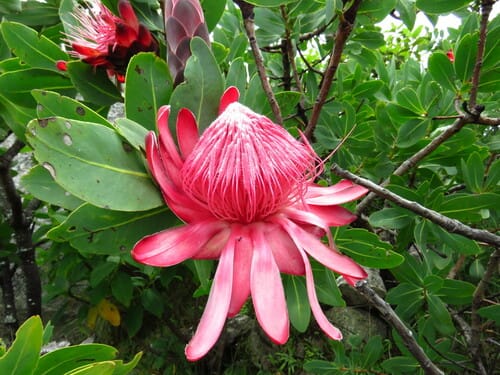
(c) Penny English, some rights reserved (CC BY-NC)
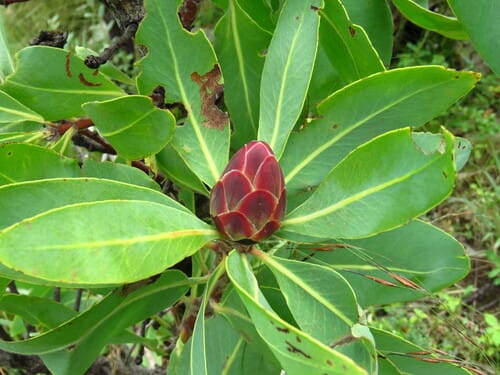
(c) Penny English, some rights reserved (CC BY-NC)
What to Eat
Edible parts: Sap, Tips, Nectar
Young tips are chewed, especially by children. Nectar-rich flowers are simmered in water to produce a syrup.
Where to Find It
A tropical plant. It grows in open wooded grassland.
Africa, Angola, Central Africa, East Africa, Mozambique, South Africa, Southern Africa, Zambia, Zimbabwe,
How to Identify
A small straggling tree. It grows up to 3 m high. The bark is black and fissured. The leaves are long and oblong. They are 10-16 cm long by 2-8 cm wide. They are light green and taper to both ends. The flower heads are up to 10 cm across. The bracts are pale green and the flowers generally white. Both can be tinged with pink. The fruit is a nut which is hairy.
Wikipedia
Source ↗Protea angolensis is also known as the Angolan protea, northern protea or northern sugarbush. In Afrikaans it is known as the noordelijke suikerbos. This is a dwarf, multistemmed shrub or small straggling tree occurring in open wooded grassland and miombo.
Notes
There are 100-130 Protea species. Variety divaricata in Zimbabwe.
Names & Synonyms
Estimende, Murrualo
References (5)
- Facciola, S., 1998, Cornucopia 2: a Source Book of Edible Plants. Kampong Publications, p 189
- Fowler, D. G., 2007, Zambian Plants: Their Vernacular Names and Uses. Kew. p 53
- Palgrave, K.C., 1996, Trees of Southern Africa. Struik Publishers. p 130
- Tredgold, M.H., 1986, Food Plants of Zimbabwe. Mambo Press. p 116
- World Checklist of Useful Plant Species 2020. Royal Botanic Gardens, Kew
More from Proteaceae


