Protea repens
(L.) L.
Sugarbush, Honey flower
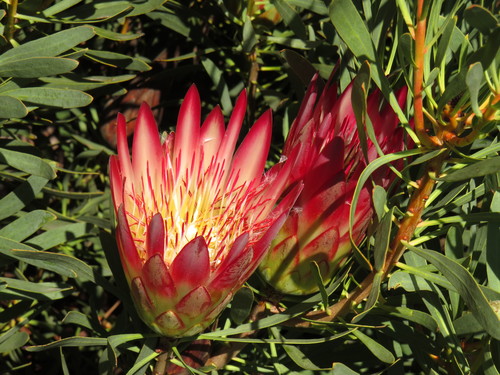
(c) Jeremy Gilmore, some rights reserved (CC BY)
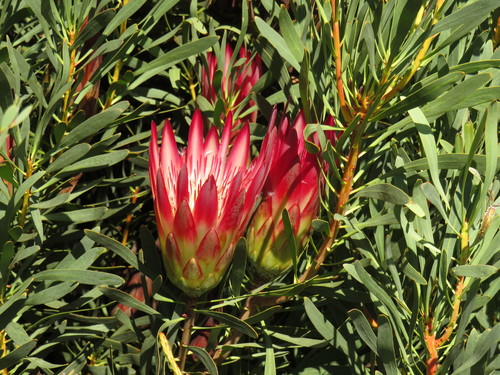
(c) Jeremy Gilmore, some rights reserved (CC BY)
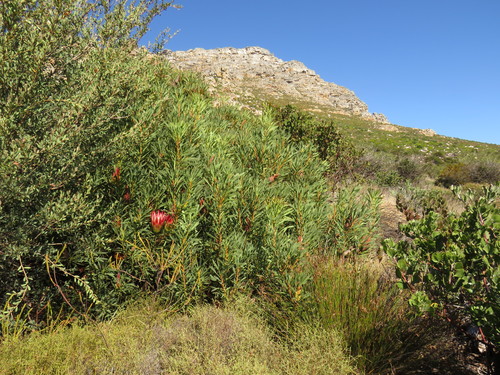
(c) Jeremy Gilmore, some rights reserved (CC BY)
What to Eat
Edible parts: Sap, Flower - nectar
The nectar from the flowers can be consumed directly or made into a delicious syrup.
Where to Find It
It is a warm temperate plant. It grows from sea level to 2000 m altitude in South Africa. It suits hardiness zones 8-10. Hobart Botanical Gardens. Wittunga Botanical Gardens.
Africa, Australia, South Africa*, Southern Africa, Tasmania,
How to Identify
A shrub. It grows up to 2.5 m tall. The leaves are clustered near the ends of branches. They are narrow and oval. They are 13 cm long by 0.8-1.3 cm wide. It tapers to the ends. The flower heads are slender and 10-13 cm long by 7.5 cm across. The colour can be white to pink or red.
How to Grow
Propagation: Sow seed as soon as it is ripe in autumn, placing it in individual pots in a greenhouse. Pay attention to soil requirements. Once seedlings are large enough to handle, prick them out into individual pots and grow on in the greenhouse for at least their first winter. Plant out into permanent positions in late spring or early summer after the last expected frosts, and consider providing cold protection for at least their first winter outdoors. Cuttings of half-ripe wood can be taken in July/August in a frame.
Medicinal Uses
None known
Other Uses
None known
Wikipedia
Source ↗Protea repens, known as the common sugarbush and in Afrikaans as the suikerbossie, is an erect shrub growing in the southern Cape Provinces of South Africa. This species is relatively adaptable and variable and can be found growing widely in various soils. Due to its showy flowers and adaptability, it is a popular subject for use in wildlife gardens in South Africa.
Names & Synonyms
Suikerbos
References (16)
- Bodkin, F., 1991, Encyclopedia Botanica. Cornstalk publishing, p 839
- Brickell, C. (Ed.), 1999, The Royal Horticultural Society A-Z Encyclopedia of Garden Plants. Convent Garden Books. p 835
- Cundall, P., (ed.), 2004, Gardening Australia: flora: the gardener's bible. ABC Books. p 1089
- De Vynk, J. C., et al, 2016, Indigenous edible plant use by contemporary Khoe-San descendants of South Africa's Cape South Coast. South African Journal of Botany. 102 (2016) 60-69
- Facciola, S., 1998, Cornucopia 2: a Source Book of Edible Plants. Kampong Publications, p 189
- Fox, F. W. & Young, M. E. N., 1982, Food from the Veld. Delta Books. p 311
- Hedrick, U.P., 1919, (Ed.), Sturtevant's edible plants of the world. p 519
- Hibbert, M., 2002, The Aussie Plant Finder 2002, Florilegium. p 240
- Lord, E.E., & Willis, J.H., 1999, Shrubs and Trees for Australian gardens. Lothian. p 254
- Mant. pl. 2:189. 1771
- Palgrave, K.C., 1996, Trees of Southern Africa. Struik Publishers. p 140
- Peters, C. R., O'Brien, E. M., and Drummond, R.B., 1992, Edible Wild plants of Sub-saharan Africa. Kew. p 164
- Ruiters-Welcome, A. K., 2019, Food plants of southern Africa. Ph.D. thesis. Univ. of Johannesburg p 93
- Tredgold, M.H., 1986, Food Plants of Zimbabwe. Mambo Press. p 116
- van Wyk, Be., & Gericke, N., 2007, People's plants. A Guide to Useful Plants of Southern Africa. Briza. p 110
- Welcome, A. K. & Van Wyk, B.-E., 2019, An inventory and analysis of the food plants of southern Africa. South African Journal of Botany 122 (2019) 136–179
More from Proteaceae


