Prunella grandiflora
(L.) Scholler.
Bigflower Selfheal, Large Self-heal, Prunella Loveliness
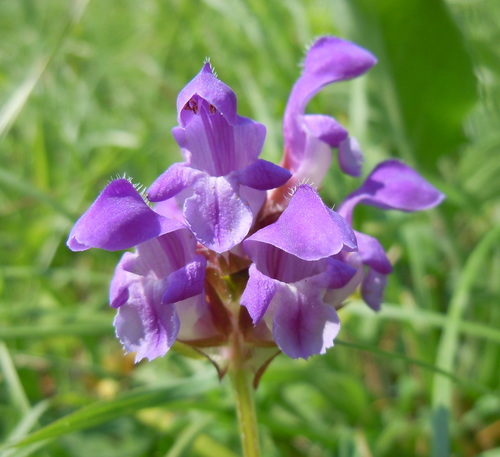
(c) cpu, some rights reserved (CC BY-NC), uploaded by cpu
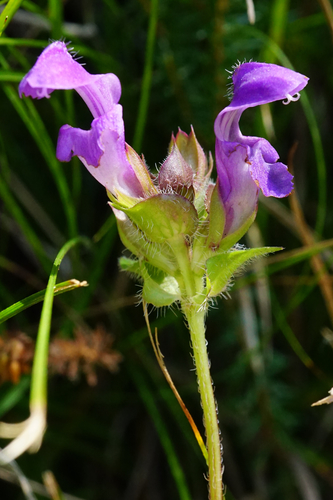
(c) Patrick Hacker, some rights reserved (CC BY), uploaded by Patrick Hacker

(c) Julien Piolain, some rights reserved (CC BY-NC), uploaded by Julien Piolain
What to Eat
Edible parts: Leaves, Flower nectar
The leaves can be eaten raw or cooked and have a mild flavour.
Where to Find It
It is a temperate plant. It grows well near the edge of water. It suits hardiness zones 4-9.
Asia, Australia, China, Europe, France, Greece, Italy, Luxembourg, Mediterranean, Portugal, Slovenia, Spain, Turkey, Türkiye,
How to Identify
A slightly hairy herb. It grows 30-60 cm high. It spreads 30-60 cm wide. It forms mats. The branches are woody. The leaves are oval and 10 cm across. They can be scalloped along the edge. The flowers are white with violet tips. They are 2.5 cm long and grow in spikes.
How to Grow
Plants can be grown from seed or by division.
Propagation: Sow seed in mid spring in a cold frame. Once seedlings are large enough to handle, prick them out into individual pots and plant out during summer. With sufficient seed, sowing can be done outdoors in situ from mid to late spring. Division in spring or autumn is very easy; larger divisions can go straight into permanent positions. Smaller divisions are better potted up and grown on in light shade in a cold frame until well established, then planted out in late spring or early summer.
Medicinal Uses
None known
Other Uses
Can be used as ground cover in a sunny position or light shade, requiring weeding for the first year or so. Plants are best spaced about 45cm apart each way. In Cornwall, plants have not proven reliably persistent as ground cover, often dying after flowering, though they usually self-sow.
Wikipedia
Source ↗Prunella grandiflora, the large-flowered selfheal, is a species of flowering plant in the family Lamiaceae. It is native to Europe and neighboring parts of West Asia.
Notes
There are about 7 Prunella species.
Names & Synonyms
Herba melera, Velecvetna črnoglavka
References (11)
- Blamey, M and Grey-Wilson, C., 2005, Wild flowers of the Mediterranean. A & C Black London. p 394
- Bonet, M. A. & Valles, J., 2002, Use of non-crop food vascular plants in Montseny biosphere reserve (Catalonia, Iberian Peninsula). International Journal of Food Sciences and Nutrition (2002) 53, 225–248 (As subsp. pyrenaica)
- Cundall, P., (ed.), 2004, Gardening Australia: flora: the gardener's bible. ABC Books. p 1091
- Flora of China.
- Hibbert, M., 2002, The Aussie Plant Finder 2002, Florilegium. p 240
- http://www.botanic-gardens-ljubljana.com/en/plants
- Lawton, B.P., 2002, Mints. A Family of Herbs and Ornamentals. Timber Press, Portland, Oregon. p 177
- Plants for a Future database, The Field, Penpol, Lostwithiel, Cornwall, PL22 0NG, UK. http://www.scs.leeds.ac.uk/pfaf/
- Rigat, M et al, 2009, Ethnobotany of Food Plants in the High River Ter Valley (Pyrenees, catalonia, Iberian Peninsula): Non-Crop Food Vascular Plants and Crop Food Plants with medicinal Properties. Ecology of Food and Nutrition, 48:303-327
- Slocum, P.D. & Robinson, P., 1999, Water Gardening. Water Lilies and Lotuses. Timber Press. p 132
- Tardio, J., et al, Ethnobotanical review of wild edible plants in Spain. Botanical J. Linnean Soc. 152 (2006), 27-71