Pterostylis mutica
R.Br.
Midget greenhood, Blunt Greenhood

(c) izakschoon, some rights reserved (CC BY-NC), uploaded by izakschoon

(c) Rolf Lawrenz, some rights reserved (CC BY), uploaded by Rolf Lawrenz

(c) Lukas Clews, some rights reserved (CC BY), uploaded by Lukas Clews
What to Eat
Edible parts: Tuber, Root
The tubers and roots are eaten.
Where to Find It
It grows in warm temperate places. It grows on clay and clay loam soils.
Australia*, New Zealand, Tasmania,
How to Identify
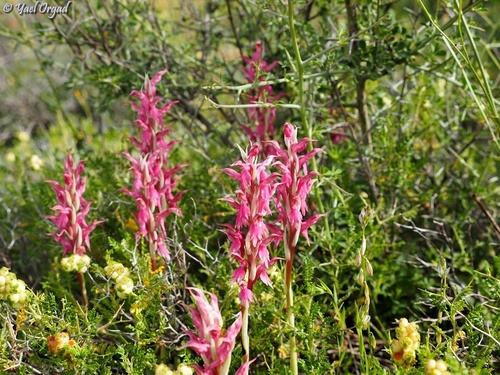
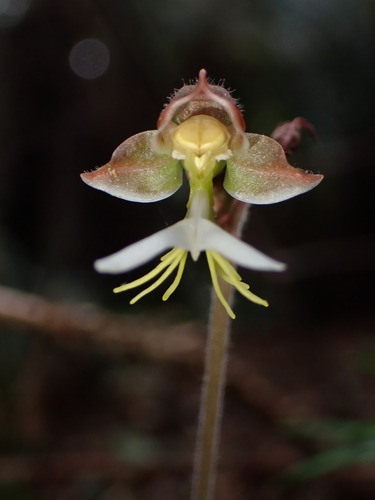
An orchid. It is a small herb. It keeps growing from year to year. It forms tubers. It grows 10-20 cm high. It has one stem. The leaves are in a ring at the base. There are 5-14 leaves. The flowers are green. There are 2-20 small flowers crowded in a spike arranged like a spiral. Each flower is about 1 cm long. The flowers have a hood.
Wikipedia
Source ↗Pterostylis mutica, commonly known as the midget greenhood, is a plant in the orchid family Orchidaceae and is endemic to Australia, occurring in all states but not the Northern Territory. There is a rosette of leaves at the base of the flowering stem and up to fifteen pale green flowers which have a sensitive labellum.
Notes
There are about 150 Pterostylis species. They are mostly in the Australia and Pacific area.
References (7)
- Bodkin, F., 1991, Encyclopedia Botanica. Cornstalk publishing, p 849
- Cherikoff V. & Isaacs, J., The Bush Food Handbook. How to gather, grow, process and cook Australian Wild Foods. Ti Tree Press, Australia p 196
- Hunter, J. T. & Sheringham, P., 2006, Vegetation and Floristics of Melville Range Nature Reserve. A Report to the New South Wales Parks and Wildlife Service. p 178
- Lim, T. K., 2015, Edible Medicinal and Non Medicinal Plants. Volume 9, Modified Stems, Roots, Bulbs. Springer p 70
- Mallee Wildflower Committee, Flowers of the Mallee. p 11
- Paczkowska, G. & Chapman, A.R., 2000, The Western Australian Flora. A Descriptive Catalogue. Western Australian Herbarium. p 89
- Tasmanian Herbarium Vascular Plants list p 76