Pygmaeothamnus zeyheri
(Sond.) Robyns
Sand apple, Dwarf medlar
(c) Joseph Heymans, some rights reserved (CC BY-NC-ND), uploaded by Joseph Heymans

(c) Philip Desmet, some rights reserved (CC BY-NC), uploaded by Philip Desmet

(c) Andrew Hankey, some rights reserved (CC BY-SA), uploaded by Andrew Hankey
What to Eat
Edible parts: Fruit
The ripe fruit is eaten raw or dried and stored for up to 4 weeks before eating. The fruit can also be pounded and left to stand in water to make juice.
Where to Find It
A tropical plant. It grows in hot arid places. It grows in sandy and stony soil. It grows between 90-2,000 m above sea level. It can grow in arid places.
Africa, Angola, Botswana, Burundi, Central Africa, Congo, East Africa, Namibia, South Africa, Southern Africa, Tanzania, Zambia, Zimbabwe,
How to Identify
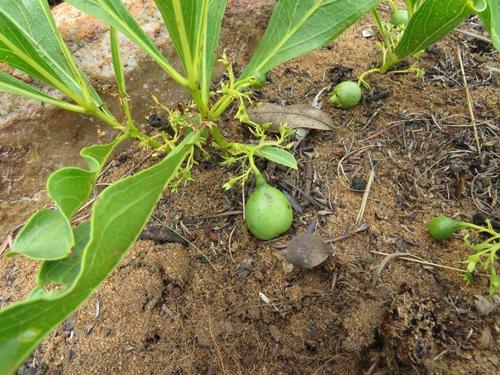
A small shrub. It grows 20 cm high. It forms colonies from branched underground stems. The branches are erect. The leaves are dark green above and paler underneath. They are leathery and in rings of 3 or opposite in twos. The leaves are 4-16 cm long by 2-6 cm wide. The leaves do not have hairs. The flowers are in groups in the axils of leaves. The flowers are green. The fruit are green and 2 cm across. They turn yellow when ripe.
How to Grow
Plants can be grown by seeds or suckers.
Propagation: Seed - Suckers.
Other Uses
The plant is sometimes grown as an ornamental and, going by its natural habit, has the potential to be a useful ground cover.
Production
They are collected during the rainy season.
Other Information
The fruit are especially eaten by children.
Names & Synonyms
Boboo, Booboo, Kave, Kindokoli, Kitokoli, Maboya, Mandungu, Mbumba, Mothlabelo, Mpenzwa, Namadhata, Umkukuzela
References (11)
- Fox, F. W. & Young, M. E. N., 1982, Food from the Veld. Delta Books. p 325
- Jardin, C., 1970, List of Foods Used In Africa, FAO Nutrition Information Document Series No 2.p 157
- Leger, S., 1997, A Description of Today's Use of Plants in West Bushmanland (Namibia). German Development Service. PO Box 220035, 14061 Berlin, Germany. http://www.sigridleger.de/book/
- Maguire, 1978,
- Peters, C. R., O'Brien, E. M., and Drummond, R.B., 1992, Edible Wild plants of Sub-saharan Africa. Kew. p 174
- Royal Botanic Gardens, Kew (1999). Survey of Economic Plants for Arid and Semi-Arid Lands (SEPASAL) database. Published on the Internet; http://www.rbgkew.org.uk/ceb/sepasal/internet [Accessed 10th June 2011]
- Ruffo, C. K., Birnie, A. & Tengnas, B., 2002, Edible Wild Plants of Tanzania. RELMA p 554
- Tredgold, M.H., 1986, Food Plants of Zimbabwe. Mambo Press. p 77
- Welcome, A. K. & Van Wyk, B.-E., 2019, An inventory and analysis of the food plants of southern Africa. South African Journal of Botany 122 (2019) 136–179
- Wild, 1975,
- World Checklist of Useful Plant Species 2020. Royal Botanic Gardens, Kew


