Combretum indicum
(L.) DeFilipps
Rangoon creeper, Chinese honeysuckle
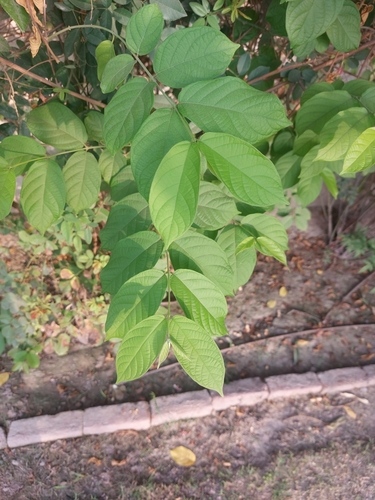
(c) arham_farooq, some rights reserved (CC BY-NC)
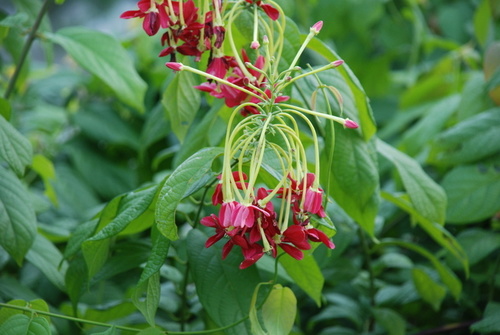
(c) Tan Kok Hui, some rights reserved (CC BY-NC), uploaded by Tan Kok Hui

(c) 106611639464075912591, some rights reserved (CC BY-NC-SA), uploaded by 106611639464075912591
What to Eat
Edible parts: Fruit, Seeds, Leaves, Stems
The tender shoots can be eaten raw and cooked. The ripe seeds are eaten, typically in small numbers, with the ovary wall and seed coat removed.
Known Hazards
Where to Find It
It is a tropical plant. It does best in light well-drained soils. It prefers an open sunny position. It is damaged by drought and frost. It needs a temperature above 13°C. It is common amongst shrubs in hot dry valleys throughout the Philippines. It is often cultivated as an ornamental woody vine. It can grow in arid places. In XTBG Yunnan. It suits hardiness zones 10-12.
Africa, Andamans, Angola, Asia, Australia, Bangladesh Benin, Burkina Faso, Cambodia, Cameroon, Central Africa, Central America, China, Comoros, Congo DR, Congo R, Cuba, Dominica, Dominican Republic, East Africa, Gabon, Ghana, Haiti, Hawaii, Himalayas, India, Indochina, Indonesia, Ivory Coast, Jamaica, Laos, Madagascar, Malawi, Malaysia, Mali, Mauritius, Myanmar, Nepal, New Caledonia, Nicaragua, Nigeria, North America, Northeastern India, Pacific, Pakistan, Panama, Papua New Guinea, PNG, Philippines, Puerto Rico, Reunion, Sao Tome and Principe, SE Asia, Sierra Leone, Sri Lanka, Taiwan, Tanzania, Thailand, Togo, Tonga, Trinidad-Tobago, USA, Venezuela, Vietnam, West Africa, West Indies,
How to Identify
A scrambling shrub or vine. The stem is strong and woody. It branches freely. It can climb to 20 m high. The plant is erect and shrub like when young. The twigs have soft brown hairs when young. The leaves are opposite and oblong. They have heart shaped bases. They are 8-18 cm long and 4-6 cm wide. They have long sharp tips and prominent veins. The flowers are at the ends of branches or in the axils of leaves, sometimes in large clusters. There are broad bracts near the flowers. The flowers have a smell and vary between white, pink and purple. The colour changes and darkens over 3 days. The fruit is narrow and long. It is dry and light and has 5 wings along the sides.
Nutrition Score: 36/100
| Part | Moisture | kJ | kcal | Protein | Vit A | Vit C | Iron | Zinc |
|---|---|---|---|---|---|---|---|---|
| Leaves | 75.4 | 318 | 76 | 4.8 | — | — | — | — |
How to Grow
Plants can be grown from seed or cuttings. Plants spread by root suckers.
Propagation: Seed - Softwood cuttings with a heel in a frame.
Medicinal Uses
The plant is widely used in traditional medicine, valued particularly for ridding the body of parasites. All parts of the plant are used. The fruits are anthelmintic, used particularly to treat ascarids. In large doses they cause nausea, vomiting, hiccough and even unconsciousness. A decoction of the fruit is used as a vermifuge. The fruits are used to alleviate nephritis. A concentrated decoction of the fruit is used as a gargle that is effective against toothache. The seeds are anthelmintic, used particularly to treat ascarids. In large doses they cause nausea, vomiting, hiccough and even unconsciousness. The seeds need to be stripped of their surrounding envelopes in order to eliminate their vomitive properties. A decoction of the seed is used as a vermifuge. The seeds are used to alleviate nephritis. A decoction of the seeds is given to children to stop diarrhoea. The seeds, macerated in oil, are applied to parasitic skin diseases, boils or sores on children's faces. A decoction of the root is used as a vermifuge and is also an effective treatment for rheumatism. In the Philippines, the plant is used as a bechic or pectoral The juice of the leaves is considered a remedy for boils and ulcers and the leaves are applied to the head to relieve ache caused by jungle fever. The plants are eaten daily by men and women as a method of birth control.
Other Uses
Widely cultivated throughout the tropics as an ornamental hedge plant. The plant needs support for growing, but is very useful in covering fences, supports, and walls. The fragrant white flowers grow in pendent racemes, quickly changing to pink then red, making a spectacular show. The growth rate is generally fast, and the plant does not make heavy fertilizer demands.
Wikipedia
Source ↗Combretum indicum, commonly known as the Rangoon creeper or Burma creeper, is a vine with red flower clusters which is native to tropical Asia and grows in thickets, primary and secondary forest, and along river banks in the Indian subcontinent, Malaysia and the Philippines. It has since been cultivated and naturalized in tropical areas such as Burma, Vietnam, and Thailand. This plant is grown as an ornament.
Other Information
It is cultivated as a vegetable.
Notes
In some places the seeds are used to control worms. There are about 16-17 Quisqualis species.
Names & Synonyms
Akar dani, Akar pontianak, Ara dani, Barmasi vel, Bidani, Ceguk, Cheguk, Dani, Dawe-hmaing-nwe, Espuelo de gallo, Ettaguttilativva, Ilengaramalligai, Indian Jessamine, Irangunmalli, Kachekluk, Kasunbal, Lalachameli, Leb-mue-nang, Lep mu nang, Lep-mue-naang, Mawk-nang-nang, Niog-nigan, Quisqual, Rangonimalle, Rangoon-ki-bel, Rangunachavel, Redani, Sak sehs, Selimpas, Su quan tu, Tagulo, Tangolon, Tangulo, Tartaraok, Tige-ganneru, Udani, Urdani, Wedani
References (38)
- Abbiw, D.K., 1990, Useful Plants of Ghana. West African uses of wild and cultivated plants. Intermediate Technology Publications and the Royal Botanic Gardens, Kew. p 42 (As Quisqualis indica)
- Ambasta S.P. (Ed.), 2000, The Useful Plants of India. CSIR India. p 510 (As Quisqualis indica)
- Arora, R. K., 2014, Diversity in Underutilized Plant Species - An Asia-Pacific Perspective. Bioversity International. p 50 (As Quisqualis indica)
- Bodkin, F., 1991, Encyclopedia Botanica. Cornstalk publishing, p 866 (As Quisqualis indica)
- Brickell, C. (Ed.), 1999, The Royal Horticultural Society A-Z Encyclopedia of Garden Plants. Convent Garden Books. p 856 (Photo) (As Quisqualis indica)
- Burkill, I.H., 1966, A Dictionary of the Economic Products of the Malay Peninsula. Ministry of Agriculture and Cooperatives, Kuala Lumpur, Malaysia. Vol 2 (I-Z) p 1892 (As Quisqualis indica)
- Coode, M.J.E., in Womersley, J.S., (Ed), 1978, Handbooks of the Flora of Papua New Guinea. Melbourne University Press. Vol 1. p 51 (Drawing) (As Quisqualis indica)
- Cooper, W. and Cooper, W., 2004, Fruits of the Australian Tropical Rainforest. Nokomis Editions, Victoria, Australia. p 127 (As Quisqualis indica)
- Cundall, P., (ed.), 2004, Gardening Australia: flora: the gardener's bible. ABC Books. p 1129 (As Quisqualis indica)
- Dunlop, C.R., Leach, G.J. & Cowie, I.D., 1995, Flora of the Darwin Region. Vol 2. Northern Territory Botanical Bulletin No 20. p 143 (As Quisqualis indica)
- Engel, D.H., & Phummai, S., 2000, A Field Guide to Tropical Plants of Asia. Timber Press. p 198 (As Quisqualis indica)
- Food Composition Tables for use in East Asia FAO http://www.fao.org/infoods/directory No. 692 (As Quisqualis indica)
- Hibbert, M., 2002, The Aussie Plant Finder 2002, Florilegium. p 245 (As Quisqualis indica)
- Kew Plants of the World Online
- Llamas, K.A., 2003, Tropical Flowering Plants. Timber Press. p 176 (As Quisqualis indica)
- Lord, E.E., & Willis, J.H., 1999, Shrubs and Trees for Australian gardens. Lothian. p 337 (As Quisqualis indica)
- Manandhar, N.P., 2002, Plants and People of Nepal. Timber Press. Portland, Oregon. p 389 (As Quisqualis indica)
- Martin, F.W. & Ruberte, R.M., 1979, Edible Leaves of the Tropics. Antillian College Press, Mayaguez, Puerto Rico. p 92, 183 (As Quisqualis indica)
- McMakin, P.D., 2000, Flowering Plants of Thailand. A Field Guide. White Lotus. p 14 (As Quisqualis indica)
- Melander, M., 2007, Endangered plants on the market in Havana City, Cuba. Uppsala University, Sweden p 19 (As Quisqualis indica)
- Menninger, E.A., 1977, Edible Nuts of the World. Horticultural Books. Florida p 62 (As Quisqualis indica)
- Monsalud, M.R., Tongacan, A.L., Lopez, F.R., & Lagrimas, M.Q., 1966, Edible Wild Plants in Philippine Forests. Philippine Journal of Science. p 453 (As Quisqualis indica)
- Mot So Rau Dai an Duoc O Vietnam. Wild edible Vegetables. Ha Noi 1994, p 255 (As Quisqualis indica)
- Ochse, J.J. et al, 1931, Vegetables of the Dutch East Indies. Asher reprint. p 106 (As Quisqualis indica)
- Paczkowska, G. & Chapman, A.R., 2000, The Western Australian Flora. A Descriptive Catalogue. Western Australian Herbarium. p 215 (As Quisqualis indica)
- Peekel, P.G., 1984, (Translation E.E.Henty), Flora of the Bismarck Archipelago for Naturalists, Division of Botany, Lae, PNG. p 401, 402 (As Quisqualis indica)
- Perry, F., and Hay, R., 1982, Guide to Tropical and Subtropical Plants. Sun Books p 92 (As Quisqualis indica)
- Phon, P., 2000, Plants used in Cambodia. © Pauline Dy Phon, Phnom Penh, Cambodia. p 529 (As Quisqualis indica)
- Raponda-Walker, A & Sillans, R., 1961, Les Plantes Utiles du Gabon. Editions Paul Lechevalier, Paris. p 122 (As Quisqualis indica)
- Royal Botanic Gardens, Kew (1999). Survey of Economic Plants for Arid and Semi-Arid Lands (SEPASAL) database. Published on the Internet; http://www.rbgkew.org.uk/ceb/sepasal/internet [Accessed 10th April 2011] (As Quisqualis indica)
- Smith, N., Mori, S.A., et al, 2004, Flowering Plants of the Neotropics. Princeton. p 111 (As Quisqualis indica)
- Sp. pl., ed. 2, 556. 1762 (As Quisqualis indica)
- Staples, G.W. and Herbst, D.R., 2005, A tropical Garden Flora. Bishop Museum Press, Honolulu, Hawaii. p 243 (As Quisqualis indica)
- Terra, G.J.A., 1973, Tropical Vegetables. Communication 54e Royal Tropical Institute, Amsterdam, p 70 (As Quisqualis indica)
- World Checklist of Useful Plant Species 2020. Royal Botanic Gardens, Kew
- Xu, Z., Tao, G. & Tan, J., 1988, Tropical Wild Flowers and Plants in Xishuangbanna, Agricultural Publishing House. photo 116 (As Quisqualis indica)
- Yuncker, T.G., 1959, Plants of Tonga, Bernice P. Bishop Museum, Hawaii, Bulletin 220. p 200 (As Quisqualis indica)
- Zeven, A. C. & de West, J. M. J., 1982, Dictionary of cultivated plants and their regions of diversity. Wageningen. p 51 (As Quisqualis indica)


