Rosenbergiodendron formosum
(Jacq.) Fagerl.
Blackberry Jam-fruit, Raspberry bush
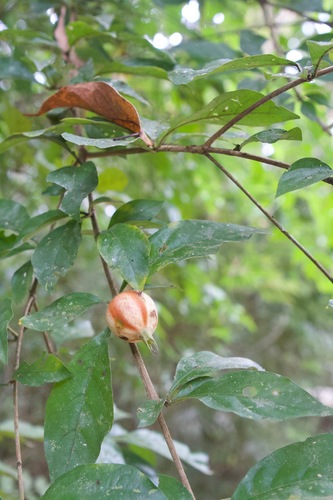
(c) Riley Fortier, some rights reserved (CC BY-NC), uploaded by Riley Fortier

(c) Juan Francisco Cruz Mejía, some rights reserved (CC BY-NC)

(c) Juan Francisco Cruz Mejía, some rights reserved (CC BY-NC)
What to Eat
Edible parts: Fruit
Fruit - raw or cooked. Eaten fresh or used to make jams, jellies, preserves and beverages. The sweet tasting fruits have a hard yellow shell containing a dark black pulp. They are said to have a flavour like molasses or blackberry jam. The subglobose fruits are about 3cm x 2cm.
Where to Find It
It is a tropical plant. It suits the hot, wet tropical lowlands. It grows on sandy ridges in the coastal plain. It also grows in dry savanna and along roadsides. It can grow in acid soils. It needs a USDA hardiness zone 10.
Australia, Brazil*, Central America, Colombia, Cuba, Ecuador, Guiana, Guianas, Guyana, Panama, South America, Suriname, Trinidad-Tobago, Venezuela, West Indies,
How to Identify
A shrub. It grows 4 m high. The flowers are white and have s scent. The fruit is a round berry 2-3 cm long by 1.6 cm wide. The fruit are green but turn yellow outside and black inside and are sweet. There are 2 rows of seeds.
How to Grow
Plants are grown from seed.
Wikipedia
Source ↗Rosenbergiodendron formosum is a species of flowering plant in the madder and coffee family, Rubiaceae, and is native to Panama, Colombia, Venezuela, and Ecuador. Common names include blackberry jam fruit, raspberry bush, and jasmin de rosa.
Names & Synonyms
Genipapo do campo, Guazutibatinga
References (12)
- Bodkin, F., 1991, Encyclopedia Botanica. Cornstalk publishing, p 867 (As Randia formosa)
- Facciola, S., 1998, Cornucopia 2: a Source Book of Edible Plants. Kampong Publications, p 213 (As Randia formosa)
- Kew Plants of the World Online
- Martin, F. W., et al, 1987, Perennial Edible Fruits of the Tropics. USDA Handbook 642 p 55 (As Randia formosa)
- C. F. P. Martius, Fl. bras. 6(6):342. 1889 (As Randia formosa)
- Miguel, E., et al, 1989, A checklist of the cultivated plants of Cuba. Kulturpflanze 37. 1989, 211-357 (As Randia formosa)
- Omawale, 1973, Guyana's edible plants. Guyana University, Georgetown p 6 (As Randia formosa)
- Reis, S. V. and Lipp, F. L., 1982, New Plant Sources for Drugs and Foods from the New York Botanical Garden herbarium. Harvard. p 292 (As Randia formosa)
- Roa, J. A. G. & Boada, D. S. G., 2018, Fundación para el Fortalecimiento de la Fruticultura y Plantas Alimenticias no Convencionales en Colombia.
- Tanaka, (As Randia formosa)
- van Roosmalen, M.G.M., 1985, Fruits of the Guianan Flora. Utrecht Univ. & Wageningen Univ. p 386 (As Randia formosa)
- www.colecionandofrutas.org


