Aidia genipiflora
(DC.) Dandy
Karkar
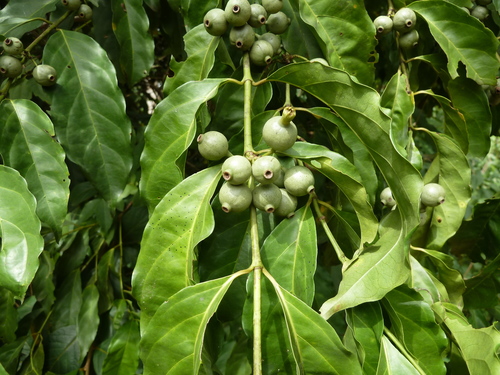
(c) Carel Jongkind, some rights reserved (CC BY-NC), uploaded by Carel Jongkind
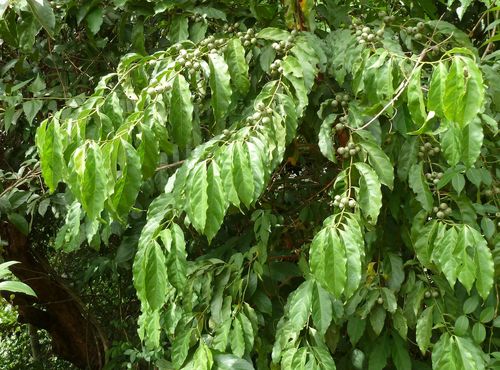
(c) Carel Jongkind, some rights reserved (CC BY-NC), uploaded by Carel Jongkind
What to Eat
Edible parts: Fruit
The fresh fruit are eaten, and can also be dried and reconstituted with water.
Where to Find It
A tropical plant. Kordofan district. It grows in closed forest.
Africa, Cameroon, Equatorial Guinea, Guinea, Guinée, Guinea-Bissau, Sudan,
How to Identify
A shrub or small tree. It grows 16 m tall. The trunk is 90 cm around. The flowers are white but turn yellow. They have a scent. The fruit are round and have a crown formed by the calyx. They are 1-2 cm across.
Nutrition Score: 16/100
| Part | Moisture | kJ | kcal | Protein | Vit A | Vit C | Iron | Zinc |
|---|---|---|---|---|---|---|---|---|
| Fruit dried | 226 | — | 5.9 | — | — | 23.7 | 3 | — |
Notes
Chemical composition: Protein (crude) = 5.9% (dry). Fat = 1.2% (dry). Fibre (crude) = 12.3% (dry). Ash = 4.9% (dry). Carbohydrate (soluble): Starch = 10.1% (dry). Sucrose = 14.8% (dry. D-Glucose = 5.3% (dry). F-Fructose = 6.9% (dry). Amino acids (g [16g N]-1): Aspartic Acid = 11g. Threonine = 2.5g. Serine = 2.9g. Glutamic Acid = 7.3g. Proline = 2.4g. Glycine = 3.6g. Alanine = 2.9g. Valine = 3.4g. Cysteine = 0.7g. Methionine = 0.7g. Isoleucine = 2.5g. Leucine = 4.4g. Tyrosine = 2.2g. Phenylalanine = 2.7g. Lysine = 3.1g. Histidine = 1.7g. Arginine = 6.6g. Minerals - Sulphur = 0.06% (dry). Potassium = 0.14% (dry). Magnesium = 0.12% (dry). Calcium = 0.19% (dry). Na = 0.01% (dry). K = 1.64% (dry). Zinc = 5mg/kg (dry). Iron = 302mg/kg (dry). Manganese = 24mg/kg (dry). Copper = 4mg/kg (dry).
Names & Synonyms
References (5)
- ABDELMUTI (As Randia genipiflora)
- Burkill, H. M., 1997, The Useful Plants of West Tropical Africa. Vol. 4 969 pp
- Guil-Guerrero, J. L., et al, 2001, Edible Wild Plants. in Recent Progress in Medicinal Plants Vol. 8 Sci. Tech publishing, Texas (As Randia genipiflora)
- Prodr. 4:389. 1830 (As Randia genipiflora)
- World Checklist of Useful Plant Species 2020. Royal Botanic Gardens, Kew


