Ranunculus californicus
Benth.
California buttercup

(c) Jeff Harter, some rights reserved (CC BY-SA), uploaded by Jeff Harter
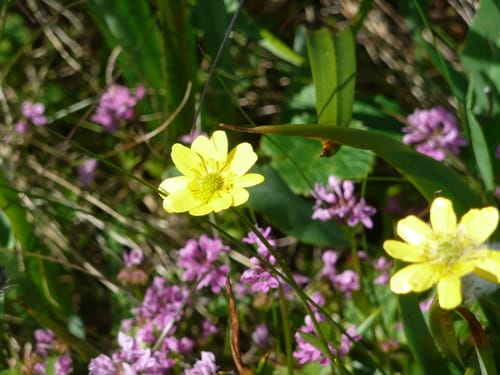
(c) Ian Cruickshank, some rights reserved (CC BY-NC)
What to Eat
Edible parts: Seeds
The seed must be cooked before eating. It is typically ground into a powder and used as a mush with water, as a flavouring in soups, or mixed with cereals when making bread.
Known Hazards
Where to Find It
It is a temperate plant.
North America, USA,
How to Identify
A perennial buttercup reaching 0.6 m tall, hardy to UK zone 7. Hermaphroditic flowers bloom May to July and attract insects. Grows in light sandy, medium loamy, and heavy clay soils with mildly acidic to basic pH. Tolerates semi-shade or full sun and prefers moist soil. Resists strong winds but cannot tolerate maritime salt exposure.
How to Grow
Prefers a moist loamy soil. A greedy plant, inhibiting the growth of nearby plants, especially legumes.
Propagation: Sow seed in spring in a cold frame. Prick seedlings into individual pots when large enough to handle and plant out in summer. Division in spring is straightforward; larger divisions can be planted directly into their permanent positions. Smaller divisions are better potted up and grown on in light shade in a cold frame until well established before planting out in late spring or early summer.
Medicinal Uses
None known
Other Uses
None known Special Uses
Wikipedia
Source ↗Ranunculus californicus, commonly known as the California buttercup, is a flowering plant of the buttercup family Ranunculaceae. It is a native of California, where it is common in many habitats, including chaparral and woodlands. Its distribution extends across many habitats of California, north into Oregon and south into Baja California. Its reported locations include the islands between British Columbia and Washington, the Channel Islands of California, and the Sierra Nevada.
Notes
There are about 400 Ranunculus species.
References (4)
- Anderson, M. K., 2012, Edible Seeds and Grains of California Tribes and the Klamath Tribe of Oregon in the Phoebe Apperson Hearst Museum of Anthropology Collections, University of California, Berkeley. USDA p 15
- Beckstrom-Sternberg, Stephen M., and James A. Duke. "The Foodplant Database." http://probe.nalusda.gov:8300/cgi-bin/browse/foodplantdb.(ACEDB version 4.0 - data version July 1994)
- Moerman, D. F., 2010, Native American Ethnobotany. Timber Press. p 468
- Plants for a Future database, The Field, Penpol, Lostwithiel, Cornwall, PL22 0NG, UK. http://www.scs.leeds.ac.uk/pfaf/


