Ranunculus japonicus
Thunb.
Crowfoot
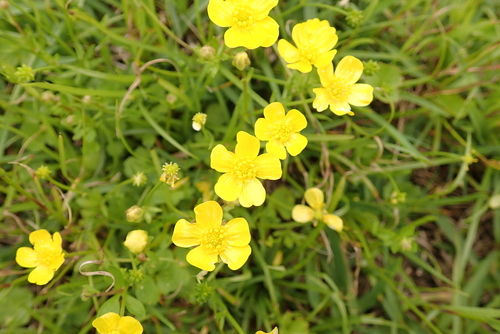
(c) Liu JimFood, some rights reserved (CC BY-NC), uploaded by Liu JimFood

(c) 空猫 T. N, some rights reserved (CC BY-NC)

(c) 空猫 T. N, some rights reserved (CC BY-NC)
What to Eat
Edible parts: Leaves
Leaves are edible when cooked. They contain a low level of toxicity, but not enough to be harmful.
Known Hazards
Where to Find It
It is a tropical plant. In China it grows between 100-3,500 m above sea level.
Asia, China, Indochina, Japan, Korea, Laos, Mongolia, Russia, SE Asia,
How to Identify
A herb. It keeps growing from year to year. It has short rhizomes. The stems are 12-65 cm long. There are 3-6 leaves at the base. The leaves have 3 parts. They are heart shaped and 1-7 cm long by 2-10 cm wide. There are unequal teeth along the edge. The leaves on the stem are smaller. The flowers are 1.4-2.4 cm across.
How to Grow
We have very little information on this species and do not know if it will be hardy in Britain, though judging by its native range it should succeed outdoors in most parts of the country. It is clsely related to R. acris. The following notes are based on the general needs of the genus. Prefers a moist loamy soil. A greedy plant, inhibiting the growth of nearby plants, especially legumes.
Propagation: Sow seed in spring in a cold frame. Prick seedlings out into individual pots once large enough to handle, and plant out during summer. Can also be propagated by division in spring.
Medicinal Uses
The plant is decongestant and vermicidal, and is used in the treatment of malaria. It also contains antitumour compounds.
Other Uses
None known.
Wikipedia
Source ↗A low-growing perennial reaching only 10cm tall with a spread of 30cm, flowering from May to July. Hermaphroditic flowers are pollinated by insects. Tolerates light sandy, medium loamy, and heavy clay soils with mildly acidic to basic pH. Grows in semi-shaded woodland or full sun, preferring moist soil conditions.
Notes
There are about 400 Ranunculus species.
Names & Synonyms
Mao gen
References (2)
- READ,
- Trans. Linn. Soc. London 2:337. 1794


