Ranunculus repens
L.
Creeping buttercup, Butter daisy, Creeping crowfoot, Yellow gowan
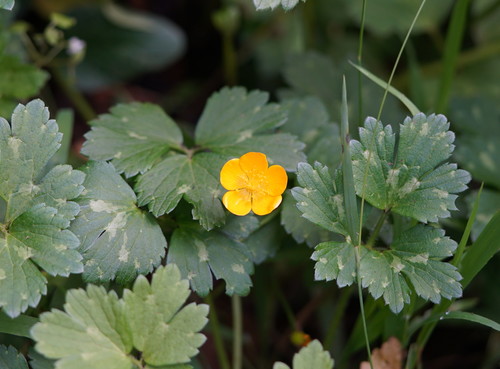
(c) Reiner Richter, some rights reserved (CC BY-NC-SA), uploaded by Reiner Richter
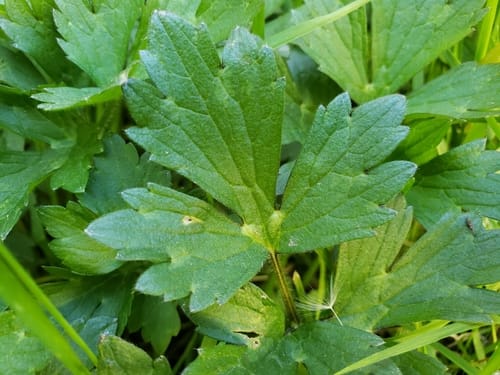
(c) Gavin Slater, some rights reserved (CC BY)
What to Eat
Edible parts: Leaves, Root
Leaves can be cooked and used as a pot-herb, though they are considered a famine food, used only when nothing else is available. The root is also edible but must be thoroughly dried and then fully cooked before eating. The plant's toxicity should be borne in mind for both uses.
Known Hazards
Where to Find It
It is a temperate plant. It grows in damp soil. In Argentina it grows from sea level to 2,000 m above sea level. It suits hardiness zones 3-9. Tasmania Herbarium.
Argentina, Armenia, Asia, Australia, Brazil, Britain, Caucasus, Central Asia, Chile, Europe, Falklands, Georgia, Italy, Korea, Luxembourg, Mediterranean, Mongolia, Slovenia, South America, Switzerland, Tajikistan, Tasmania,
How to Identify
A small herb which keeps growing from year to year. It grows 10-60 cm high. It has creeping runners or stolons. These form roots at the nodes. The leaf is made up of 3 leaflets. These are triangle shaped and 2-13 cm long. The leaflets are usually divided into 3 lobes. These have teeth along the edge. The flowers are yellow. They are 2-3 cm across. The petals are smooth and shiny. There are 5 petals and 5 spreading and hairy sepals. The fruit are dry and 2-3 mm long. The edges have ridges.
How to Grow
Prefers a moist loamy soil on the heavy side. A rampantly spreading weed of grassland, few gardeners would want to introduce it to their land. A greedy plant, inhibiting the growth of nearby plants, especially legumes. In garden design, as well as the above-ground architecture of a plant, root structure considerations help in choosing plants that work together for their optimal soil requirements including nutrients and water.
Propagation: Sow seed in spring in a cold frame, though this plant is a very common weed and rarely needs assistance. Division in spring is also very easy; larger divisions can be planted directly into their permanent positions.
Medicinal Uses
The entire plant is analgesic and rubefacient. A poultice of chewed leaves has been applied to treat sores, muscular aches, and rheumatic pains. Some caution is advised in use due to the plant's toxicity.
Other Uses
None known.
Wikipedia
Source ↗Ranunculus repens, the creeping buttercup, is a flowering plant in the buttercup family Ranunculaceae, native to Europe, Asia and northwestern Africa. It is also called creeping crowfoot and (along with restharrow) sitfast.
Notes
There are about 400 Ranunculus species.
Names & Synonyms
Niakhura, Plazeča zlatica
References (16)
- Bussman, R. W., et al, 2021, Unity in diversity—food plants and fungi of Sakartvelo (Republic of Georgia), Caucasus. Journal of Ethnobiology and Ethnomedicine (2021) 17:72 p 13
- Cundall, P., (ed.), 2004, Gardening Australia: flora: the gardener's bible. ABC Books. p 1132
- Dashorst, G.R.M., and Jessop, J.P., 1998, Plants of the Adelaide Plains & Hills. Botanic Gardens of Adelaide and State Herbarium. p 64
- Hedrick, U.P., 1919, (Ed.), Sturtevant's edible plants of the world. p 548
- Hibbert, M., 2002, The Aussie Plant Finder 2002, Florilegium. p 245
- Hovsepyan, R., et al, 2016, Food as a marker for economy and part of identity: traditional vegetal food of Yezidis and Kurds in Armenia. Journal of Ethnic Foods. 3:32-41
- http://www.botanic-gardens-ljubljana.com/en/plants
- Hyde-Wyatt, B.H. & Morris D.I., 1975, Tasmanian Weed Handbook. Dept of Ag Tasmania. p 95
- Lamp, C & Collet F., 1989, Field Guide to Weeds in Australia. Inkata Press. p 232
- Paoletti, M.G., Dreon, A.L., and Lorenzoni, G.G., 1995, Pistic, Traditional Food from Western Friuli, NE Italy. Economic Botany 49(1) pp 26-30
- Plants for a Future database, The Field, Penpol, Lostwithiel, Cornwall, PL22 0NG, UK. http://www.scs.leeds.ac.uk/pfaf/
- Sainty, G.R. & Jacobs, S.W.L., 1981, Waterplants of New South Wales. Water Resources Commission. NSW p 385
- Sp. pl. 1:554. 1753
- Tasmanian Herbarium Vascular Plants list p 48
- Urgamal, M., Oyuntsetseg, B., Nyambayar, D. & Dulamsuren, Ch. 2014. Conspectus of the vascular plants of Mongolia. (Editors: Sanchir, Ch. & Jamsran, Ts.). Ulaanbaatar, Mongolia. “Admon“ Press. 334pp. (p. 79-90).
- Wilson, A.J.G., (Ed.), 1994, Flora of Australia Volume 49, Oceanic Islands1, Australian Government Publishing Service, Canberra. p 52


