Ranunculus scleratus
L.
Buttercup, Celery-leaved buttercup
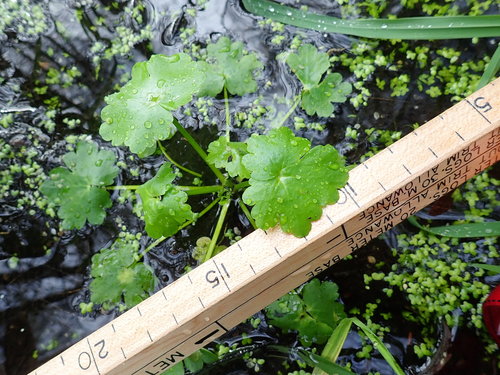
(c) Laura Shappell, some rights reserved (CC BY-NC)
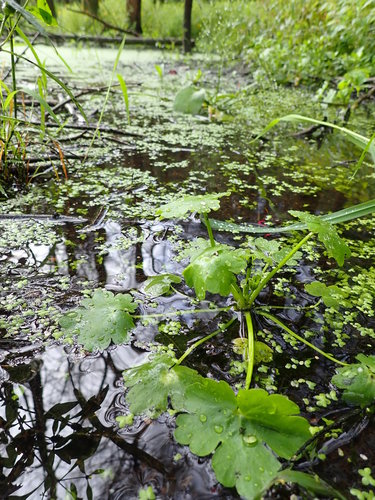
(c) Laura Shappell, some rights reserved (CC BY-NC)

(c) Susan J. Hewitt, some rights reserved (CC BY-NC)
What to Eat
Edible parts: Leaves, Caution, Roots
Young tender leaves are boiled and cooked as a vegetable with water changes, or dried, pickled, or fermented as a green vegetable. The rootstock is boiled with rice and eaten. Used as a famine food; leaves are sold in local markets.
Known Hazards
Where to Find It
It is a temperate plant. It grows in wet and marshy places. In Nepal it grows to about 2500 m altitude. Tasmania Herbarium.
Africa, Asia, Australia, Bhutan, Britain, Canada, Caucasus, Central Asia, China, East Africa, Europe, Falklands, Georgia, Himalayas, India, Indochina, Iraq, Japan, Korea, Laos, Mediterranean, Middle East, Mongolia, Myanmar, Nepal, North America, Northeastern India, Pakistan, SE Asia, Siberia, Spain, Tajikistan, Tasmania, Turkey, Türkiye, USA, Vietnam, Wallachia, Zimbabwe,
How to Identify
An annual herb. It is 20-70 cm high. The leaves vary in shape. The leaves near the base are stalked. They are 1.5-3 cm long by 2.5-4 cm wide. They are kidney shaped and with 3 lobes. The upper leaves are narrowly sword shaped with 3 lobes. The flowers are yellow. The fruit is dry, one seeded and in an oblong head.
How to Grow
Plants are grown from seeds or from root offshoots.
Other Information
Famine food. Leaves are sold in local markets.
Notes
There are about 400 Ranunculus species.
Names & Synonyms
Baia, Bir-mani, Celery-leaved crowfoot, Cursed crowfoot, Dhungre jhar, Jaldhania, Jhal dhania, Maocan satnhan, Mon dhonia, Nagakor, Niakhura, Othukoshi, Ram-pa, Shim, Tanga-ngayoke
References (22)
- Ambasta S.P. (Ed.), 2000, The Useful Plants of India. CSIR India. p 514
- Barua, U., et al, 2007, Wild edible plants of Majuli island and Darrang districts of Assam. Indian Journal of Traditional Knowledge 6(1) pp 191-194
- Blamey, M and Grey-Wilson, C., 2005, Wild flowers of the Mediterranean. A & C Black London. p 56
- Bodkin, F., 1991, Encyclopedia Botanica. Cornstalk publishing, p 869
- Cormack, R. G. H., 1967, Wild Flowers of Alberta. Commercial Printers Edmonton, Canada. p 115
- Curtis, W.M., 1956, The Students Flora of Tasmania Vol 1 p 19
- Dangol, D. R. et al, 2017, Wild Edible Plants in Nepal. Proceedings of 2nd National Workshop on CUAOGR, 2017.
- Dobriyal, M. J. R. & Dobriyal, R., 2014, Non Wood Forest Produce an Option for Ethnic Food and Nutritional Security in India. Int. J. of Usuf. Mngt. 15(1):17-37
- Facciola, S., 1998, Cornucopia 2: a Source Book of Edible Plants. Kampong Publications, p 190
- Hedrick, U.P., 1919, (Ed.), Sturtevant's edible plants of the world. p 548
- Joshi, N., et al, 2007, Traditional neglected vegetables of Nepal: Their sustainable utilization for meeting human needs. Tropentag 2007. Conference on International Agricultural Research for Development.
- Lazarides, M. & Hince, B., 1993, Handbook of Economic Plants of Australia, CSIRO. p 203
- Luczaj, L. et al, 2017, Comfrey and Buttercup Eaters: Wild Vegetables of the Imereti Region in Western Georgia, Caucasus. Economic Botany, 71(2), 2017, pp. 188–193
- Manandhar, N.P., 2002, Plants and People of Nepal. Timber Press. Portland, Oregon. p 390
- Pfoze, N. L., et al, 2012, Survey and assessment of floral diversity on wild edible plants from Senapati district of Manipur, Northeast India. Journal or Biodiversity and Environmental Sciences. 1(6):50-52
- Pham-Hoang Ho, 1999, An Illustrated Flora of Vietnam. Nha Xuat Ban Tre. p 323
- Plants for a Future database, The Field, Penpol, Lostwithiel, Cornwall, PL22 0NG, UK. http://www.scs.leeds.ac.uk/pfaf/
- Singh, H.B., Arora R.K.,1978, Wild edible Plants of India. Indian Council of Agricultural Research, New Delhi. p 40
- Sp. pl. 1:551. 1753
- Upson, R., & Lewis R., 2014, Updated Vascular Plant Checklist and Atlas for the Falkland Islands. Falklands Conservation and Kew.
- Urgamal, M., Oyuntsetseg, B., Nyambayar, D. & Dulamsuren, Ch. 2014. Conspectus of the vascular plants of Mongolia. (Editors: Sanchir, Ch. & Jamsran, Ts.). Ulaanbaatar, Mongolia. “Admon“ Press. 334pp. (p. 79-90).
- WATT,


