Anthoxanthum odoratum
L.
Sweet vernal grass, Grass tea
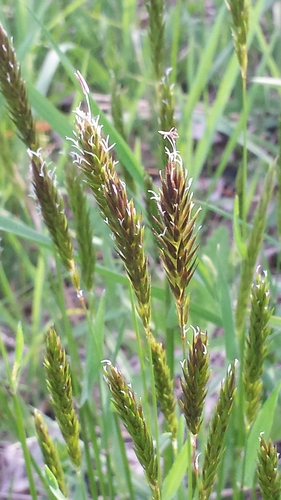
(c) Tom Norton, some rights reserved (CC BY), uploaded by Tom Norton

(c) csmallridge, some rights reserved (CC BY-NC)

(c) David McCorquodale, some rights reserved (CC BY-NC), uploaded by David McCorquodale
What to Eat
Edible parts: Leaves - tea, Seeds, Cereal
Edible Parts: Seed Edible Uses: Tea Seed. The seed is very small and its use would be fiddly. A tea is made from the fresh or dried leaves. A sweet pleasant fragrance. Some caution is advised, see notes at top of the page.
Known Hazards
Where to Find It
It is a temperate plant. It grows in poorly developed pasture. In China it grows on alpine steppes between 1,400-2,900 m above sea level. In Argentina it grows between sea level and 1,000 m above sea level. Tasmanian Herbarium.
Alaska, Albania, Algeria, Argentina, Asia, Australia, Austria, Belarus, Belgium, Bolivia, Brazil, Britain, Bulgaria, Canary Is., Caucasus, Central Asia, Chile, China, Colombia, Costa Rica, Crete, Czech Republic, Denmark, Dominican Republic, Ecuador, Europe, Falklands, Finland, France, Germany, Greece, Haiti, Himalayas, Hungary, Iceland, India, Ireland, Italy, Jamaica, Japan, Kazakhstan, Korea, Kyrgyzstan, Lebanon, Luxembourg, Macquarie Island, Mongolia, Morocco, Netherlands, New Zealand, North America, Norway, Pakistan, Poland, Portugal, Reunion, Romania, Russia, Scandinavia, Siberia, Slovenia, South Africa, Southern Africa, South America, Spain, St Helena, Sweden, Syria, Switzerland, Taiwan, Tasmania, Tunisia, Turkey, Türkiye, Ukraine, Uruguay, USA, West Indies, Yugoslavia,
How to Identify
A grass which keeps growing from year to year and grows in tufts. It grows 10-100 cm high. It only has a few hairs. The flower head is narrowly oval. It is 2-7 cm long. This can be green to golden brown. The spikelets are flattened and crowded on short branches. They are 7-9 mm long. The plant has a sweet smell like new mown hay.
How to Grow
Succeeds in most soils. Dislikes shade. This is one of the earliest grasses to flower in the year, it produces a lot of pollen and is a major irritant to people who suffer from hay fever. The dried plant releases a strong and persistent fragrance with a refreshing pungent smell that is difficult to describe but is somewhat like newly-mown hay.
Propagation: Seed - sow April in situ, only just covering the seed. The seed usually germinates in 2 - 3 weeks. Division in spring. Very easy, it can be done successfully at almost any time of the year, though it is best to pot up the divisions in a cold frame if you are doing it outside the growing season.
Medicinal Uses
Anticoagulant Antiemetic Antispasmodic Stimulant The whole plant, and especially the flowering stems, is anticoagulant, antispasmodic and stimulant. It is normally only applied externally, where it is used in the treatment of rheumatic pain, chilblains, nervous insomnia etc. It is said that a tincture made from this grass with spirit of wine is an effective and immediate cure for hay fever.
Other Uses
Basketry Pot-pourri Strewing The aromatic leaves and dried flowers are used as a strewing herb, they are also woven into baskets and used in pot-pourri. The plant contains coumarin - this is used medicinally and also in rat poisons where it prevents the blood from co-aggulating and thus means that the slightest cut can kill the rat. Special Uses Scented Plants
Wikipedia
Source ↗Anthoxanthum odoratum is a short-lived perennial grass, commonly known as sweet vernal grass, that is native to acidic grassland in Eurasia and northern Africa. It is grown as a lawn grass and a house plant, due to its sweet scent, and can also be found on unimproved pastures and meadows. The specific epithet odoratum is Latin for 'odorous'.
Notes
There are about 18 Anthoxanthum species. The plant in flower can cause hay fever. Damp grass can develop a toxic compound dicoumarol.
Names & Synonyms
Dišeča boljka, Gulaks
References (25)
- Ambasta S.P. (Ed.), 2000, The Useful Plants of India. CSIR India. p 44
- Bircher, A. G. & Bircher, W. H., 2000, Encyclopedia of Fruit Trees and Edible Flowering Plants in Egypt and the Subtropics. AUC Press. p 33
- Bodkin, F., 1991, Encyclopedia Botanica. Cornstalk publishing, p 89
- Bremness, L., 1994, Herbs. Collins Eyewitness Handbooks. Harper Collins. p 147
- Brown, D., 2002, The Royal Horticultural Society encyclopedia of Herbs and their uses. DK Books. p 124
- Cribb, A.B. & J.W., 1976, Wild Food in Australia, Fontana. p 178
- Curtis, W.M., & Morris, D.I., 1994, The Student's Flora of Tasmania. Part 4B St David's Park Publishing, Tasmania, p 250
- Dashorst, G.R.M., and Jessop, J.P., 1998, Plants of the Adelaide Plains & Hills. Botanic Gardens of Adelaide and State Herbarium. p 186
- Facciola, S., 1998, Cornucopia 2: a Source Book of Edible Plants. Kampong Publications, p 173
- Flora of Australia Volume 49, Oceanic Islands 1, Australian Government Publishing Service, Canberra. (1994) p 459
- Girard, N. J., 2020, Sustainable Foraging of Wild Edible Plants in Norway. A Biocultural Approach. M. Sc. thesis Norwegian University. p 133
- Hussey, B.M.J., Keighery, G.J., Cousens, R.D., Dodd, J., Lloyd, S.G., 1997, Western Weeds. A guide to the weeds of Western Australia. Plant Protection Society of Western Australia. p 42
- Irving, M., 2009, The Forager Handbook, A Guide to the Edible Plants of Britain. Ebury Press p 326
- Kew Plants of the World Online
- Lamp, C & Collet F., 1989, Field Guide to Weeds in Australia. Inkata Press. p 24
- Lamp, C.A., Forbes, S.J. and Cade, J.W., 1990, Grasses of Temperate Australia. Inkata Press. p 80
- Lazarides, M. & Hince, B., 1993, Handbook of Economic Plants of Australia, CSIRO. p 22
- Paczkowska, G. & Chapman, A.R., 2000, The Western Australian Flora. A Descriptive Catalogue. Western Australian Herbarium. p 95
- Plants for a Future database, The Field, Penpol, Lostwithiel, Cornwall, PL22 0NG, UK. http://www.scs.leeds.ac.uk/pfaf/
- Plants of Haiti Smithsonian Institute http://botany.si.edu/antilles/West Indies
- Seidemann J., 2005, World Spice Plants. Economic Usage, Botany, Taxonomy. Springer. p 44
- Sp. pl. 1:28. 1753
- Steenbeeke, Greg as part of the Plants Directory project. List of plant species from northern NSW that may be used as food plants p 7
- Tasmanian Herbarium Vascular Plants list p 81, 102
- Upson, R., & Lewis R., 2014, Updated Vascular Plant Checklist and Atlas for the Falkland Islands. Falklands Conservation and Kew.


