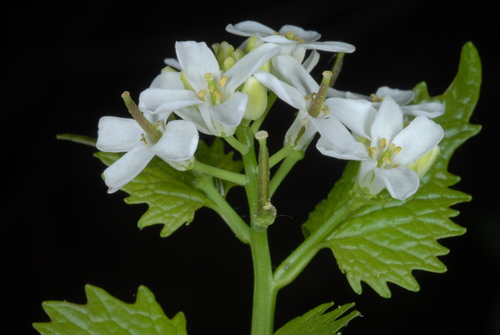
Raphanus raphanistrum
L.
Wild radish, Jointed charlock, White charlock

(c) arnel, some rights reserved (CC BY-NC), uploaded by arnel

lagomorphaaquatica

(c) gkatragadda106, some rights reserved (CC BY-NC)
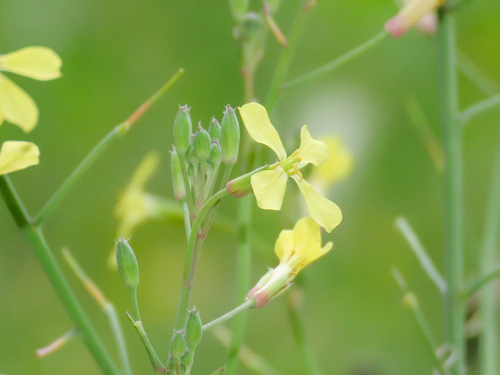
(c) Emanuele Santarelli, some rights reserved (CC BY-SA), uploaded by Emanuele Santarelli
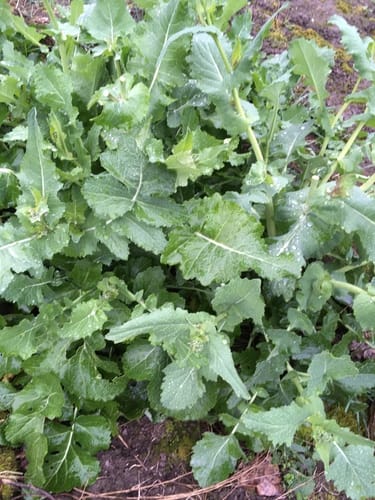
(c) Sarah Wilson, some rights reserved (CC BY-NC)
What to Eat
Edible parts: Leaves, Seeds - spice, Flowers
Young leaves can be eaten raw or cooked — they have a somewhat hot taste and are finely cut for use in salads or as a potherb. Use only the young spring leaves, as older leaves soon turn bitter. The seeds are very pungent and can be eaten raw, ground into a powder, and made into a paste that works as an excellent mustard substitute. Sprouted seeds have a hot, spicy flavour and make a tasty salad addition. Flowers are eaten raw and make a nice addition to salads. The flower buds can be used as a broccoli substitute and should be lightly steamed for no more than 5 minutes. Young seedpods are eaten raw — crisp and juicy, they must be harvested while young as they quickly become tough and fibrous. An edible oil is also obtained from the seed.
Where to Find It
It is a temperate plant. It grows near damp sites. It can grow in tropical and temperate places. In Argentina it grows from sea level to 1,100 m above sea level. Tasmania Herbarium. In Sichuan.
Afghanistan, Africa, Albania, Algeria, Argentina, Asia, Australia, Austria, Bahamas, Balkans, Belarus, Belgium, Bosnia, Brazil, Britain, Bulgaria, Canary Is., Chile, China, Cuba, Cyprus, Czech Republic, Denmark, Dominican Republic, East Africa, Ecuador, El Salvador, Eritrea, Ethiopia, Europe*, Fiji, Greece, Greenland, Guatemala, Haiti, Hawaii, Himalayas, India, Indonesia, Ireland, Italy, Japan, Kenya, Korea, Kuwait, Lesotho, Libya, Luxembourg, Manchuria, Mauritania, Mauritius, Mediterranean*, Mexico, Mongolia, Morocco, Nepal, New Caledonia, New Zealand, North Africa, North America, Oman, Pacific, Pakistan, Paraguay, Peru, Poland, Portugal, Russia, Sicily, Slovenia, South Africa, Southern Africa, Spain, St Helena, Taiwan, Tajikistan, Tanzania, Tasmania, Turkey, Türkiye, Turkmenistan, Uruguay, USA, West Indies, Yemen, Zimbabwe,
How to Identify
A cabbage family herb. It is an annual herb. It grows 80-100 cm high. It is rough to the touch. The stems branch at the base. The stems are solid but with grooves along them. The stems have downward directed hairs. The lower leaves are larger than the leaves higher up the stem. The lower leaves occur in a ring. The lower leaves are lobed and 20 cm long. The flower is at the top. The flower petals can be white, yellow or lilac and do not overlap. The fruit is a long pointed pod. It is 3-7 cm long and 3-4 mm wide. It is constricted between the seeds. It is held erect.
Nutrition Score: 44/100
| Part | Moisture | kJ | kcal | Protein | Vit A | Vit C | Iron | Zinc |
|---|---|---|---|---|---|---|---|---|
| Leaves | 87.4 | 142 | 34 | 3.7 | — | 11 | 9.5 | 1.4 |
How to Grow
Prefers a rich soil with ample moisture. Dislikes very heavy soils. This plant is a host of an eelworm that attacks cultivated crops. This species is possibly the original source of the cultivated radish, R. sativus. The flowers are very attractive to bees.
Propagation: Sow seed in spring directly in situ. Germination should take place within 2 weeks.
Medicinal Uses
Antirheumatic.
Other Uses
An oil is obtained from the seed.
Wikipedia
Source ↗Raphanus raphanistrum, also known as wild radish, white charlock or jointed charlock, is a flowering plant in the family Brassicaceae. The species is native to western Asia, Europe and parts of Northern Africa. It has been introduced into most parts of the world and is regarded as a habitat threatening invasive species in many areas, for example, Australia. It spreads rapidly and is often found growing on roadsides or in other places where the ground has been disturbed. The cultivated radish, widely used as a root vegetable, is sometimes considered to be one of its subspecies as Raphanus raphanistrum subsp. sativus.
Names & Synonyms
Bedhaka, Bouham-mou, Ermulatta, Fiore di San Giuseppe, Gramolaccio, Jaramago, Karamancar, Karaturp, Lapistra, Lass'ne, Mostaza, Nabica, Nabo, Nabo-bravo, Pisciacane, Rabanete-de-cavalo, Rabanete-selvagen, Rabani to salvaje, Rabanito, Rabanito silvestre, Rabano, Rabizon, Rapistre, Rodakva divlja, Runch, Saramago, Skellog, Turpoti, Turpotu, Yabarni turp, Ye luo bo
References (63)
- Ashagre, M., et al, 2016, Ethnobotanical study of wild edible plants in Burji District, Segan Area Zone of Southern Nations, Nationalities and Peoples Region (SNNPR), Ethiopia. Journal of Ethnobiology and Ethnomedicine (2016) 12:32
- Banga, O., 1979, Radish, in Simmonds N.W.,(ed), Crop Plant Evolution. Longmans. London. p 60
- Biscotti, N. & Pieroni, A., 2015, The hidden Mediterranean diet: wild vegetables traditionally gathered and consumed in the Gargano area, Apulia, SE Italy. Acta Societatis Botanicorum Poloniae 84 (3): 327-338
- Biscotti, N. et al, 2018, The traditional food use of wild vegetables in Apulia (Italy) in the light of Italian ethnobotanical literature. Italian Botanist 5:1-24
- Blamey, M and Grey-Wilson, C., 2005, Wild flowers of the Mediterranean. A & C Black London. p 69
- Bodkin, F., 1991, Encyclopedia Botanica. Cornstalk publishing, p 870
- Cerne, M., 1992, Wild Plants from Slovenia used as Vegetables. Acta Horticulturae 318
- Cordero, S. E., Abello, L. A., & Galvez, F. L., 2017, Plantas silvestres comestibles y medicinales de Chile y otras partes del mundo. CORMA p 228 (As Raphanus sativus)
- Curtis, W.M., 1956, The Students Flora of Tasmania Vol 1 p 48
- Dashorst, G.R.M., and Jessop, J.P., 1998, Plants of the Adelaide Plains & Hills. Botanic Gardens of Adelaide and State Herbarium. p 68
- Dogan, Y., et al, 2004, The Use of Wild Edible Plants in Western and Central Anatolia (Turkey). Economic Botany 58(4) pp. 684-690
- Dogan, Y., 2012, Traditionally used wild edible greens in the Aegean Region of Turkey. Acta Societatis Botanicorum Poloniae 81(4): 329-342
- Dogan, Y. et al, 2013, Wild Edible Plants sold in the Local Markets of Izmir, Turkey. Pak. J. Bot. 45(S1): 177-184
- Dogan, Y., et al, 2015, Of the importance of a leaf: the ethnobotany of sarma in Turkey and the Balkans. Journal of Ethnobiology and Ethnomedicine, 11:56
- Ertug, F., 2004, Wild Edible Plants of the Bodrum Area. (Mugla, Turkey). Turk. J. Bot. 28 (2004): 161-174
- Ertug, F, Yenen Bitkiler. Resimli Türkiye Florası -I- Flora of Turkey - Ethnobotany supplement
- Facciola, S., 1998, Cornucopia 2: a Source Book of Edible Plants. Kampong Publications, p 58
- Flora of Australia, Volume 8, Lecythidales to Batales, Australian Government Publishing Service, Canberra (1982) p 247
- Flora of China @ efloras.org Volume 8
- Fox, F. W. & Young, M. E. N., 1982, Food from the Veld. Delta Books. p 136
- Geraci, A., et al, 2018, The wild taxa utilized as vegetables in Sicily (Italy): a traditional component of the Mediterranean diet. Journal of Ethnobiology and Ethnomedicine (2018) 14:14
- Gurdal, B. & Kultur, S., 2014, The edible and miscellaneous useful plants in Marmaris (Southwest Turkey). İstanbul Ecz. Fak. Derg. / J. Fac. Pharm. Istanbul 44(1) 2014 pp.69-78
- Hadjichambis, A. C., et al, 2007, Wild and semi-domesticated food plant consumption in seven circum-Mediterranean areas. International Journal of Food Sciences and Nutrition. 2007, 1-32.
- Hammer, K. & Spahillari, M., 1999, Crops of European origin. in Report of a networking group on minor crops. IPGRI p 44
- Harris, S., Buchanan, A., Connolly, A., 2001, One Hundred Islands: The Flora of the Outer Furneaux. Tas Govt. p 214
- Hedrick, U.P., 1919, (Ed.), Sturtevant's edible plants of the world. p 549
- Hussey, B.M.J., Keighery, G.J., Cousens, R.D., Dodd, J., Lloyd, S.G., 1997, Western Weeds. A guide to the weeds of Western Australia. Plant Protection Society of Western Australia. p 120
- Hyde-Wyatt, B.H. & Morris D.I., 1975, Tasmanian Weed Handbook. Dept of Ag Tasmania. p 43
- Irving, M., 2009, The Forager Handbook, A Guide to the Edible Plants of Britain. Ebury Press p 95
- Kermath, B. M., et al, 2014, Food Plants in the Americas: A survey of the domesticated, cultivated and wild plants used for Human food in North, Central and South America and the Caribbean. On line draft. p 739
- Kew Plants of the World Online
- Kizilarslan, C. & Ozhatay, N., 2012, An ethnobotanical study of the useful and edible plants of İzmit. Marmara Pharmaceutical Journal 16: 134-140, 2012.
- Lamp, C & Collet F., 1989, Field Guide to Weeds in Australia. Inkata Press. p 233
- Lazarides, M. & Hince, B., 1993, Handbook of Economic Plants of Australia, CSIRO. p 203
- Lentini, F. and Venza, F., 2007, Wild food plants of popular use in Sicily. J Ethnobiol Ethnomedicine. 3: 15
- Licata, M., et al, 2016, A survey of wild plant species for food use in Sicily (Italy) – results of a 3-year study in four Regional Parks. Journal of Ethnobiology and Ethnomedicine 12:12
- Low, T., 1991, Wild Herbs of Australia and New Zealand. Angus & Robertson. p 54 (Drawing)
- Low, T., 1992, Bush Tucker. Australia’s Wild Food Harvest. Angus & Robertson. p 146
- Łukasz Łuczaj and Wojciech M Szymański, 2007, Wild vascular plants gathered for consumption in the Polish countryside: a review. J Ethnobiol Ethnomedicine. 3: 17
- Mahklouf, M. H., 2019, Ethnobotanical Study of Edible Wild Plants in Libya. European Journal of Ecology. 5(2): 30-40
- Malezas Comestibles del Cono Sur, INTA, 2009, Buernos Aires
- Motti, R. et al, 2009, Traditional Plant Use in the Phlegraean Fields Regional Park (Campania, Southern Italy). Human Ecology 37:775-782
- Paczkowska, G. & Chapman, A.R., 2000, The Western Australian Flora. A Descriptive Catalogue. Western Australian Herbarium. p 188
- Pasta, S., et al, 2020, An Updated Checklist of the Sicilian Native Edible Plants: Preserving the Traditional Ecological Knowledge of Century-Old Agro-Pastoral Landscapes. Frontiers in Plant Science. Volume 11|Article 388
- Pieroni, A., 1999, Gathered wild food plants in the Upper Valley of the Serchio River (Garfagnana), Central Italy. Economic Botany 53(3) pp 327-341
- Plants for a Future database, The Field, Penpol, Lostwithiel, Cornwall, PL22 0NG, UK. http://www.scs.leeds.ac.uk/pfaf/
- Plants of Haiti Smithsonian Institute http://botany.si.edu
- Polat, R., et al, 2015, Survey of wild food plants for human consumption in Elazig (Turkey). Indian Journal of Traditional Knowledge. Vol. 1(1): 69-75
- Redzic, S. J., 2006, Wild Edible Plants and their Traditional Use in the Human Nutrition in Bosnia-Herzegovina. Ecology of Food and Nutrition, 45:189-232
- Redzic, S., 2010, Use of Wild and Semi-Wild Edible Plants in Nutrition and Survival of People in 1430 Days of Siege of Sarajevo during the War in Bosnia and Herzegovina (1992–1995). Coll. Antropol 34 (2010) 2:551-570
- Ruiters-Welcome, A. K., 2019, Food plants of southern Africa. Ph.D. thesis. Univ. of Johannesburg p 40
- Signorini, M. A., et al, 2009, Plants and traditional knowledge: An ethnobotanical investigation on Monte Ortobene (Nuoro, Sardinia). Journal or Ethnobiology and Ethnomedicine, 5:6
- Simkova, K. et al, 2014, Ethnobotanical review of wild edible plants used in the Czech Republic. Journal of Applied Botany and Food Quality 88, 49-67
- Sp. pl. 2:669. 1753
- Tasmanian Herbarium Vascular Plants list p 18
- Tardio, J., et al, Ethnobotanical review of wild edible plants in Spain. Botanical J. Linnean Soc. 152 (2006), 27-71
- Urgamal, M., Oyuntsetseg, B., Nyambayar, D. & Dulamsuren, Ch. 2014. Conspectus of the vascular plants of Mongolia. (Editors: Sanchir, Ch. & Jamsran, Ts.). Ulaanbaatar, Mongolia. “Admon“ Press. 334pp. (p. 79-90).
- van Wyk, B., 2000, A Photographic Guide to Wild Flowers of South Africa. Struik Nature. p 35
- Vieyra-Odilon, L and Vibrans, H., 2001, Weeds as Crops: The Value of Maize Field Weeds in the Valley of Toluca, Mexico. Economic Botany 55(3):426-443
- Wehmeyer, A. S, 1986, Edible Wild Plants of Southern Africa. Data on the Nutrient Contents of over 300 species
- Welcome, A. K. & Van Wyk, B.-E., 2019, An inventory and analysis of the food plants of southern Africa. South African Journal of Botany 122 (2019) 136–179
- World Checklist of Useful Plant Species 2020. Royal Botanic Gardens, Kew
- Zhou Taiyan, Lu Lianli, Yang Guang; Ihsan A. Al-Shehbaz, BRASSICACEAE (CRUCIFERAE), Flora of China.