Garcinia macrophylla
Mart.
Large-leaf mangosteen, Big leaf garcinia
no rights reserved
no rights reserved
no rights reserved
What to Eat
Edible parts: Fruit
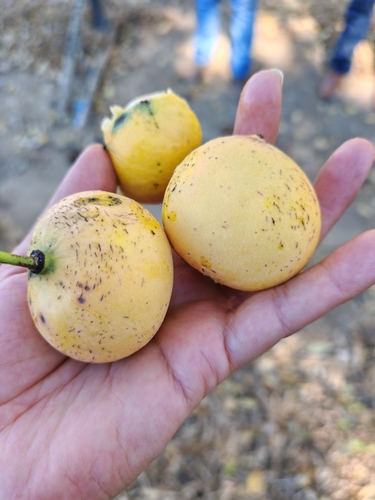
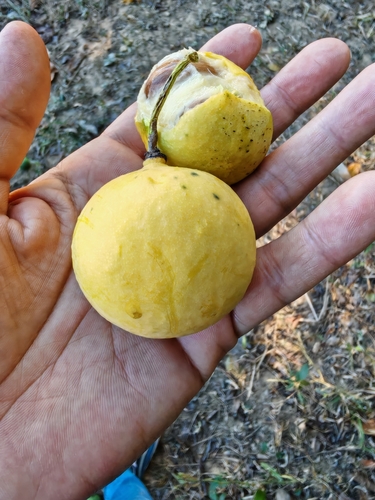
Fruit - raw or made into jam. The white, aril-like pulp is agreeably subacid. The fruit is rounded-conical, pointed at one or both ends, about 8 cm wide, with a thick yellow rind, usually smooth, sometimes rough, containing a gummy yellow latex. The fruit is not much esteemed but is widely eaten.
Where to Find It
A tropical plant. It grows naturally in both the wet and dry forests in the Amazon in Brazil. It grows in humid locations. It grows between 50-400 m above sea level. Trees are damaged by frost. It can tolerate light shade. In Cairns Botanical Gardens.
Amazon, Asia, Australia, Bolivia, Brazil*, Central America, Colombia, Ecuador, French Guiana, Guatemala, Guianas, Guyana, Indonesia, Mexico, Panama, Peru*, SE Asia, South America, Suriname, South America*, Venezuela, West Indies*,
How to Identify
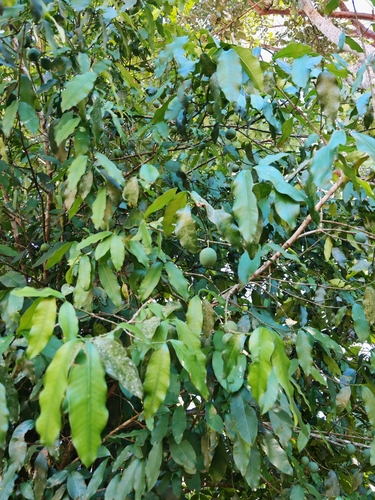
A small tree. It grows 15-20 m tall. The trunk is 50-60 cm across. The leaves are opposite and leathery. They are oblong or sword shaped and 20-30 cm long by 7-10 cm wide. The flowers are male and female and in the axils of leaves. The fruit is medium sized and firm and yellow. They are 5-7 cm long by 3.6 cm wide. The flesh is soft, white and subacid. There can be 4 seeds inside. The fruit is something like a mangosteen.
How to Grow
Plants are grown from seed. The seeds are collected from ripe fruit off the tree. The seeds are removed and washed then planted fresh. They take several weeks to germinate.
Propagation: Seed - they have remained viable for 2 to 3 weeks, but require several weeks to germinate. Best sown as soon as they are ripe in a semi-shaded position in a nursery seedbed. Germination rates are usually low, with the seed not sprouting until more than 90 days have passed.
Medicinal Uses
No medicinal uses documented.
Other Uses
The wood is irregular-grained, heavy, moderately resistant to rot. It is suitable for cabinet making and tool handles. We do not have any more information on the wood of this species, but a general description of the wood for trees in the Americas which were formerly considered to be in the genus Rheedia is as follows:- The heartwood is dark yellow-brown, grayish- or pinkish-brown, merging gradually into the sapwood; surfaces are sometimes specked with resinous exudations. The texture is medium to coarse; the grain straight to irregular and roey; luster medium to rather low; it is free from discernible odour or taste. Species in Surinam are rated durable to attack by decay fungi and fairly resistant to dry wood termites. Species in Colombia are resistant to a brown-rot fungus but not the white-rot in a laboratory assay. Under field conditions the wood was susceptible to decay and attack by insects. It dries rapidly, but is reported to be moderately difficult to air season, tending to warp and check. Reports on workability vary with species from moderate to high resistance to cutting to machining fairly well; reports on ease of finishing are also variable. The wood is used for purposes such as furniture, flooring (quarter sawn), heavy construction, and general carpentry.
Wikipedia
Source ↗Garcinia macrophylla, common name pungara, is a Garcinia species found in southern Mexico, Guatemala and northern South America. It is found in the Amazonian montane forests, at altitudes of 50–400 m. In climates with mean annual temperatures of 26–28 °C and mean annual rainfall of 1,500–4,000 mm. In Bolivia, this species is intercropped with cocoa for their edible fruits and shade.
Production
Plants grow rapidly. An established tree can produce up to 200 fruit.
Other Information
It is a cultivated fruit tree. The fruit are popular. They are sold in local markets.
Names & Synonyms
Achachairuu grande, Agridulce, Bacipari, Bacuri-da-varzea, Bacuri, Bacuripari-verdadeiro, Bacuripari, Bacury-pary, Charichuela, Chora, Cozoiba, Cundicislum, Cunyasison, Curupita, Escropari, Hashan, Kontaka, Kwindiashi, Longleaf rheedia, Madrono pequeno, Majaro, Otokay, Pacuri-acu, Penka, Pevicho, Pohon manggis daun besar, Pungara, Punkara muyu, Punkara yura, Remelento, Shora, Soiebo, Unfokawen, Unkara yura, Winul, Wushia penka
References (27)
- Bendezu, Y. F., 2018, Arboles nativos de lad Region Ucayali. Instituto Nacional de Innovacion Agraria. p 95
- Facciola, S., 1998, Cornucopia 2: a Source Book of Edible Plants. Kampong Publications, p 80 (As Rheedia magnifolia)
- Flora 24(beibl. 2):35. 1841
- Flores, Y., 2018, Arboles nativos de la Region Ucayili. Estacion Experimental Agragia Pucallpa. Pucallpa Peru, 375 p. p 95
- Grandtner, M. M., 2008, World Dictionary of Trees. Wood and Forest Science Department. Laval University, Quebec, Qc Canada. (Internet database http://www.wdt.qc.ca)
- Grandtner, M. M. & Chevrette, J., 2013, Dictionary of Trees, Volume 2: South America: Nomenclature, Taxonomy and Ecology. Academic Press p 261
- Hermandez Bermejo, J.E., and Leon, J. (Eds.), 1994, Neglected Crops. 1492 from a different perspective. FAO Plant Production and Protection Series No 26. FAO, Rome. p15 (As Rheedia macrophylla)
- Kiple, K.F. & Ornelas, K.C., (eds), 2000, The Cambridge World History of Food. CUP p 1725 (As Rheedia macrophylla)
- Lopez-Diago, D. & Garcia, N., 2021, Wild edible fruits of Colombia. Biota ColomBiana 22 (2) p 35
- Lorenzi, H., Bacher, L., Lacerda, M. & Sartori, S., 2006, Brazilian Fruits & Cultivated Exotics. Sao Paulo, Instituto Plantarum de Estuados da Flora Ltda. p 128
- Lorenzi, H., 2009, Brazilian Trees. A Guide to the Identification and Cultivation of Brazilian Native Trees. Instituto Plantarum de Estuados da Flora Ltda. Vol. 3 p 93
- Martin, F. W., et al, 1987, Perennial Edible Fruits of the Tropics. USDA Handbook 642 p 95 (As Rheedia benthamiana) (Also as Rheedia macrophylla)
- Morton, J. F., 1987, Fruits of Warm Climates. Wipf & Stock Publishers p 309 (As Rheedia macrophylla)
- NYBG herbarium "edible" (As Rheedia macrophylla)
- Paz, F. S., et al, 2021, Edible Fruit Plant Species in the Amazon Forest Rely Mostly on Bees and Beetles as Pollinators. Journal of Economic Entomology, XX(XX), 2021, 1–13 (As Rheedia macrophylla)
- Roa, J. A. G. & Boada, D. S. G., 2018, Fundación para el Fortalecimiento de la Fruticultura y Plantas Alimenticias no Convencionales en Colombia.
- Shanley, P. et al, (Eds), 2011, Fruit trees and useful plants in Amazonian life. Non-wood Forest Products No 20. FAO, CIFOR and PPI. p 72
- Smith, N., et al, 2007, Amazon River Fruits. Flavors for Conservation. Missouri Botanical Gardens Press. p 100
- Sukarya, D. G., (Ed.) 2013, 3,500 Plant Species of the Botanic Gardens of Indonesia. LIPI p 300 and 489
- Torre, de la, L., et al, 2008, Enciclopedia de las Plantas Útiles del Ecuador. Herbario QCA. Pontificia Universidad Católica del Ecuador. p 286
- Uji, T., 2007, Keanekaragaman, Persebaran dan Potensi Jenis-jenis Garcinia. Berk. Penel. Hayati: 12 (129–135), 2007
- USDA, ARS, National Genetic Resources Program. Germplasm Resources Information Network - (GRIN). [Online Database] National Germplasm Resources Laboratory, Beltsville, Maryland. Available: www.ars-grin.gov/cgi-bin/npgs/html/econ.pl (10 April 2000)
- Van den Eynden, V., et al, 2003, Wild Foods from South Ecuador. Economic Botany 57(4): 576-603
- Vasquez, Roberto Ch. & Coimbra, German S., 1996, Frutas Silvestres Comestibles de Santa Cruz. p 108 (As Rheedia macrophylla)
- Wiersema, J. H. & Leon, B., 2013, World Economic Plants. A Standard Reference CRC Press. 2nd Ed. p 317
- World Checklist of Useful Plant Species 2020. Royal Botanic Gardens, Kew
- www.colecionandofrutas.org


