Ribes aureum
Pursh
Buffalo currant, Golden currant, Missouri currant

(c) joeverica, some rights reserved (CC BY-NC), uploaded by joeverica
no rights reserved
no rights reserved
What to Eat
Edible parts: Flowers, Fruit
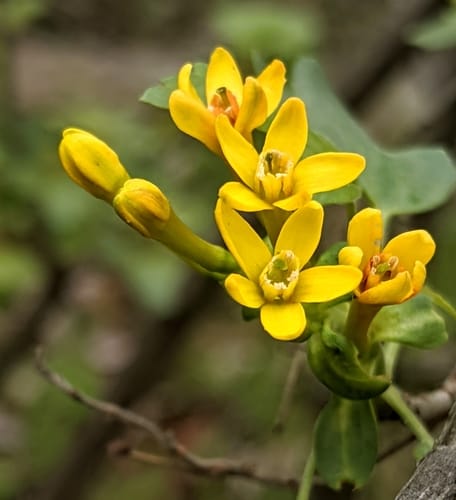
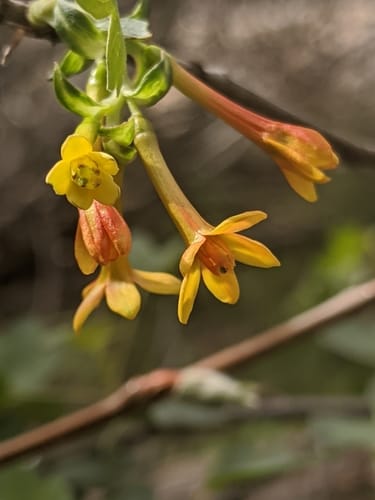
The fruit, about 5mm in diameter, is fairly large and flavourful for a currant. It can be eaten raw as a dessert fruit or cooked into jellies, sauces, and pies, and can also be dried for winter use. The flowers are also edible raw and have a very sweet flavour.
Where to Find It
Fruit, Flowers,
How to Identify
Fast-growing deciduous shrub reaching 2.4 m tall. Hermaphrodite, self-fertile flowers appear in April; seeds ripen July to August. Grows in light, medium, or heavy soils with good drainage, tolerating mildly acid to basic pH. Adapts to semi-shade or full sun in dry or moist soil. Withstands wind but not coastal exposure. Hardy to UK zone 2. Attracts wildlife.
How to Grow
Easily grown in a moisture retentive but well-drained loamy soil of at least moderate quality. Succeeds in full sun but is also quite tolerant of shade though not fruiting so well in such a position. Grows well on exposed dry sites. Very tolerant of being transplanted. Plants can spread by means of underground rhizomes, especially when growing in moist conditions. Hardy to about -20°c. The fruit can be red, black, yellow, golden or reddish-brown. A very ornamental plant, it is closely allied to R. odoratum. Plants can harbour a stage of white pine blister rust, so should not be grown in the vicinity of pine trees. Plants in this genus are notably susceptible to honey fungus. Sometimes cultivated for its edible fruit, there are some named varieties. Most Ribes species, including black, red, and white currants, are self-fertile, meaning they can produce fruit without needing cross-pollination. However, cross-pollination with another Ribes plant can improve fruiting. Currants are usually harvested in mid to late summer, from June to August (Northern Hemisphere), depending on the species and local climate. Ribes species generally flower in spring, around April to June (Northern Hemisphere), with flowering occurring before or as the leaves emerge. Currant plants are relatively fast-growing, reaching maturity in about 2 to 3 years. They typically grow to 1 to 2 meters (3 to 6 feet) and can be quite productive.
Propagation: Seed is best sown as soon as it is ripe in autumn in a cold frame. Stored seed requires 3 months of cold stratification at -2 to +2°c and should be sown as early in the year as possible. Under normal storage conditions seed can remain viable for 17 years or more. Prick out seedlings into individual pots when large enough to handle and grow on in a cold frame for their first winter, planting out in late spring the following year. Cuttings of half-ripe wood, 10–15cm with a heel, can be taken in July/August in a frame. Cuttings of mature wood of the current year's growth, preferably with a heel of the previous year's growth, can be taken November to February in a cold frame or sheltered bed outdoors.
Medicinal Uses
The dried and pulverized inner bark has been sprinkled on sores. A decoction of the inner bark has been used to treat leg swellings.
Other Uses
Currants can be used in agroforestry systems as a shrub layer in mixed-species plantings. The flowers are rich in nectar and pollen, attracting bees and other beneficial insects. The berries provide food for birds and small mammals, while the dense shrub growth offers cover, shelter, and nesting sites for wildlife. Leaf litter and dense growth also provide overwintering sites and shelter for invertebrates.
Wikipedia
Source ↗Ribes aureum, known by the common names golden currant, clove currant, pruterberry and buffalo currant, is a species of flowering plant in the genus Ribes native to North America.
Other Information
Grossulariaceae
Notes
A upright bush. It grows 1.8 m high and spreads 1.8 m wide. It loses its leaves during the year. The leaves have 3 lobes. They have coarse teeth. The yellow flowers hang down. The fruit are purple-black.
Names & Synonyms
Aranyribizli, Corinto, Pokopisa
References (26)
- Beckstrom-Sternberg, Stephen M., and James A. Duke. "The Foodplant Database." http://probe.nalusda.gov:8300/cgi-bin/browse/foodplantdb.(ACEDB version 4.0 - data version July 1994)
- Bodkin, F., 1991, Encyclopedia Botanica. Cornstalk publishing, p 883
- Chamorro, M. F., & Ladio, A., 2020, Native and exotic plants with edible fleshy fruits utilized in Patagonia and their role as sources of local functional foods. BMC Complementary Medicine and Therapies. 20:155
- Coutre, M. D., et al, 1986, Foraging Behaviour of a Contemporary Northern Great Basin Population. Journal of California and Great Bason Anthropology Vol. 8(2) pp 150-160
- Cundall, P., (ed.), 2004, Gardening Australia: flora: the gardener's bible. ABC Books. p 1206
- Denes, A., et al, 2012, Wild plants used for food by Hungarian ethnic groups living in the Carpathian Basin. Acta Societatis Botanicorum Poloniae 81 (4): 381-396
- Desert Survivors Online Plant Database
- Elias, T.S. & Dykeman P.A., 1990, Edible Wild Plants. A North American Field guide. Sterling, New York p 170
- Facciola, S., 1998, Cornucopia 2: a Source Book of Edible Plants. Kampong Publications, p 119
- Fl. Amer. sept. 1:164. 1813-1814
- Flora of Pakistan. www.eFloras.org
- Hedrick, U.P., 1919, (Ed.), Sturtevant's edible plants of the world. p 562
- Heywood, V.H., Brummitt, R.K., Culham, A., and Seberg, O. 2007, Flowering Plant Families of the World. Royal Botanical Gardens, Kew. p 160
- Jackes, D. A., 2007, Edible Forest Gardens
- Jordan, J., et al, 2006, Vascular Plants Utilized by the Plains Apache in Southwestern Oklahoma, Publications of the Oklahoma Biological Survey. 2nd Series. Volume 7: 24-33, 2006 (As var. villosum)
- Kermath, B. M., et al, 2014, Food Plants in the Americas: A survey of the domesticated, cultivated and wild plants used for Human food in North, Central and South America and the Caribbean. On line draft. p 745
- Kremer, B.P., 1995, Shrubs in the Wild and in Gardens. Barrons. p 140
- Lord, E.E., & Willis, J.H., 1999, Shrubs and Trees for Australian gardens. Lothian. p 259
- MacKinnon, A., et al, 2009, Edible & Medicinal Plants of Canada. Lone Pine. p 104
- Medsger, O. P., 1939, Edible Wild Plants. Macmillan Company. p 16
- Moerman, D. F., 2010, Native American Ethnobotany. Timber Press. p 476
- Plants for a Future database, The Field, Penpol, Lostwithiel, Cornwall, PL22 0NG, UK. http://www.scs.leeds.ac.uk/pfaf/
- Stubbs, R. D., 1966, An investigation of the Edible and Medicinal Plants used by the Flathead Indians. MA thesis University of Montana. p 70
- USDA, ARS, National Genetic Resources Program. Germplasm Resources Information Network - (GRIN). [Online Database] National Germplasm Resources Laboratory, Beltsville, Maryland. Available: www.ars-grin.gov/cgi-bin/npgs/html/econ.pl (10 April 2000)
- Wiersema, J. H. & Leon, B., 2013, World Economic Plants. A Standard Reference CRC Press. 2nd Ed. p 591
- World Checklist of Useful Plant Species 2020. Royal Botanic Gardens, Kew
More from Grossulariaceae


