Ribes divaricatum
Douglas
Coastal black gooseberry, Spreading Gooseberry

(c) Lunabelle Loiseau-Tremblay, some rights reserved (CC BY-NC), uploaded by Lunabelle Loiseau-Tremblay
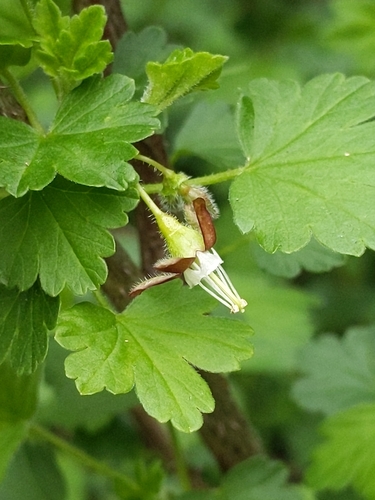
(c) Ken-ichi Ueda, some rights reserved (CC BY), uploaded by Ken-ichi Ueda
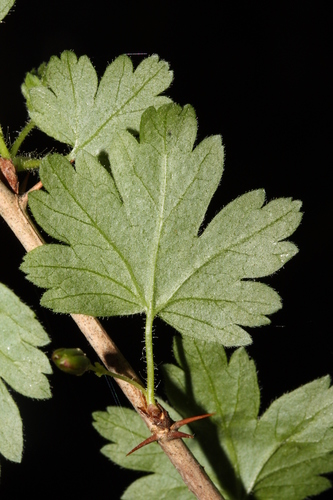
(c) Walter Siegmund, some rights reserved (CC BY-SA)
What to Eat
Edible parts: Fruit, Leaves
The fruit is eaten raw or cooked and is sweet, juicy, and very acceptable in flavour, though slightly on the acid side. It is considered one of the finest wild North American gooseberries. Fruit is sometimes harvested before fully ripe and then cooked, and measures about 10mm in diameter. On wild plants, the fruit can hang on the bush into autumn if left by birds. Young leaves and unripe fruits are also used together to make a sauce.
Where to Find It
It is a temperate plant. It grows in open woods and along the coastline.
Britain, Canada, Europe, North America, USA,
How to Identify
A shrub. It can be erect or spreading. It loses its leaves during the year. It grows 2 m tall and the branches spread over. The bark is smooth and grey. The stems have 1-3 stout spines at each nodes. The leaves are small and have 3-5 lobes. The flowers are small and red or green. They occur in drooping clusters. The fruit is a smooth black berry.
Nutrition Score: 37/100
| Part | Moisture | kJ | kcal | Protein | Vit A | Vit C | Iron | Zinc |
|---|---|---|---|---|---|---|---|---|
| Fruit | 83 | 322 | 77 | 1.1 | — | 40.2 | 0.7 | 0.2 |
How to Grow
Easily grown in a moisture retentive but well-drained loamy soil of at least moderate quality. Requires a very sunny position if it is to do well. Plants are hardy to about -20°c. This species is closely allied to R. rotundifolium. Immune to mildew, this species is a parent of many mildew resistant hybrids and is being used in breeding programmes in Europe. Plants can harbour a stage of white pine blister rust, so should not be grown in the vicinity of pine trees. Plants in this genus are notably susceptible to honey fungus. Sometimes cultivated for its edible fruit, there is at least one named variety. In garden design, as well as the above-ground architecture of a plant, root structure considerations help in choosing plants that work together for their optimal soil requirements including nutrients and water.
Propagation: Seed is best sown as soon as it is ripe in autumn in a cold frame. Stored seed requires 4–5 months of cold stratification at between 0 and 9°C and should be sown as early in the year as possible. Under normal storage conditions seed can remain viable for 17 years or more. Prick out seedlings into individual pots when large enough to handle, grow on in a cold frame through their first winter, and plant out in late spring the following year. Take cuttings of half-ripe wood, 10–15cm with a heel, in July or August in a frame. Cuttings of mature wood from the current year's growth, preferably with a heel of the previous year's growth, can be taken November to February in a cold frame or sheltered bed outdoors.
Medicinal Uses
The inner bark has been chewed and the juice swallowed as a treatment for colds and sore throats. A decoction of the bark or root has been used as an eye wash for sore eyes. An infusion of the roots has been used to treat sore throats, venereal disease, and tuberculosis. Burnt stems have been rubbed on neck sores.
Other Uses
The roots have been boiled together with cedar (Juniperus spp., Thuja sp.) and wild rose (Rosa spp.) roots, then pounded and woven into rope. The plant's sharp thorns have been used as probes for boils, for removing splinters, and for tattooing.
Wikipedia
Source ↗Ribes divaricatum is a species in the genus Ribes found in the forests, woodlands, and coastal scrub of western North America from British Columbia to California. The three accepted varieties have various common names which include the word "gooseberry". Other common names include coast black gooseberry, wild gooseberry, Worcesterberry, or spreading-branched gooseberry.
Notes
There are about 150 Ribes species.
Names & Synonyms
Atl'anulh, North American Worcesterberry
References (14)
- Beckstrom-Sternberg, Stephen M., and James A. Duke. "The Foodplant Database." http://probe.nalusda.gov:8300/cgi-bin/browse/foodplantdb.(ACEDB version 4.0 - data version July 1994) (As Grossularia divaricata and Grossularia irrigua)
- Facciola, S., 1998, Cornucopia 2: a Source Book of Edible Plants. Kampong Publications, p 120
- Flowerdew, B., 2000, Complete Fruit Book. Kyle Cathie Ltd., London. p 72
- Hedrick, U.P., 1919, (Ed.), Sturtevant's edible plants of the world. p 562
- Kermath, B. M., et al, 2014, Food Plants in the Americas: A survey of the domesticated, cultivated and wild plants used for Human food in North, Central and South America and the Caribbean. On line draft. p 746
- Kuhnlein, H. V., et al, 2009, Indigenous Peoples' food systems. FAO Rome p 32
- MacKinnon, A., et al, 2009, Edible & Medicinal Plants of Canada. Lone Pine. p 106
- Moerman, D. F., 2010, Native American Ethnobotany. Timber Press. p 477
- Plants for a Future database, The Field, Penpol, Lostwithiel, Cornwall, PL22 0NG, UK. http://www.scs.leeds.ac.uk/pfaf/
- Trans. Hort. Soc. London 7:515. 1830
- Turner, N., 1995, Food Plants of Coastal First Peoples. Royal BC Museum Handbook p 99
- Turner, N., 1997, Food Plants of Interior First Peoples. Royal BC Museum Handbook p 127
- Wiersema, J. H. & Leon, B., 2013, World Economic Plants. A Standard Reference CRC Press. 2nd Ed. p 591
- World Checklist of Useful Plant Species 2020. Royal Botanic Gardens, Kew
More from Grossulariaceae


