Ribes gayanum
(Spach) Steud.
Coastal Black Gooseberry, Chilean blackcurrant

(c) Nolan Exe, some rights reserved (CC BY)
(c) Nolan Exe, some rights reserved (CC BY)
(c) Nolan Exe, some rights reserved (CC BY)
What to Eat
Edible parts: Fruit
The fruit is eaten raw or cooked and has a fine taste. The hairy berries are roughly the size of a pea.
Where to Find It
It is a warm temperate plant. It grows naturally in the Chilean Andes. It grows between 500-2,000 m above sea level. It grows in humid areas but can tolerate some drought. It can tolerate some shade. It suits hardiness zones 8-10.
Andes, Australia, Chile*, South America,
How to Identify
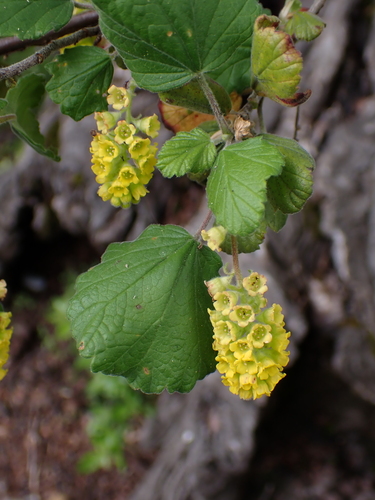
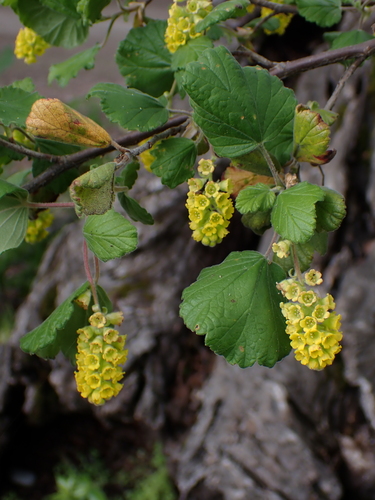
An evergreen shrub. It grows 1.5 m high and spreads 0.9 m wide. The leaves are covered with down. They have 3-5 lobes. These have coarse teeth. The flowers are yellow. They have a honey scent. The fruit have a downy coating. The fruit are black. They are edible.
How to Grow
Propagation: Seed is best sown as soon as it is ripe in autumn in a cold frame. Stored seed requires 4–5 months of cold stratification at between 0 and 9°C and should be sown as early in the year as possible. Under normal storage conditions seed can remain viable for 17 years or more. Prick out seedlings into individual pots when large enough to handle, grow on in a cold frame through their first winter, and plant out in late spring the following year. Take cuttings of half-ripe wood, 10–15cm with a heel, in July or August in a frame. Cuttings of mature wood from the current year's growth, preferably with a heel of the previous year's growth, can be taken November to February in a cold frame or sheltered bed outdoors.
Medicinal Uses
None known.
Other Uses
None known.
Wikipedia
An evergreen shrub reaching 1.5 m, hardy to UK zone 8. Maintains foliage year-round and flowers in June. Hermaphrodite species with both male and female organs, insect-pollinated and self-fertile. Grows in light sandy, medium loamy, and heavy clay soils. Tolerates mildly acid to basic pH and adapts to semi-shade or full sun, preferring moist soil.
Notes
There are about 150 Ribes species.
References (4)
- Cundall, P., (ed.), 2004, Gardening Australia: flora: the gardener's bible. ABC Books. p 1206
- Nomencl. bot. ed. 2, 2:439. 1841 (Walpers, Repert. bot. syst. 2:360. 1843)
- Plants for a Future database, The Field, Penpol, Lostwithiel, Cornwall, PL22 0NG, UK. http://www.scs.leeds.ac.uk/pfaf/
- www.chileflora.com
More from Grossulariaceae


