Ribes glaciale
Wall.
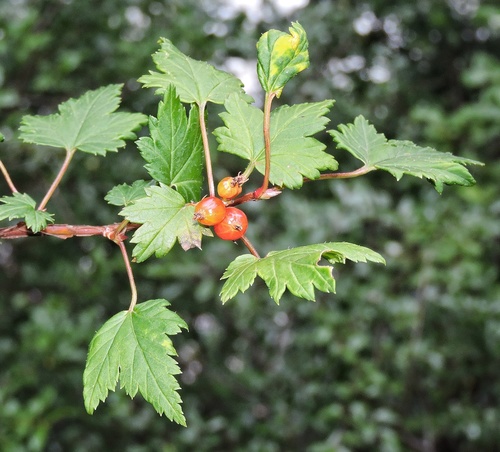
(c) Subhajit Roy, some rights reserved (CC BY-NC-ND), uploaded by Subhajit Roy

Wikimedia Commons - Jerzy Opioła

Wikimedia Commons - Jerzy Opioła
What to Eat
Edible parts: Fruit
The ripe fruit is edible raw or cooked but is extremely sour. The red berries measure about 7mm in diameter.
Where to Find It
It is a temperate plant. In Nepal they grow between 2400-4400 m altitude. They grow in open places. It grows in Sichuan and Yunnan in China.
Asia, Afghanistan, Bhutan, China, Himalayas, India, Myanmar, Nepal, Northeastern India, Pakistan, SE Asia, Sikkim, Tibet,
How to Identify
A shrub. It grows to 3 m high. The leaves have stalks. The leaves are oval and taper to the tip. They have 3-5 lobes. They have rounded or sharp teeth. The leaf can be heart shaped. There are scattered hairs on both surfaces. The flowers are pinkish. The fruit is a berry. It is orange when ripe. They are 5 mm across.
How to Grow
We have very little information on this species and do not know if it will be hardy in Britain, though judging by its native range it should succeed outdoors in most parts of the country. The following notes are based on the general needs of the genus. Easily grown in a moisture retentive but well-drained loamy soil of at least moderate quality. Plants are quite tolerant of shade though do not fruit so well in such a position. Plants can harbour a stage of 'white pine blister rust', so they should not be grown in the vicinity of pine trees. Plants in this genus are notably susceptible to honey fungus. This species is dioecious. Both male and female plants must be grown if fruit is required, one male plant being sufficient to fertilize about 5- 6 female plants.
Propagation: Seed is best sown as soon as it is ripe in autumn in a cold frame. Stored seed requires 4–5 months of cold stratification at between 0 and 9°C and should be sown as early in the year as possible. Under normal storage conditions seed can remain viable for 17 years or more. Prick out seedlings into individual pots when large enough to handle, grow on in a cold frame through their first winter, and plant out in late spring the following year. Take cuttings of half-ripe wood, 10–15cm with a heel, in July or August in a frame. Cuttings of mature wood from the current year's growth, preferably with a heel of the previous year's growth, can be taken November to February in a cold frame or sheltered bed outdoors.
Medicinal Uses
None known.
Other Uses
None known.
Wikipedia
Source ↗A deciduous shrub reaching 3 m tall with a dioecious flowering pattern. Blooms April to June with seed maturation from July to August. Grows in light, medium, or heavy soils with good drainage, tolerating mildly acidic to basic pH. Adapts to semi-shade or full sun and prefers consistently moist conditions. Requires both male and female plants for seed production as it is not self-fertile and relies on insect pollination.
Notes
There are about 150 Ribes species.
Names & Synonyms
Dabia, Darbai, Dhak, Domaru, Durbai, Kembu, Khali, Kukuliya, Mangle, Ren bu, Tanfu
References (18)
- Agarwal, R. & Chandra, V., 2019, Diversity of wild edible plants in the Mandal-Chopta forest, Uttarakhand. Journal of Medicinal Plants Studies 2019; 7(1): 89-92
- Ambasta S.P. (Ed.), 2000, The Useful Plants of India. CSIR India. p 526
- Cheng, Z., et al, 2022, Ethnobotanical study on wild edible plants used by Dulong people in northwestern Yunnan, China. Journal of Ethnobiology and Ethnomedicine (2022) 18:3
- Flora of China @ efloras.org Volume 8
- Flora of Pakistan. www.eFloras.org
- Guo, C., et al, 2022, An Ethnobotany Survey of Wild Plants Used by the Tibetan People of the Yadong River Valley, Tibet, China. Journal of Ethnobiology and Ethnomedicine p 24
- Ju, Y., et al, 2013, Eating from the wild: diversity of wild edible plants used by Tibetans in Shangri-la region, Yunnan, China, Journal of Ethnobiology and Ethno medicine 9:28
- Kang, Y., et al, 2012, Wild food plants and wild edible fungi in two valleys on the Qinling Mountains (Shaanxi, central China) Journal of Ethnobiology and Ethnomedicine; 9:26
- Manandhar, N.P., 2002, Plants and People of Nepal. Timber Press. Portland, Oregon. p 399
- Negi, P. S. & Subramani, S. P., 2015, Wild Edible Plant Genetic Resources for Sustainable Food Security and Livelihood of Kinnaur District, Himachal Pradesh, India, International Journal of Conservation Science. 6 (4): 657-668
- Plants for a Future database, The Field, Penpol, Lostwithiel, Cornwall, PL22 0NG, UK. http://www.scs.leeds.ac.uk/pfaf/
- Polunin, O., & Stainton, A., 2006, Flowers of the Himalaya, Oxford India Paperbacks. p 140
- Rawat, G.S., & Pangtey, Y.P.S., 1987, A Contribution to the Ethnobotany of Alpine Regions of Kumaon. J. Econ. Tax. Bot. Vol. 11 No. 1 pp 139-147
- W. Roxburgh, Fl. ind. 2:513. 1824
- Sharma, L. et al, 2018, Diversity, distribution pattern, endemism and indigenous uses of wild edible plants in Cold Desert Biosphere Reserve of Indian Trans Himalaya. Indian Journal of Traditional Knowledge. Vol 17(1) January 2018 pp 122-131
- Singh, H.B., Arora R.K.,1978, Wild edible Plants of India. Indian Council of Agricultural Research, New Delhi. p 69
- Upreti, K., et al, 2010, Diversity and Distribution of Wild Edible Fruit Plants of Uttarakhand. Bioversity Potentials of the Himalaya. p 183
- Zhang, L., et al, 2016, Ethnobotanical study of traditional edible plants used by the Naxi people during droughts. Journal of Ethnobiology and Ethnomedicine. 12:39
More from Grossulariaceae


