Ribes himalense
Royle ex Decne.
Khamar, Paunro
(c) Shanta Budha-Magar, some rights reserved (CC BY-NC), uploaded by Shanta Budha-Magar
(c) zhouhy, some rights reserved (CC BY-NC)
What to Eat
Edible parts: Fruit
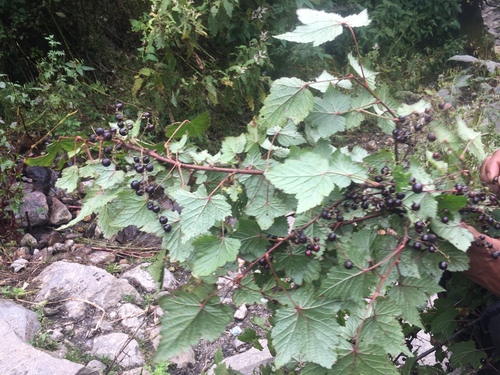
The fruit is eaten raw or cooked and is quite large, though the seeds are proportionally large as well. Berries start red and turn purplish-black when fully ripe, reaching about 7mm in diameter.
Where to Find It
It is a subtropical plant. In Nepal they grow between 2700-3900 m altitude. They grow in drier places in shrubby areas of forest. In Sichuan and Yunnan.
Asia, Bhutan, China, Himalayas, India, Myanmar, Nepal, Northeastern India, Pakistan, SE Asia, Sikkim, Tibet,
How to Identify
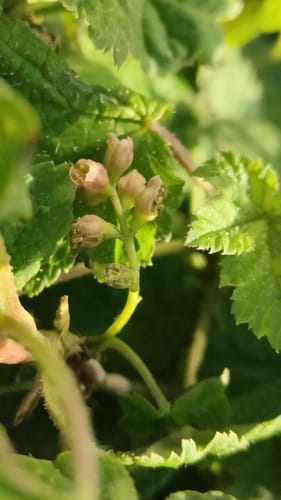
An erect shrub. The leaves have stalks. They have 3-5 lobes. They are 3-7.5 cm long and with teeth. They are heart shaped and the tip is pointed. The flowers are greenish-yellow. The fruit is a berry. It is red. It is edible.
How to Grow
Easily grown in a moisture retentive but well-drained loamy soil of at least moderate quality. Plants are quite tolerant of shade though do not fruit so well in such a position. Hardy to about -20°c. This species is closely related to R. petraeum. Plants can harbour a stage of white pine blister rust, so should not be grown in the vicinity of pine trees. Plants in this genus are notably susceptible to honey fungus.
Propagation: Seed is best sown as soon as it is ripe in autumn in a cold frame. Stored seed requires 4–5 months of cold stratification at between 0 and 9°C and should be sown as early in the year as possible. Under normal storage conditions seed can remain viable for 17 years or more. Prick out seedlings into individual pots when large enough to handle, grow on in a cold frame through their first winter, and plant out in late spring the following year. Take cuttings of half-ripe wood, 10–15cm with a heel, in July or August in a frame. Cuttings of mature wood from the current year's growth, preferably with a heel of the previous year's growth, can be taken November to February in a cold frame or sheltered bed outdoors.
Medicinal Uses
Leaf juice is used in the treatment of diarrhoea and dysentery. A paste made from the leaves is applied externally to cuts and wounds.
Other Uses
None known.
Wikipedia
Source ↗A deciduous shrub reaching 2 m in height, hardy to UK zone 6. Hermaphrodite flowers bloom April to June with seed maturation August to September. Accommodates light, medium, or heavy well-drained soils at mildly acidic to basic pH. Tolerates semi-shade or full sun and thrives in moist soil. Pollinated by insects.
Other Information
The fruit are sold in markets.
Notes
There are about 150 Ribes species.
Names & Synonyms
Karan, Kinkola
References (12)
- Afzal, S., et al, 2009, Ethno-botanical Studies from Northern Pakistan. J. Ayub Med Coll Abbottabad 21(1)
- Dobriyal, M. J. R. & Dobriyal, R., 2014, Non Wood Forest Produce an Option for Ethnic Food and Nutritional Security in India. Int. J. of Usuf. Mngt. 15(1):17-37
- Flora of China @ efloras.org Volume 8
- Flora of Pakistan. www.eFloras.org
- V. Jacquemont, Voy. Inde 4(Bot.):66, t. 77. 1835-1844 (J. F. Royle, Ill. bot. Himal. Mts. 1(7):225. 1835, nom. nud.)
- Khan, D. & Shaukat, S.S., 2006, The Fruits of Pakistan: Diversity, Distribution, Trends of Production and Use. Int. J. Biol. Biotech., 3(3):463-499
- Li, F., et al, 2015, Ethnobotanical study on wild plants used by Lhoba people in Milin County, Tibet. Journal of Ethnobiology and Ethnomedicine, 11:23
- Manandhar, N.P., 2002, Plants and People of Nepal. Timber Press. Portland, Oregon. p 399
- Negi, P. S. & Subramani, S. P., 2015, Wild Edible Plant Genetic Resources for Sustainable Food Security and Livelihood of Kinnaur District, Himachal Pradesh, India, International Journal of Conservation Science. 6 (4): 657-668
- Plants for a Future database, The Field, Penpol, Lostwithiel, Cornwall, PL22 0NG, UK. http://www.scs.leeds.ac.uk/pfaf/
- Polunin, O., & Stainton, A., 2006, Flowers of the Himalaya, Oxford India Paperbacks. p 139
- Sharma, L. et al, 2018, Diversity, distribution pattern, endemism and indigenous uses of wild edible plants in Cold Desert Biosphere Reserve of Indian Trans Himalaya. Indian Journal of Traditional Knowledge. Vol 17(1) January 2018 pp 122-131
More from Grossulariaceae


